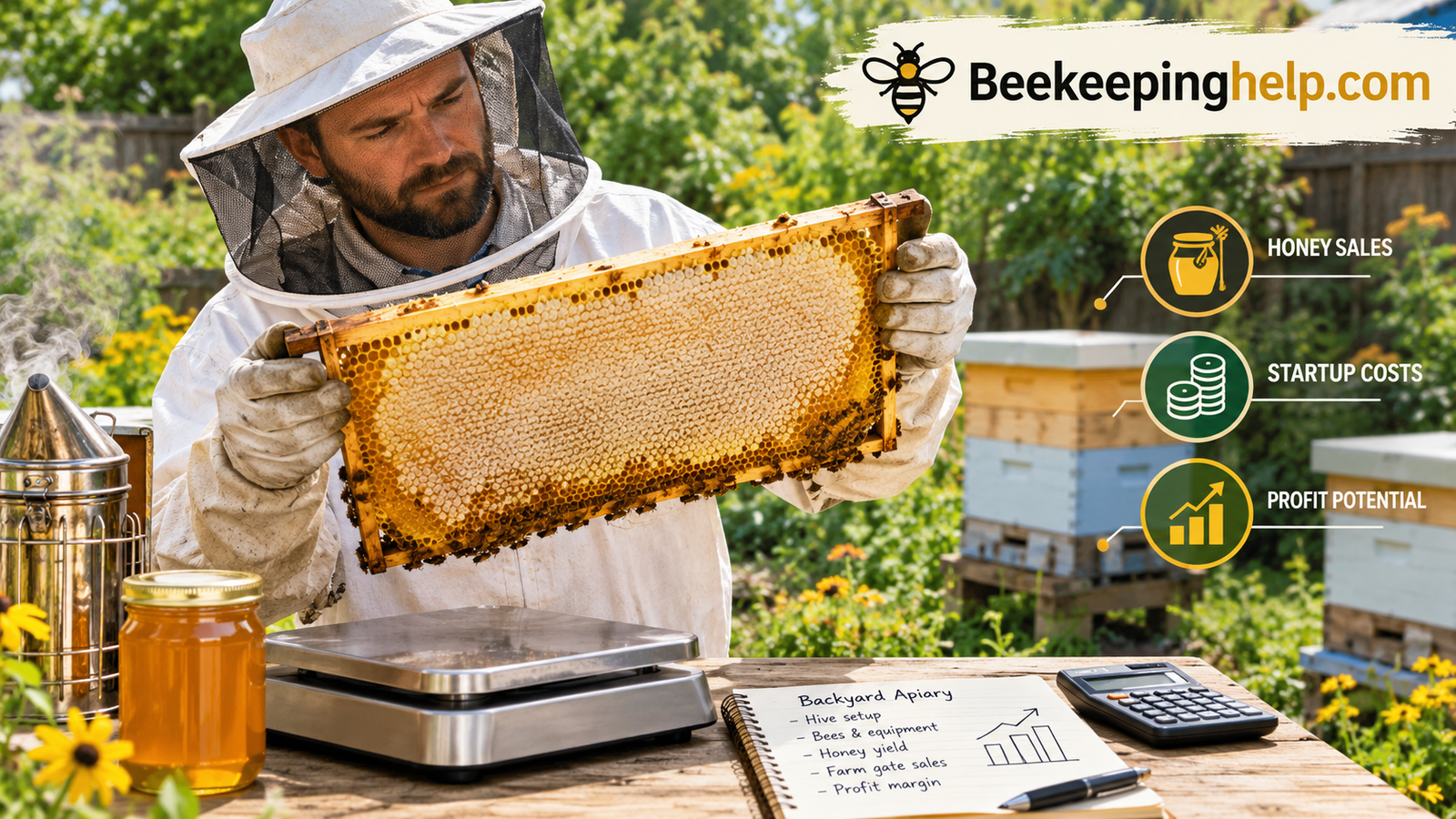
Is Beekeeping Profitable? An Honest Look at the Money Behind the Honey
Everyone sees the honey jars. Far fewer people see the ledger underneath them. This guide walks through real revenue streams, real costs, and the planning math that separates a self-funding hobby from an expensive one.
The Short Answer: Yes, It Can Be — But Not the Way Most People Imagine
Beekeeping can pay for itself, and at meaningful scale it can generate real income. But profit is not something that happens to a hive. It is something that happens to a plan.
Ask a room full of beekeepers whether beekeeping is profitable and you will get a fascinating split. The keepers running dozens or hundreds of colonies will tell you it is a genuine business with genuine margins, squeezed by losses and labor but absolutely real. The hobbyists with two hives in the backyard will tell you they have never come close to covering their costs. Both are telling the truth, and both answers describe the same activity.
The difference is not magic and it is not luck. It comes down to four variables: how many colonies you manage, what those colonies are used for, how much you sell beyond honey, and how efficiently you handle the work. Get those four aligned and beekeeping moves toward profitability quickly. Get them wrong and you have an expensive, wonderful, sticky hobby.
This guide does not cheerlead. It lays out the actual revenue streams — honey, pollination, bees, wax, and value-added products — and stacks them against the real costs: equipment, colonies, feed, treatments, extraction, packaging, transportation, insurance, and your own time. By the end you will be able to build a simple profit model for your own situation rather than relying on someone else’s anecdote.
If you are still at the beginning of the road, it helps to understand the basics first. Our overview of beekeeping explains what the craft actually involves day to day, and how to start beekeeping walks through the setup sequence. Both are worth reading before you attach a dollar figure to the dream.
The Rule of Honest Beekeeping Economics
Revenue is concentrated in a few months. Costs and labor are spread across the entire year. Profitability depends less on what you harvest and more on how well you manage the months when nothing visible is happening.
What “Profitable” Actually Means in Beekeeping
The word “profitable” does different work depending on who is holding the hive tool. Before comparing numbers, it is worth deciding which definition you are working toward, because each one implies a different amount of gear, land, labor, and risk.
Three different meanings of profit
| Goal | What It Looks Like | What It Requires |
|---|---|---|
| Self-funding hobby | Honey and wax sales cover equipment, feed, and treatment costs | Consistent records, modest scale, and disciplined spending |
| Side income | The apiary produces meaningful income on top of other work | Multiple colonies, diversified products, and reliable sales channels |
| Primary business | Beekeeping supports a household as a full commercial operation | Substantial colony count, pollination contracts, labor, and logistics |
Why the two-hive scenario rarely pencils out
A small apiary carries almost all of the fixed costs of a large one. You need the same protective gear, the same tools, the same extractor or access to one, the same jars, the same vehicle trips. With only a couple of colonies, those costs are divided across a very small harvest, which is why most backyard beekeepers describe their operation as a passion rather than an investment.
That is not a criticism — it is a description of fixed-cost economics. The mistake is expecting hobby-scale hardware to generate business-scale returns. If your goal is genuinely financial, the plan needs colony count behind it from the beginning.
The variables that move the needle most
- Colony count: More colonies spread fixed costs and increase total harvest, but also increase labor and winter loss exposure.
- Revenue mix: Operations that sell bees and pollination services are far less dependent on honey prices than honey-only operations.
- Overwintering success: Colonies that survive winter start the season earning; colonies that die restart you at zero.
- Labor efficiency: Systems, standardization, and good location choices determine how many colonies one person can realistically manage.
- Sales channel: Selling direct at retail prices is a completely different business from selling bulk honey at wholesale.
It also matters how demanding the craft is in practice. New keepers consistently underestimate the learning curve, and the learning curve is where money leaks out — lost colonies, late treatments, missed swarm windows. Our honest look at how hard it is to start beekeeping is worth reading alongside any spreadsheet you build.
Finally, keep legality in the profit equation. Registration, placement rules, food sales regulations, and insurance all carry costs and constraints. Our guide to beekeeping laws by state covers what applies to you before you model any revenue.
See What Established Keepers Use
Compare reference books before building your plan.
Browse Beekeeping Books on AmazonWhere the Money Actually Comes From: Revenue Streams Ranked
Most beginners assume honey is the product. In commercial beekeeping, honey is often one of several income lines — and occasionally not even the largest one. Understanding the full revenue stack is the single biggest mindset shift that separates hobby thinking from business thinking.
| Stream | What You Sell | Effort Level | Income Reliability |
|---|---|---|---|
| Bulk honey | Harvested honey sold by weight to packers or buyers | Moderate | Seasonal, price-sensitive |
| Retail honey | Jarred, labeled honey sold direct to consumers | Higher (packaging + sales) | Good margins, demand-dependent |
| Pollination services | Healthy colonies placed with growers during bloom | High (transport + timing) | Contract-based, predictable |
| Bees, nucs, and queens | Splits, nucleus colonies, and mated queens | High (skill-intensive) | Strong early-season demand |
| Wax and propolis | Rendering and selling wax or collecting propolis | Low to moderate | Supplementary |
| Value-added goods | Candles, cosmetics, soaps, infused honey, foods | High (making + marketing) | Brand-dependent |
| Education and experiences | Classes, apiary tours, mentoring, memberships | Moderate | Local audience-dependent |
Why diversification matters so much
Honey yields swing with weather and forage. Nectar flows can be excellent one season and disappointing the next, and a single bad flow can erase a year of margin. Operations with several income lines survive those swings because a weak honey year is often a strong bee-sales year, and vice versa.
There is a practical benefit too: different streams use different parts of your equipment and calendar. Extraction equipment earns its keep at harvest time, while splits and nuc production happen earlier in the season. Spreading work across the calendar means steadier cash flow and less pressure to dump honey at low prices.
How experienced keepers weight the mix
You will notice that operations closer to commercial scale often treat pollination and bee sales as the financial backbone, with honey as a valuable secondary line. Smaller operations that sell direct to customers often find that retail honey margins are what make the numbers work, because the jar that leaves a market stall is worth far more per pound than the bulk tank.
Equipment choices interact with this decision. If you plan to sell retail, extraction and packaging matter enormously; if you plan to sell colonies, hive design and transportability matter more. Comparing systems through beehive types with pictures is a good first step, and our comparison of Flow Hive versus Langstroth looks at how different designs affect handling and labor.
Start With the Right Hive Format
Equipment choices shape your labor and your margins.
Check Beehive Kits on AmazonThe Real Startup Costs: What It Takes to Get Going
Startup cost is the number everyone wants and almost nobody quotes accurately, because it depends entirely on how you start. Buying complete new equipment is one figure. Building boxes yourself, buying used gear, and starting with fewer colonies produce very different totals.
For a full breakdown, read our guide on how much it costs to start beekeeping. In this section, the focus is on the categories of spending and how each one affects your eventual profitability.
| Category | What It Covers | How to Keep It Reasonable |
|---|---|---|
| Hive bodies and frames | Boxes, bottom boards, covers, and the frames inside them | Standardize on one hive system and buy frames in bulk |
| Bees | Packages, nucleus colonies, or established colonies | Buy local, healthy stock and expand through your own splits later |
| Protective gear | Suit or jacket, veil, gloves, and footwear | Start with dependable basics rather than premium collections |
| Hand tools | Hive tool, smoker, brush, feeder, and record supplies | Buy once, buy properly — cheap tools cost twice |
| Extraction and packaging | Extractor, uncapping tools, filters, jars, labels | Borrow or share early; upgrade when volume justifies it |
| Feed and treatments | Sugar or syrup, feeders, mite and disease management supplies | Monitor before treating and buy seasonal supplies ahead |
| Learning and compliance | Books, courses, registration, and insurance | Join a local club — mentorship is the cheapest education |
Build or buy?
Building your own equipment is one of the few genuine cost levers available to a beginner, and it comes with an added benefit: you understand the gear. Our guide to how to make a beehive covers construction in detail, while how beehives are made explains the design thinking behind the boxes. Once you understand the components, our walkthrough of the parts of a bee hive and their functions makes maintenance and upgrades far cheaper over time.
Longevity is a profit issue too. Equipment that rots, warps, or peels costs you repeatedly. Finishing exterior wood properly extends its life considerably — see how to paint a beehive — and buying quality from the start is why many keepers compare options through guides like the best beekeeping hives.
Protective gear: spend where it counts
Gear failures waste time and cause stings, and stings cause inspections to get rushed. A dependable suit and gloves are worth prioritizing over decorative extras. Our bee suit review and roundup of the best beekeeping gloves cover what matters in real use.
Build Your First Setup
Quality hives and frames pay back over many seasons.
Shop Hive Boxes on AmazonOngoing Operating Costs: The Bills That Arrive Every Year
Startup costs are visible. Operating costs are the ones that quietly determine whether an apiary is profitable five years later. They arrive whether or not the season is good, and they scale with colony count.
The recurring cost categories
- Feed: Sugar or syrup for buildup and winter stores, especially in regions with long cold seasons or unreliable flows.
- Pest and disease management: Monitoring supplies and treatments applied on a schedule rather than in a panic.
- Equipment replacement: Frames and comb rotation, box repairs, lids, and straps that wear out.
- Consumables: Jars, labels, filters, fuel for extraction and travel.
- Transportation: Fuel and vehicle wear for inspections, markets, pollination moves, and bee purchases.
- Compliance and protection: Registration, liability coverage, and any food handling requirements.
- Storage and utilities: Space for equipment, honey storage, and cold or hot storage needs.
Feed is more than an expense — it is risk management
Colonies that run short of food fail at the worst possible times, and recovering them costs far more than feeding them would have. Understanding what to feed a bee and when prevents the slow starvation that shows up as spring losses. Equipment choices matter here as well: a good feeder reduces waste and robbing, and our look at the best bee feeder options plus how to make a bee feeder covers both buying and building.
Seasonal scarcity is the trigger for most feeding decisions. Understanding what a dearth is and how to recognize it early keeps colonies productive instead of defensive.
Maintenance labor is a real cost
Everything you own in an apiary needs cleaning, repairing, or replacing eventually. Suits get sticky and stiff; gloves get brittle and contaminated. Staying on top of that is cheap insurance — see how to clean beekeeping gloves — and skipping it costs you in stings and rushed inspections.
| Cost Driver | What Pushes It Up | What Keeps It Down |
|---|---|---|
| Feed | Poor forage, long winters, late-season buildup | Good apiary placement and realistic colony counts |
| Treatments | Reactive use after problems appear | Scheduled monitoring and early intervention |
| Equipment | Cheap materials and neglected maintenance | Proper finishing, storage, and standardized parts |
| Fuel and transport | Scattered apiaries and frequent single-purpose trips | Grouped yards and combined routes |
| Packaging | Small-batch purchasing and custom branding early on | Buying consumables in bulk once demand is proven |
Site choice quietly affects several of these at once. Colonies in a good location need less feeding, produce more surplus, and are easier to work. Our guide to where to place a beehive is essentially a cost-reduction document in disguise.
Honey Math: What an Average Hive Actually Produces
This is the section where most profitability articles invent a number and present it as a promise. Instead, let us build the calculation so you can insert your own figures.
What determines a hive’s surplus
Surplus honey is what remains after the colony feeds itself, and it varies with nectar flow, weather during bloom, colony strength, disease pressure, and how aggressively you super the hive. Regional differences are enormous: a hive in a rich agricultural or wildflower landscape can outperform one in a dry or urban setting several times over.
Rather than quoting a single figure, think in ranges and test them locally. Talk to beekeepers in your county — their experience is far more useful than a national average.
| Factor | Effect on Surplus | What You Control |
|---|---|---|
| Forage and landscape | The single largest variable between regions | Apiary site selection and number of yards |
| Weather during bloom | Cold, wind, or rain during a flow can wipe out a season | Very little — spread risk across sites |
| Colony population | Strong colonies forage more and store faster | Requeening, feeding, splits, and disease control |
| Supers available | Colonies without space stop storing surplus | Inspection timing and equipment readiness |
| Pest pressure | Mites and beetles reduce both bees and output | Monitoring and treatment discipline |
| Harvest timing | Leaving supers on too long reduces quality and price | Moisture checks and scheduled extraction |
The two prices of honey
Honey has two completely different values depending on how it is sold. Bulk honey sold by the drum is a commodity with commodity pricing. Retail honey in a labeled jar sold directly to a customer is a specialty product with a dramatically higher return per unit of weight. The difference between those two prices is often what makes an apiary profitable.
That gap explains why serious small operations invest in packaging, branding, and direct sales. It also explains why extraction capacity matters so much — the ability to harvest cleanly and package consistently is what unlocks the retail price point.
Post-harvest handling affects both value and risk. Honey that crystallizes unevenly, absorbs moisture, or ferments cannot be sold at retail and ends up discounted. Our guide to how to store honey covers the practices that protect your product value, and our roundup of the best honey extractor options covers the tool that sits at the center of every harvest.
A worked example you can adapt
Imagine an operation with a handful of productive colonies, harvesting a modest surplus per hive, and selling a portion of that at retail jars with the remainder kept for local direct sales. Plug in your own expected surplus per colony, your own percentage sold at retail, and your own per-unit prices. The structure of the calculation matters more than any specific figure: colonies × surplus per colony × percentage sold at retail × retail price, minus costs.
Why moisture and quality matter financially
Low-quality harvests get discounted or blended. Quality control at extraction — clean equipment, proper ripeness, careful filtering — is one of the few places where better practice converts directly into better price.
Pollination Income: The Revenue Stream Beginners Overlook
For many commercial beekeepers, pollination is the business and honey is the byproduct. Growers of pollinator-dependent crops need strong colonies placed precisely during bloom, and they pay for that service. It is contract income — agreed in advance, delivered on a schedule.
What a pollination service involves
Pollination work means transporting healthy colonies to a grower’s field before bloom, leaving them for the contracted period, and collecting them afterward. It requires transport equipment, timing precision, and documentation of colony strength. It also requires relationships: growers contract with beekeepers they trust to deliver strong colonies on time.
| Aspect | Pros | Cons |
|---|---|---|
| Income | Contracted and predictable; often paid before honey is even harvested | Requires scale to be worthwhile; pricing is negotiated per region |
| Workload | Concentrated around bloom periods with quieter intervals between | Heavy lifting, night loading, and long transport days |
| Risk | Contracts can include placement terms and expectations | Exposure to pesticide incidents, theft, and colony stress in transit |
| Growth | Relationships with growers scale well over multiple seasons | Reputation takes years to build and moments to damage |
Colony strength is the product
Growers are not buying boxes — they are buying forager populations. That means your husbandry directly determines your billable inventory. Colonies weakened by mites, disease, queen failure, or poor nutrition cannot be delivered, and losing a contract because your colonies were weak is a compounding financial blow.
This is where swarm management becomes a business issue. Colonies that swarm right before a contract lose the population the grower is paying for. Understanding what swarming is in beekeeping and managing buildup properly protects billable strength.
Getting started in pollination
Most beekeepers enter pollination work gradually: a few colonies for a local grower, delivered reliably, leading to larger agreements. Documenting colony strength, carrying appropriate coverage, and communicating clearly all matter. Our guide to beekeeping insurance is essential reading before you start moving colonies onto other people’s land.
Regional opportunities vary enormously. In large agricultural states, pollination networks are well developed; elsewhere, local orchards and small growers represent the entry point. Keepers operating in major agricultural regions often find this path especially viable — our guide to how to start beekeeping in Texas touches on operating within a large, diverse agricultural landscape.
Move Colonies Safely and Securely
Straps and transport gear protect billable strength.
Shop Transport Gear on AmazonSelling Bees, Nucs, and Queens: Where Early-Season Income Lives
Bee sales are one of the strongest income lines available to a skilled operation, and demand is driven by the same thing that drives your own costs: the constant need to replace winter losses and expand apiaries.
What you are actually selling
| Product | What It Is | What Buyers Care About |
|---|---|---|
| Package | A quantity of bees with a queen, sold without drawn comb | Queen acceptance, bee condition, and delivery timing |
| Nucleus colony | A small established colony with frames of brood, food, and a laying queen | Brood pattern, disease status, and queen quality |
| Mated queen | A queen raised and mated for requeening or splitting | Laying performance, temperament, and health status |
| Full colony | A complete, established hive ready to work | Strength, equipment condition, and documentation |
If the terminology is new to you, our explanation of what a nuc is in beekeeping covers the format that most small buyers prefer, and how to buy bees for beekeeping shows the questions your own buyers will be asking you.
Why bee sales pay well
A nuc or package converts a management skill — growing colonies — into a product that sells at a meaningful price relative to its weight and volume. It also solves a seasonal cash flow problem: bee sales typically happen earlier in the season than honey sales, giving you income before harvest.
The counterweight is skill and risk. Queen rearing, splitting at the right moment, and keeping young colonies healthy all demand experience. Mistakes here are expensive, because every colony sold is a colony you cannot also put on a pollination contract or in a honey yard.
Building a reputation as a seller
- Document health: Buyers increasingly expect registration and inspection status.
- Deliver what you promise: Queen status and colony strength should match the description exactly.
- Support new keepers: Post-sale advice generates repeat customers and referrals.
- Plan your splits: Colony expansion for sales competes directly with honey production — allocate deliberately.
- Follow the rules: Selling colonies triggers registration and documentation obligations; see our beekeeping laws by state guide.
Improving the skills behind these products is a direct investment in revenue. Our guide on how to improve your beekeeping skills focuses on the habits that make splits and queen work reliable.
Grow Your Operation With Splits
Nuc boxes and equipment keep expansion organized.
Check Nuc Boxes on AmazonValue-Added Products: Turning Byproducts Into Income
Every harvest produces more than honey. Wax cappings, burr comb, propolis, and pollen are all byproducts that can become products — and value-added goods typically carry better margins than raw commodities.
The value-added ladder
| Material | Product Options | Considerations |
|---|---|---|
| Beeswax | Candles, wraps, polish, soap, cosmetics | Rendering quality determines every downstream product |
| Honey | Creamed honey, infused honey, spreads, gift sets | Food safety and labeling rules apply; infusions may be treated differently |
| Comb | Cut comb, comb honey sections, honey straws | High presentation value; requires careful handling and storage |
| Propolis | Collected propolis, tinctures, ingredient supply | Collection methods and purity standards matter |
| Experiences | Classes, tours, apiary memberships, gifts | Liability, scheduling, and insurance requirements |
Why wax deserves attention
Beeswax is often discarded or given away, yet finished wax products command respectable prices and have long shelf lives. The economics improve further because wax is a byproduct — you have already paid the cost of producing it.
Regulations are the gatekeeper
Value-added products cross into food, cosmetic, and sometimes alcohol regulation depending on what you make. Infused honey containing fresh ingredients frequently falls outside basic home-producer exemptions, and cosmetics carry their own labeling expectations. Before producing at volume, confirm the classification of each product with your state food safety program.
Labeling matters commercially as well as legally. Product identity, net contents, and producer information are standard expectations, and getting labels right on the first run avoids reprints. Our guide to how to store honey includes the handling practices that keep product shelf-stable and presentable.
Brand and packaging economics
Value-added goods live or die on presentation. Clean, consistent packaging with clear labels signals quality and justifies pricing. The good news is that packaging costs drop quickly with volume, so early products cost more per unit than later ones — a reality worth building into your first pricing.
| Approach | Pros | Cons |
|---|---|---|
| Selling raw honey only | Simple process, fewer regulations, minimal equipment | Commodity pricing, seasonal income, heavy dependence on yield |
| Value-added range | Better margins, year-round sales, gift market appeal | More rules, more equipment, more time per unit of revenue |
| Experiences and education | High margins, builds local brand loyalty | Liability questions, scheduling demands, limited scale |
Package Your Products Professionally
Consistent jars and labels support better pricing.
Shop Packaging Supplies on AmazonScale Changes Everything: Hobby, Sideline, and Commercial Compared
Two beekeepers with identical skills can have opposite answers to the profitability question simply because of scale. Fixed costs dominate at small scale; labor and logistics dominate at large scale. The middle — the sideline operation — is where most people who describe beekeeping as profitable actually sit.
| Scale | Primary Goal | Typical Revenue Mix | Reality Check |
|---|---|---|---|
| Hobby | Enjoyment and learning | Mostly honey jars, occasional wax products | Rarely covers full costs; treat it as a funded hobby |
| Sideline | Supplemental income | Retail honey, nucs, pollination, value-added | Profitable when systems and sales channels are in place |
| Commercial | Primary livelihood | Pollination, bulk honey, bee sales, contracts | Real margins, real labor, real logistics and risk |
Why the middle path works
Sideline operations benefit from a powerful combination: enough colonies to spread fixed costs and generate serious volume, without the full overhead of employees, trucks, and commercial facilities. A focused keeper with a manageable number of colonies, strong husbandry, and a retail channel can produce income that genuinely matters.
The constraint is time. A sideline operation has to fit around other work, which means efficiency matters more than ambition. Standardized equipment, organized records, and realistic inspection schedules determine how many colonies one person can handle well.
The labor question
Labor is the cost most often set to zero in hobby accounting and the cost that dominates commercial accounting. Every inspection, every extraction, every market day is time. If you are calculating profit honestly, put a value on your own hours — even a modest one — and see how the picture changes.
- Standardize: One hive system, one frame size, one jar format reduces decision fatigue and cost.
- Batch your work: Inspections, feeding, and extraction all go faster when grouped.
- Site smart: Fewer, better-located apiaries beat many scattered ones.
- Automate records: Simple systems prevent the lost information that causes expensive mistakes.
- Know your ceiling: More colonies than you can manage well is a loss, not growth.
Site economics deserve real attention here. Colonies in productive locations with good sun, water, and shelter perform better and need less input — our guide to where to place a beehive is directly relevant to your cost per pound. And if you are wondering whether a small property can support real numbers, see whether you can keep bees in your backyard.
Scale Up Without Guesswork
Standard gear keeps a growing apiary manageable.
Shop Beekeeping Supplies on AmazonThe Hidden Costs: Losses, Pests, Weather, and Time
Every beekeeping business plan has a section on revenue and a much thinner section on loss. That imbalance is why so many first-year projections fail. Colony losses, pest pressure, weather shocks, and uncounted hours are the four forces that turn a promising season into a disappointing one.
Colony loss is a normal cost of doing business
Colonies die or fail. Queens fail, colonies starve, mite pressure builds, winter is harsh, spring comes late. In a sound financial model, replacement is a planned annual expense rather than an emergency. That means either budgeting for replacement stock or building enough internal capacity — through splits and nucs — to replace losses yourself.
What quietly destroys colonies
| Risk | Why It Costs Money | Prevention |
|---|---|---|
| Parasites and disease | Weakens colonies, reduces yield, kills hives outright | Scheduled monitoring, prompt treatment, careful equipment hygiene |
| Swarming | Splits your population right before the main earning period | Timely inspections and proactive colony management |
| Robbing and drifting | Spreads disease and redistributes strength away from strong colonies | Reduced entrances during dearth and good apiary spacing |
| Starvation | Kills colonies fast, often unnoticed until it is too late | Weight checks, timely feeding, realistic autumn stores |
| Queen failure | Stops brood production and stalls the entire colony’s earning power | Regular brood assessment and planned requeening |
Two of these deserve special attention. Understanding what robbing is in beekeeping prevents the cascade where stressed colonies spread problems across the whole apiary. And swarm management — covered in our guide to what swarming is — is pure revenue protection.
Wild colonies and odd situations
Not every colony arrives through a supplier. Feral swarms, cutouts from structures, and colonies established in trees all raise questions about equipment reuse, disease risk, and legality. Our look at types of beehives in trees covers what to consider before taking on wild stock.
Insurance and protection
Once you sell products, move colonies, or host visitors, liability becomes a genuine business consideration. Coverage is not automatic under standard policies, and gaps can be financially devastating. Our guide to beekeeping insurance covers the questions worth asking.
Your time is the biggest hidden cost
Between inspections, feeding, extraction, jar washing, labeling, driving, and selling, hours add up fast. Track them honestly for a season. Many beekeepers discover that their profitable-looking operation is trading a great deal of time for modest returns — which is a perfectly valid choice, as long as it is a conscious one.
Protect Your Investment
Reliable protective gear keeps inspections efficient.
Check Bee Suits on AmazonMarketing and Selling: Where Margins Are Won or Lost
You can produce excellent honey and still lose money if selling is inefficient. The difference between bulk pricing and retail pricing is essentially the value of marketing — and marketing at small scale is mostly about consistency, story, and showing up.
Sales channels compared
| Channel | Margin Potential | Time Required | Best For |
|---|---|---|---|
| Farmers markets | Strong | High | Building a loyal local customer base |
| Direct website or social | Strong | Moderate | Repeat customers and gift sales |
| Local shops and cafes | Moderate | Moderate | Steady volume without market stalls |
| Wholesale or bulk | Lower | Low | Moving large volumes quickly |
| Gift and corporate | Strong | Seasonal spikes | Premium sets and seasonal revenue |
What actually sells honey
- Local origin: Customers value knowing where their honey came from.
- Consistency: Same jar, same label, same quality every time builds trust.
- Story: The beekeeper, the location, and the season are part of the product.
- Availability: Selling year-round matters more than selling only at harvest.
- Presentation: Clean, professional packaging justifies a premium price.
Education as a marketing channel
Teaching is one of the most underrated revenue paths. Classes, workshops, and apiary experiences produce income, build a customer base, and establish credibility — and they use equipment you already own. Speaking at clubs and schools also feeds every other sales channel.
Improved skills translate directly into better marketing, because confident beekeepers make better sellers and better educators. Our guide to how to improve your beekeeping skills covers the habits that make you credible in front of customers.
Pricing honestly
Underpricing is the most common small-apiary mistake. Price should reflect real costs — equipment, jars, labels, fuel, market fees, and your time — not just what feels comfortable to charge. A price that does not cover your true cost is not a sale; it is a subsidy.
Make Your Product Stand Out
Polished packaging supports premium pricing.
Shop Labeling Supplies on AmazonBuild Your Own Break-Even Model
Everything so far has been building to this: a simple structure you can populate with your own numbers. Forget precision — the purpose is to see which assumptions matter most and where your plan is vulnerable.
The five-line profit model
- Colony inventory: How many colonies will you actually manage by the second or third season?
- Revenue per colony: Estimate income from honey, bees, pollination, and products for each colony.
- Total annual revenue: Colony count multiplied by average revenue per colony.
- Total annual cost: Feed, treatments, replacements, packaging, transport, compliance, and market fees.
- Net position: Revenue minus costs, evaluated alongside the hours you invested.
The levers that move results most
| Lever | Why It Matters | Practical Move |
|---|---|---|
| Retail share of sales | Often the largest single swing in revenue per unit | Build a direct sales channel before expanding colonies |
| Colony survival rate | Dead colonies reset your earning capacity completely | Invest in monitoring, feeding, and queen quality |
| Revenue diversification | Buffers against poor flows and price swings | Add bee sales or pollination once husbandry is solid |
| Labor efficiency | Determines how many colonies one person can run well | Standardize equipment and consolidate apiary sites |
| Product quality | Protects price and customer retention | Control moisture, cleanliness, and storage conditions |
Test before you scale
The safest expansion is slow expansion. Run a season with a modest number of colonies, record everything — harvests, hours, costs, sales, losses — and then decide whether to grow. Beekeepers who scale before they have data often scale their losses along with their revenue.
Equipment is part of that test. Work with dependable basics first and upgrade when volume proves the need. Reference material helps here too: our roundup of the best bee smokers and the guide to how a bee smoker works are useful when tool quality starts slowing down your inspections, and what to use in a bee smoker keeps them running efficiently.
The decision rule
Expand only when your records show that your current colonies are healthy, your selling is consistent, and your hours are under control. Growth without those three is just a larger problem.
Frequently Asked Questions About Beekeeping Profitability
Is beekeeping actually profitable?
It can be, but it depends on scale, revenue mix, and management. Small backyard operations rarely cover their full costs, while sideline and commercial operations that combine honey, bee sales, and pollination can generate real income. Profit comes from planning and systems, not from owning bees.
How many hives do I need to make money?
There is no universal threshold, but fixed costs are spread across colonies, so more colonies generally improve the economics. Hobby-scale numbers usually cannot carry equipment and labor costs, while sideline-level colony counts combined with direct sales are where profitability becomes realistic for most people.
Is honey the main source of income?
Not always. Many operations earn more from pollination services and bee sales than from honey. Retail honey sold directly to customers is far more valuable per unit than bulk honey, so how you sell matters as much as how much you harvest.
How long does it take to break even?
It depends on startup spending, colony survival, and sales channels. New keepers typically spend their first seasons recovering equipment costs while building skills and customers. Operations with retail sales and diversified income reach break-even faster than those selling only bulk honey.
What are the biggest ongoing costs?
Feed, pest and disease management, equipment replacement, packaging, fuel, and compliance costs such as registration and insurance. Labor is the largest hidden cost and the one most often left out of calculations.
Can I make money from just a few hives?
A small number of hives can offset some costs and produce a meaningful amount of honey, but it rarely generates true profit once equipment and time are accounted for. Small operations work best as funded hobbies or as a learning stage before expanding deliberately.
Is pollination work worth it?
For operations with enough colonies and transport capability, pollination can be the most reliable income line because it is contracted in advance. It requires healthy colonies, careful timing, documentation, and insurance, and it involves significant physical work during bloom periods.
Do I need to sell value-added products to be profitable?
Not necessarily, but value-added products usually carry better margins than raw honey. Wax goods, cosmetics, gift sets, and experiences diversify income and smooth seasonal swings, though they bring additional regulations and production time.
How much does equipment affect profitability?
Considerably. Durable, standardized equipment reduces repair costs, saves time, and lasts longer. Poor-quality gear fails in the field and costs twice. Building some equipment yourself can lower startup costs if you have the tools and time.
What is the biggest financial risk in beekeeping?
Colony loss. Winter losses, parasites, disease, queen failure, and starvation all destroy earning capacity. Planning for replacement — either through budgeting or through your own splits and nucs — is essential to a sound financial model.
Should I count my own time as a cost?
Yes, if you want an honest answer. Inspections, extraction, packaging, and selling consume substantial hours. Even valuing your time modestly changes the picture and helps you decide whether to expand, streamline, or keep the operation intentionally small.
What should I do first if I want beekeeping to be a business?
Start small, keep meticulous records for at least a full season, and build a sales channel before expanding colony count. Those records will tell you your real yield, real costs, and real hours — the only reliable foundation for a business decision.
Start Your Records From Day One
Good data is the cheapest business tool you own.
Find Beekeeping Journals on AmazonFinal Verdict: Profitable for the Prepared, Expensive for the Passive
Beekeeping is profitable when it is run like a small business and enjoyed like a hobby — in that order. The bees do not know your spreadsheet exists, so the plan has to account for them.
Let us close the loop on the question that started this. Yes, beekeeping can be profitable. The operations that achieve it tend to share the same traits: enough colonies to spread fixed costs, several revenue streams so a weak flow is not a lost year, retail sales where margins are strongest, disciplined loss prevention, and honest accounting of time.
Equally important is the honest counterpoint. Beekeeping kept casually at small scale is usually not profitable, and there is nothing wrong with that — plenty of wonderful hobbies cost money. The financial disappointment comes only when a hobby is mistaken for a business. If you know which one you are running, you will never feel misled by the numbers.
Your best next step is not a purchase. It is a plan. Write down your expected colony count, your intended sales channels, and your realistic costs for the first couple of seasons. Then talk to beekeepers in your area about actual yields and local pricing, because regional knowledge beats national averages every time.
When you are ready to build the operation itself, start with solid fundamentals: proper placement, dependable equipment, careful recordkeeping, and continuous improvement. Our guides on where to place a beehive and how to start beekeeping are good places to begin, and beekeeping laws by state will keep you compliant as you grow.
Turn Your Plan Into an Apiary
Get dependable equipment before the season starts.
Check Price on Amazon