What Is Robbing in Beekeeping? Causes, Warning Signs, and How to Stop It
A calm hive can turn into a battlefield in minutes. Here’s what robbing actually is, why it happens, and how to protect your colonies before it starts.
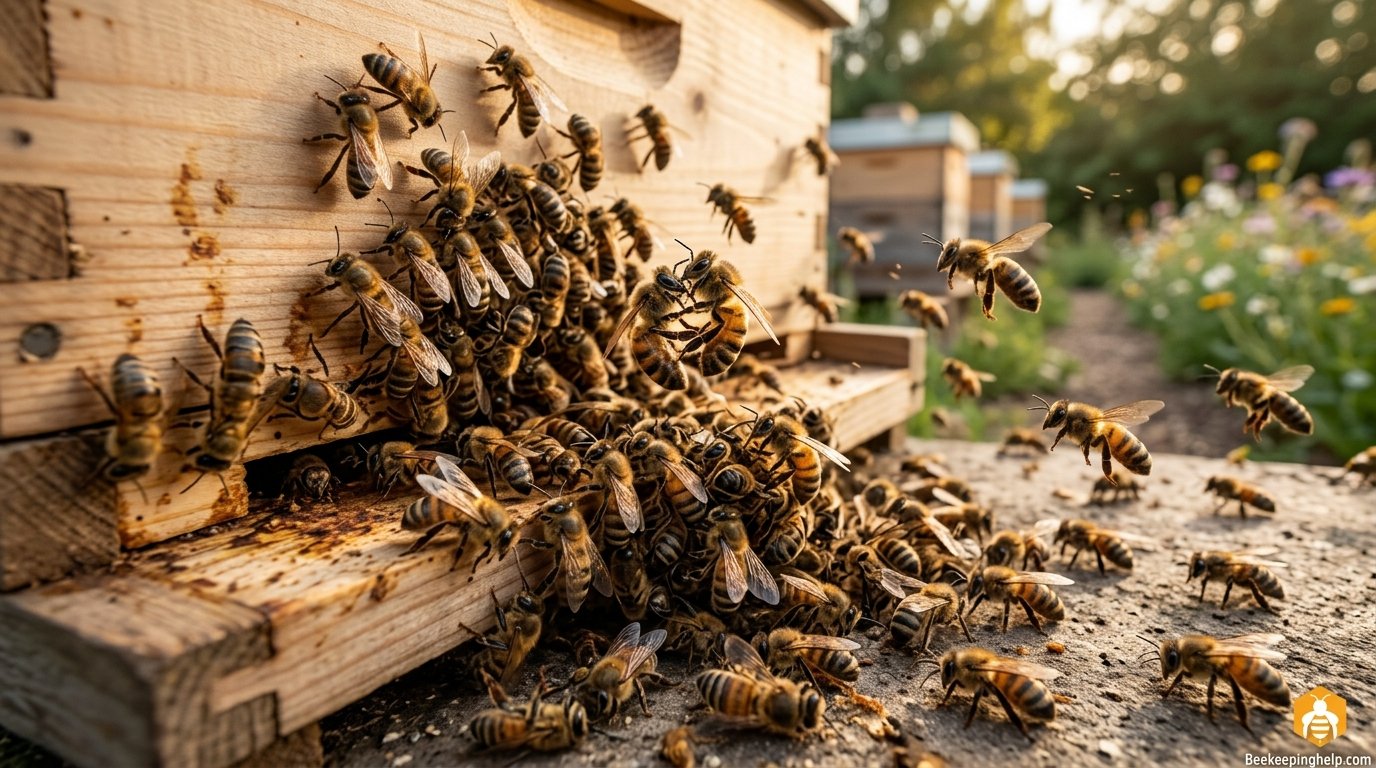
If you’ve kept bees for more than a season, you’ve probably had that stomach-drop moment: you walk out to the apiary and one hive looks like it’s boiling over. Bees are slamming into the entrance, tumbling on the landing board, wrestling in twos and threes in the grass. It’s loud, it’s frantic, and it doesn’t look anything like the calm, steady traffic you’re used to seeing. What you’re witnessing is robbing — one of the most stressful and, if left unchecked, most destructive behaviors in beekeeping.
Robbing isn’t rare, and it isn’t a sign that you’re a bad beekeeper. It’s a natural, if brutal, expression of colony survival instinct. But it is something every beekeeper needs to recognize quickly, understand deeply, and know how to stop, because a robbing event that goes unmanaged for even a few hours can wipe out a weaker colony entirely. This guide walks through what robbing is, why it happens, how to tell it apart from normal hive activity, and exactly what to do when it starts — along with the tools and habits that keep it from happening in the first place.
1. What Robbing Behavior Actually Is
Robbing is the act of bees from one colony forcibly entering another colony to steal its honey stores. Unlike foraging, where bees gather nectar and pollen from flowers, robbing targets the finished, concentrated food resource sitting inside a hive — capped and uncapped honey. It’s a high-reward, high-risk strategy that colonies resort to when the payoff of stealing outweighs the danger of getting stung to death in the process.
Robbing can happen between two managed colonies in the same apiary, between a strong hive and a weak neighbor’s hive down the road, or even involve feral colonies and swarms joining in on an already-chaotic scene. It can also happen between a colony and an unattended stash of drawn comb, cappings, or supers left out in the open — bees don’t distinguish between “a hive” and “an accessible source of honey.”
There are generally two intensities of robbing worth knowing:
- Testing or probing behavior — a small number of bees investigate a hive’s entrance, checking for weakness, without full-scale conflict breaking out yet.
- Full-blown robbing frenzy — dozens to hundreds of bees are actively fighting, and the defending colony is losing ground. This is the stage that can end in colony collapse within a single afternoon.
2. Why Bees Rob Other Colonies
Robbing doesn’t come out of nowhere. It’s almost always triggered by a mismatch between the amount of energy a colony needs and the amount of nectar available in the landscape. When flowers stop producing nectar — during a dearth, after a hard frost, in the peak heat of summer, or in late fall as the last blooms fade — foraging bees come home empty more often than not. A colony that senses its own stores are thin, and that the environment offers nothing, will shift its foraging behavior from “search for flowers” to “search for any available carbohydrate,” and a neighboring hive’s honey stash qualifies.
Several specific triggers make robbing far more likely:
- Nectar dearth — the single biggest driver. When natural forage disappears, competition for existing resources spikes.
- A weak or queenless colony nearby — fewer guard bees means a much easier target.
- Spilled syrup or honey — sticky residue on the ground, on hive tools, or on clothing acts like a dinner bell.
- Hive inspections left open too long — an open hive during a dearth practically advertises itself.
- Feeding done carelessly — syrup dripped outside the hive or fed in open containers invites a frenzy.
- Newly installed nucs or packages — small, disoriented populations with limited defenders. If you’re setting up new colonies, it helps to understand what a nuc in beekeeping is and how vulnerable that early buildup period can be.
Interestingly, robbing behavior often escalates from the scout bees of a strong hive stumbling across a weakness almost by accident. A handful of foragers investigate a smell of honey, find little resistance at the entrance, and return to their own colony recruiting more bees through pheromone signals and the waggle dance. Within twenty or thirty minutes, what started as a few curious bees can turn into an overwhelming assault force.
It’s also worth noting that robbing pressure isn’t distributed evenly across an apiary or a region. Beekeepers in areas with a high density of managed colonies, or those near large commercial operations, often report more robbing pressure simply because there are more foragers competing for the same limited nectar sources during a lean stretch. Urban and suburban beekeepers sometimes see the opposite problem — fewer competing colonies but also fewer flowering plants overall, which can make dearth periods hit harder and last longer than in a rural setting with diverse forage.
Genetics can play a smaller supporting role as well. Certain bee strains are bred or selected for particularly strong foraging drive, and that same trait that makes them excellent honey producers during a flow can make them quicker to shift into opportunistic robbing behavior once the flow ends. This doesn’t mean any particular bee strain is “bad” — it simply means beekeepers running especially vigorous colonies may want to be a little more proactive about entrance management heading into a dearth.
3. Signs Your Hive Is Being Robbed
Catching robbing early is the single biggest factor in whether a colony survives it. The earlier you intervene, the less damage is done and the easier it is to shut down. Here’s what to watch for.
Visual signs at the entrance
- Unusual “zig-zagging” or hovering flight pattern in front of the hive, distinctly different from normal, direct in-and-out traffic.
- Bees wrestling in pairs or small clusters on the landing board or in the grass nearby, often falling and tumbling together.
- Bees trying to force their way in at points other than the main entrance — gaps at the bottom board, ill-fitting supers, or cracks in the woodenware.
- A shiny, “washboarding” look to bees at the entrance as they rock back and forth, which can sometimes precede or accompany robbing tension.
Audible and behavioral signs
- A higher-pitched, more frantic hum coming from the hive compared to its usual tone.
- Dead bees accumulating in front of the hive — often with visible wing damage from fighting.
- Bits of wax cappings or comb debris on the landing board, evidence that intruders are tearing into capped honey.
- Guard bees adopting an aggressive “grappling” posture, rearing up and lunging at incoming bees.
4. Robbing vs. Normal Foraging Activity
New beekeepers often mistake ordinary busy traffic — especially during a strong nectar flow — for robbing, and vice versa. The table below breaks down the practical differences you can observe in the field.
| Observation | Normal Foraging | Robbing |
|---|---|---|
| Flight path | Direct, purposeful flight to and from flowers | Low, darting, zig-zag flight around the hive body |
| Bees returning | Legs loaded with pollen, abdomens often full of nectar | No pollen; bees may look shiny or slightly greasy from stolen honey |
| Entrance behavior | Steady in-and-out traffic, minimal conflict | Wrestling pairs, bees pushed back repeatedly, clustered fighting |
| Sound | Steady, even hum | Higher-pitched, agitated, uneven hum |
| Ground activity | Few or no dead bees | Dead and dying bees accumulating at the entrance |
| Time of onset | Consistent throughout a strong nectar flow | Often sudden, especially during a dearth or after disturbance |
If you’re still unsure, a simple test helps: dab a small amount of water or unscented lotion near (not on) the entrance and watch whether the intense bees are drawn to investigate it aggressively — robber bees are opportunistic and will check almost anything that could be a food source, while foragers headed out to flowers generally ignore it.
5. When Robbing Is Most Likely to Happen
Robbing has a seasonal and situational rhythm. Recognizing the calendar risk windows lets you tighten up your management before trouble starts rather than reacting after the fact.
Late summer dearth
In most temperate climates, the period between the end of the main nectar flow and the start of fall blooms is the highest-risk window of the entire year. Forage dries up, temperatures are still warm enough for high bee activity, and colonies are hungry.
Early spring cold snaps
A warm stretch that triggers foraging, followed by a sudden cold snap that kills off blooming plants, can leave colonies suddenly cut off from food they were relying on just days earlier.
Fall, heading into winter prep
As the last flowers fade and beekeepers are actively feeding syrup to help colonies build winter stores, both the dearth and the presence of sugar syrup combine to create a perfect storm.
After hive manipulations
Any time you open a hive — for inspections, to feed, to harvest honey, or while learning how to make a beehive components fit properly — you risk exposing honey scent to the surrounding air, particularly if the manipulation runs long or if comb or frames are left exposed nearby.
6. The Anatomy of a Robbing Frenzy
Understanding how a robbing event escalates helps you recognize which stage you’re catching it at, and how urgently you need to act.
Stage 1: Scouting
A handful of forager bees from a strong hive investigate a weaker hive’s entrance. Guard bees challenge them. Most scouts are turned away, but a few slip through or find gaps.
Stage 2: Recruitment
Successful scouts return to their home colony carrying stolen honey and communicate the find through scent and dance behavior. This recruits more foragers to the target hive.
Stage 3: Escalation
Robber numbers increase rapidly. The defending colony’s guard bees become overwhelmed. Fighting intensifies, and dead bees begin piling up at the entrance.
Stage 4: Collapse
If unaddressed, robbers overrun the hive entirely, consuming or carrying off the honey stores, killing or displacing the resident queen and workers, and sometimes leaving the hive completely empty within a day.
The entire process, once it reaches Stage 2, can move shockingly fast — sometimes fewer than two or three hours separate a “few suspicious bees” observation from a hive in genuine crisis. This is why beekeepers are taught to treat any suspected robbing activity as an emergency requiring immediate attention rather than a “check back later” situation.
One detail that surprises a lot of new beekeepers is just how much visual and behavioral change happens between Stage 1 and Stage 3. In the scouting stage, an untrained eye might not notice anything unusual at all — a few extra bees at the entrance can easily be mistaken for ordinary curiosity or drift from a neighboring colony. By Stage 3, though, the change is unmistakable: the pitch of the hive’s hum rises noticeably, the entrance area becomes littered with struggling bees, and the defending colony’s guards are visibly overwhelmed, no longer able to intercept intruders one at a time. Learning to recognize the subtler Stage 1 and Stage 2 cues — through regular, brief observation of your hive entrances rather than only during full inspections — is what separates beekeepers who catch robbing early from those who discover it only once it’s already a crisis.
7. Which Colonies Are Most Vulnerable
Not every hive faces equal risk. Certain colony conditions dramatically increase susceptibility to robbing:
- Weak or small colonies — fewer bees means fewer guards, and a smaller entrance to defend proportionally becomes harder to hold.
- Queenless colonies — without a queen’s pheromone maintaining colony cohesion, defense often becomes disorganized.
- Newly hived packages and nucs — bees haven’t yet built comb, established strong guard rotations, or accumulated defensible stores.
- Colonies recovering from pest or disease pressure — populations already thinned by mites, disease, or pesticide exposure have less defensive capacity.
- Hives with damaged or ill-fitting equipment — cracks, gaps, or warped supers create secondary entry points guards can’t cover. If you’re building your own boxes, it’s worth reviewing how beehives are made to avoid gaps that compromise defense.
- Hives near an apiary with a much stronger colony — proximity to an aggressive, populous neighbor raises baseline risk considerably.
If you keep multiple colonies, it’s worth periodically assessing relative colony strength across your apiary. A significant imbalance — one booming hive next to one struggling hive — is a robbing risk waiting to happen, especially heading into a dearth.
8. The Damage Robbing Can Cause
Robbing isn’t just an unpleasant scene to watch — it carries real, sometimes irreversible consequences for both the robbed and robbing colonies.
Loss of stores
The most direct damage is the loss of honey the defending colony worked all season to build, stores it may desperately need to survive winter or a continued dearth.
Colony death
In severe cases, robbing doesn’t stop at honey. Robber bees can kill the resident queen, and the stress and bee losses from fighting can leave a colony too depleted in population to recover, especially heading into cold weather.
Disease transmission
Robbing is a well-documented vector for spreading pests and pathogens between colonies, including varroa mites and viruses. A robbing event at an infected hive can seed problems throughout an entire apiary or even neighboring beekeepers’ yards.
Aggression spillover
Once a colony has successfully robbed, it often becomes bolder and more aggressive toward every other hive nearby for days afterward, sometimes triggering a cascade of robbing attempts across an apiary.
Stress on the robbing colony too
It’s easy to think of robbing purely as one colony’s loss and another’s gain, but robber colonies also take real losses — many robber bees die in the fighting, and the aggressive behavior it reinforces can make that colony harder to manage going forward.
9. How to Prevent Robbing Before It Starts
Prevention is dramatically easier than intervention. A handful of consistent habits go a long way toward keeping robbing from ever getting a foothold in your apiary.
Keep colonies strong
Requeen aging or failing queens promptly, monitor for pests, and combine weak colonies with stronger ones rather than letting a struggling hive limp along through a dearth.
Reduce entrances during risk periods
Installing entrance reducers during dearth periods, on new packages, and in fall gives guard bees a smaller area to defend, dramatically improving their odds against intruders.
Feed carefully
Use enclosed, drip-proof feeders. Never leave open containers of syrup, and clean up any spills around the hive immediately. Feed in the evening when forager activity is winding down, rather than in the middle of a hot afternoon.
Minimize open-hive time
Work efficiently during inspections, keep supers covered when not actively being worked, and avoid leaving frames of exposed honey sitting in the open, especially during a dearth.
Extract and process honey away from the apiary
Uncapping and extracting honey near your hives is one of the fastest ways to trigger robbing. Do this work indoors or well away from your colonies, and keep sticky equipment sealed up afterward.
Space and screen new colonies
New nucs and packages benefit enormously from reduced entrances and, in higher-risk periods, a robbing screen from day one, well before any problem has actually appeared.
Build a seasonal checklist
Many experienced beekeepers keep a simple seasonal calendar taped inside their bee shed or saved on their phone: entrance reducers go on as soon as the main flow tapers off, feeders get switched to enclosed styles by midsummer, and any wet supers from extraction are stored indoors within the hour rather than left to “air out” near the hives overnight. None of these steps take more than a few minutes, but done consistently across a season, they eliminate the vast majority of the conditions robbing needs to get started in the first place.
Watch your neighbors’ apiaries too
If you keep bees in an area with other beekeepers nearby, it’s worth having a friendly conversation about dearth timing and mutual robbing risk. A weak or neglected colony a few hundred yards away can become a robbing source that eventually turns its attention toward your own hives once it exhausts easier targets, so a little shared awareness benefits everyone’s apiary.
10. How to Stop Robbing Once It’s Happening
If you catch robbing in progress, act quickly and calmly. Panic and rushed movements around an already agitated apiary tend to make things worse.
Reduce the entrance immediately
Shrink the entrance down to a single-bee-width opening. This gives the defending colony’s guards a much more defensible chokepoint.
Install a robbing screen
A dedicated robbing screen forces incoming bees to navigate an unfamiliar route to the entrance, confusing robbers while resident bees, who already know their hive, adapt more quickly.
Close up entirely if needed
In severe cases, closing the hive completely with ventilated screening for a short period (never in extreme heat, and only briefly) can break the robbing cycle by removing access altogether.
Wet sheet method
Draping a damp sheet or towel over the entire hive, weighted at the edges, disorients robbing bees while resident bees can still find their way out from underneath. This is a well-known emergency technique for stopping an active frenzy quickly.
Move the hive as a last resort
Relocating the targeted colony at least a few miles away, or to a closed, dark space for a day or two, can break the cycle if all else fails, though this is disruptive and should be a final option.
Address the robbing colony too
If you can identify which of your own hives is doing the robbing, that colony may also need attention — sometimes overly strong colonies benefit from having a super added to redirect foraging energy, or from a temporary entrance reduction of their own to cool the aggression.
11. Robbing Screens and Entrance Reducers Explained
These two tools are the backbone of both robbing prevention and active intervention, but they work differently and are suited to different situations.
Entrance Reducers
- Simple wooden or plastic strip that narrows the entrance opening
- Cheap, easy to install and remove
- Great for routine seasonal use (fall, dearth, new colonies)
- Reduces the area guard bees must defend
Robbing Screens
- Mesh barrier that forces bees through an indirect route to the entrance
- More effective for active, in-progress robbing events
- Resident bees learn the new route faster than robbers
- Bulkier and slightly more involved to install correctly
Many experienced beekeepers keep both on hand: entrance reducers as a low-effort, always-on defensive baseline, and robbing screens reserved for higher-risk windows or as an emergency response once robbing is confirmed. If you’re also weighing broader hardware decisions for your apiary, it’s worth understanding the parts of a bee hive and their functions, since entrance design varies noticeably between hive styles like Flow Hive vs. Langstroth setups.
| Tool | Best Used For | Installation Effort | Cost |
|---|---|---|---|
| Entrance reducer | Routine seasonal prevention | Low | $ |
| Robbing screen | Active robbing events, high-risk apiaries | Moderate | $$ |
| Wet sheet method | Emergency, in-the-moment intervention | Low (temporary) | Free |
| Full closure | Severe, uncontrolled frenzies | Low (temporary) | Free |
12. Common Mistakes Beekeepers Make With Robbing
- Waiting to see if it “settles down” — robbing rarely resolves on its own once it reaches the recruitment stage; it almost always escalates.
- Opening the hive to investigate — this exposes more honey scent right when the goal should be sealing it in.
- Feeding syrup in the open during a dearth — even small drips on the ground or hive exterior can trigger an event.
- Leaving extracted, sticky equipment out near the apiary — wet supers and uncapping equipment are a magnet for robbers.
- Assuming stronger colonies don’t need protection — while strong colonies are far more resilient, they’re not immune, especially against an even larger, more aggressive neighbor.
- Not addressing the root cause — installing a robbing screen without also strengthening a chronically weak colony just delays the same problem.
- Working multiple hives back to back during a dearth — this maximizes open-hive exposure time across the whole apiary at the highest-risk moment.
Avoiding these missteps, combined with the seasonal awareness and prevention habits covered earlier, will handle the vast majority of robbing risk most backyard and small-scale beekeepers ever encounter.
Frequently Asked Questions About Robbing in Beekeeping
How quickly can a colony be destroyed by robbing?
In severe cases, a weak or queenless colony can be entirely overrun within just a few hours once robbing escalates past the scouting stage, which is why fast intervention matters so much.
Can robbing happen between two of my own hives?
Yes, and it’s actually quite common. A stronger colony in the same apiary can rob a weaker one sitting just a few feet away, especially during a dearth.
Does robbing mean my bees are aggressive or “bad” bees?
No. Robbing is a survival response tied to resource scarcity, not a genetic temperament trait, though some strains are more prone to opportunistic foraging behavior than others.
Will robber bees sting me if I’m nearby?
Robbing bees are highly agitated and more likely to sting than usual, so it’s wise to wear protective gear when intervening in an active robbing event.
Can I tell which hive is doing the robbing?
Sometimes. Marking a small number of bees at a suspected source hive with a dot of paint, then watching for marked bees at the victim hive, is a classic way to confirm the source.
Is robbing more common with certain bee breeds?
Some strains, often noted for higher foraging drive, are more prone to opportunistic robbing behavior, though environmental conditions like dearth are still the dominant factor regardless of breed.
Should I move a hive that keeps getting robbed?
If a colony is a repeat target despite prevention measures, relocating it away from the aggressor colony, even just to a different spot within the yard, can sometimes reduce ongoing pressure.
Can robbing happen in winter?
It’s less common due to lower bee activity and colder temperatures, but it can still occur on unusually warm winter days when bees briefly break cluster and forage opportunistically.
Do robbing screens work on all hive types?
Most robbing screens are designed for standard Langstroth entrances, though some manufacturers offer versions compatible with other hive styles — check compatibility before purchasing.
How long should I keep a robbing screen or reduced entrance on?
Keep protective measures in place until the nectar flow resumes and colony strength stabilizes, which is often several weeks during a prolonged dearth.
Can robbing spread disease between my hives?
Yes, robbing is a recognized route for transmitting mites and certain viral pathogens between colonies, which is one more reason to intervene quickly.
What’s the very first thing I should do if I suspect robbing?
Reduce the entrance immediately to a single-bee width, stop any feeding or open-hive activity nearby, and observe from a distance before deciding whether further intervention like a robbing screen or wet sheet is needed.
Conclusion: Staying Ahead of Robbing
Robbing is one of those beekeeping realities that can feel alarming the first time you see it, but it becomes far more manageable once you understand the pattern behind it: scarcity drives opportunity, and opportunity drives escalation. The good news is that the same handful of habits — keeping colonies strong, reducing entrances during risk periods, feeding carefully, and minimizing open-hive time — prevent the vast majority of robbing events before they ever start. And when robbing does happen, knowing the difference between a scouting probe and a full-blown frenzy lets you respond with the right level of urgency instead of either overreacting or waiting too long.
Keep an entrance reducer and a robbing screen on hand at all times, especially heading into late summer and fall dearth periods, and make a habit of watching hive entrances closely during any stretch of warm, forage-scarce weather. A few minutes of attention can be the difference between a close call and a devastating loss.