Beekeeping Insurance: The Complete Guide to Covering Your Hives, Honey, and Liability
Stings, swarms, smoke, theft, spoiled honey, broken extractors — a working apiary collects risk faster than it collects nectar. Here is how beekeeping insurance actually works, what it pays for, what it ignores, and how to buy the right protection without overpaying for it.
Why This Guide Exists
Ask a beekeeper about insurance and you will usually get one of two answers: a shrug, or a story about a lawsuit. The truth sits in between, and it is far more interesting than either response suggests.
Beekeeping sits at an awkward crossroads of hobbies, agriculture, food production, and livestock management. That means it does not slot neatly into any single insurance product. A homeowner’s policy quietly assumes you are not running a business out of the backyard. A standard farm policy may treat bees as livestock and then exclude them anyway. A general liability policy written for a retail shop has never heard of a pollination contract. And the one risk most new beekeepers obsess over — getting stung — is usually not the risk that ends up costing them money.
This guide pulls the whole picture together. Whether you keep two colonies behind the garage or truck eight hundred of them across three states for almond bloom, you will find the same questions answered here: what beekeeping insurance is, what it does and does not pay for, what it costs, who sells it, and how to buy it without buying the wrong thing twice.
If you are still in the planning stages, start with our overview of beekeeping as a practice and the practical walkthrough in how to start beekeeping. Insurance makes a great deal more sense once you understand the machinery and the workflow it is protecting.
What Is Beekeeping Insurance?
Beekeeping insurance is not one policy. It is a bundle of coverages assembled around the specific ways an apiary can hurt someone, lose something, or stop earning.
At its core, the phrase describes a package built for people who keep honey bees and everything that comes with them: hives, frames, extractors, honey tanks, trucks and trailers, out-apiaries on rented land, a jar of honey sold at a Saturday market, and a contract promising two strong colonies per acre of apple blossom. Each of those elements carries a different kind of risk, and each needs to be matched to a different part of an insurance program.
A well-structured beekeeping insurance program usually contains some combination of the following: general liability for injuries to third parties, property or inland marine coverage for hives and equipment, colony or hive loss coverage for the bees themselves, product liability for honey and other goods sold, and business interruption or loss of income coverage for the operation itself. Commercial beekeepers add commercial auto, equipment breakdown, workers’ compensation, and often a pollution or pesticide endorsement.
Why standard policies fall short
The difficulty is that bees are not quite livestock, not quite inventory, and not quite equipment. An insurer writing a homeowners policy typically assumes a limited number of domestic animals and a non-commercial use of the premises. An insurer writing a farm package expects row crops, cattle, or hay. Bees fly off the property on their own schedule, produce a food product, pollinate someone else’s crop for a fee, and occasionally end up in a neighbor’s swimming pool. Underwriting bees means understanding all of that at once, and only a handful of markets do it well.
The result is that most beekeepers end up stitching together coverage from two or three sources: a liability policy written by an agricultural or specialty carrier, property coverage for the hives and gear, and sometimes an association-sponsored plan that handles the liability side at a group rate.
Do beekeepers really need insurance?
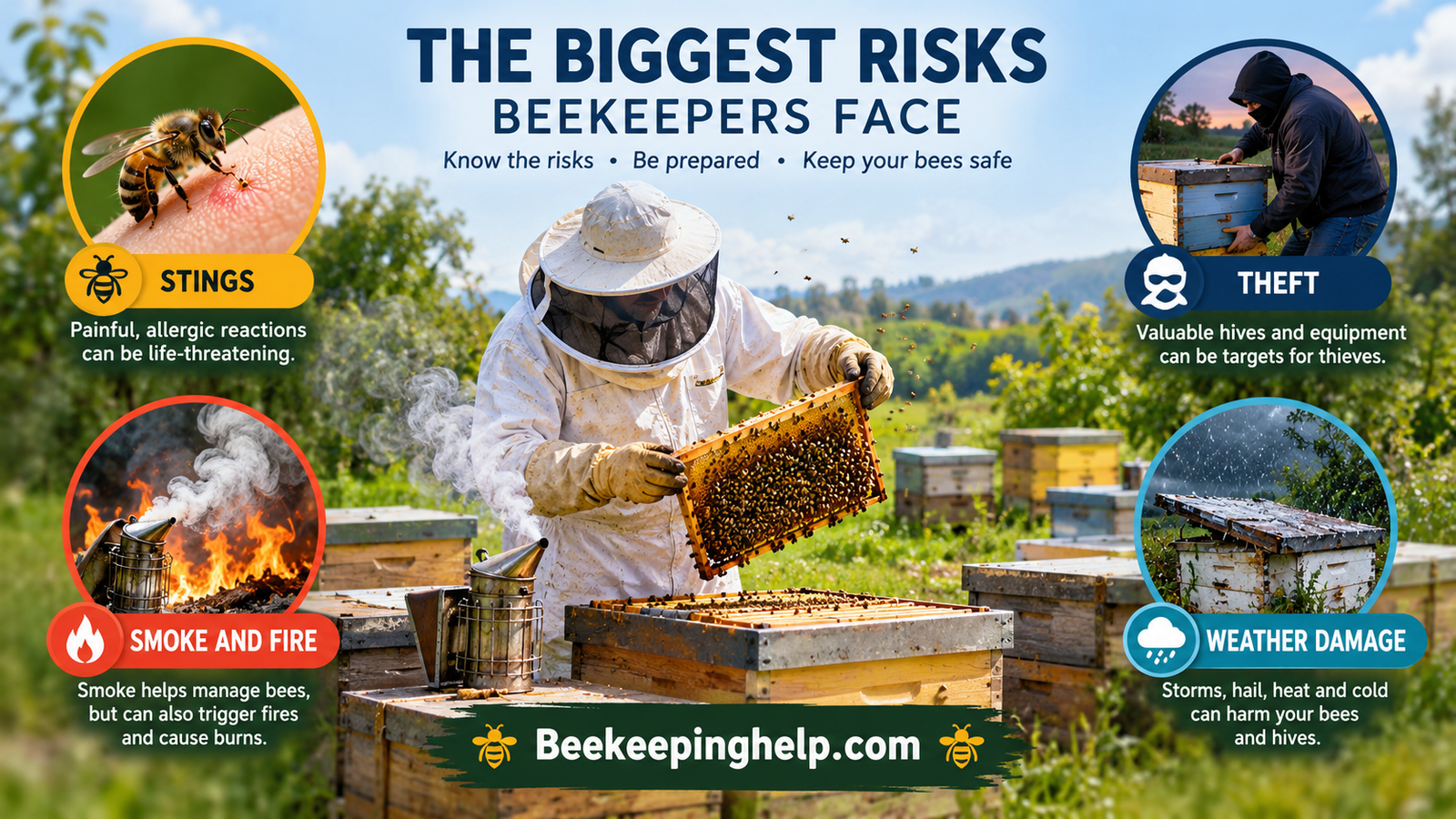
Strictly speaking, almost nowhere requires a backyard beekeeper to carry insurance. Practically speaking, the question is less about legal compulsion and more about what you stand to lose. If you own a house, a car, savings, or a future income, you have something a claim can reach. And the two most common beekeeping claims are the two people least expect.
The first is liability. Bees sting. Usually that is a nuisance, but for someone with an allergy it can become a medical emergency, and for a delivery driver who stumbles into a defensive colony at the wrong moment it can become a lawsuit. The second is property loss, and here the pattern is depressingly consistent: hives stolen from a roadside apiary, a truck rolled on a gravel lane, a smoker left near dry grass, an extractor tipped over in a shed, a barn roof collapsed under snow.
If you only keep a couple of hives and sell nothing, your exposure is modest — but it is not zero, and a single serious sting incident on your property can cost more than a decade of premiums. If you sell honey, take pollination contracts, host school groups, or run any number of hives across other people’s land, insurance stops being optional and becomes a condition of doing business.
The short answer
If you sell anything from your hives, keep bees on land you do not own, run bees for pollination, or have more than a handful of colonies, you need dedicated coverage. If you keep a few hives purely for pleasure, you at minimum need a written answer from your home insurer about what is and is not covered.
New beekeepers also tend to underestimate how quickly the operation grows. Two hives become nine; nine become thirty; thirty come with a truck, a honey house, and a market stall. Costs that seem theoretical in the first season become very concrete later, which is why learning how hard it is to start beekeeping — and how a real colony actually functions inside how a beehive works — helps you size coverage from the beginning.
Start With Gear You Can Actually Insure
Solid starter equipment is easier to value, easier to document, and far less likely to fail.
Check Beekeeping Starter Kits on AmazonTypes of Beekeeping Insurance
Think of beekeeping insurance as six distinct layers. Most operations need four of them. A working commercial apiary usually needs all six.
Understanding the layers matters more than memorizing policy names, because carriers label things differently. One company’s “apiary package” includes product liability; another sells it as a separate endorsement. What stays constant is the underlying risk each layer addresses.
Liability insurance for beekeepers
General liability is the foundation and, for most beekeepers, the most important piece. It responds when someone else gets hurt or someone else’s property gets damaged because of your beekeeping. That covers the classic scenarios: a visitor stung while walking past a hive stand, a colony that moves into a neighbor’s shed wall and stings a contractor, a delivery person knocked down while you are moving pallets, damage to a landowner’s fence while you place hives.
A good beekeeping liability policy splits into bodily injury and property damage, plus products and completed operations coverage — the part that follows the honey after it leaves your hands. It should include legal defense costs in addition to the limit, medical payments for small injuries that do not become lawsuits, and personal and advertising injury if you market your brand.
Pay attention to three details that separate real apiary policies from generic ones. First, does coverage apply at every location where you keep bees, or only at your home address? Second, does it follow you to farmers markets, fairs, and demonstrations? Third, can you issue certificates of insurance naming a landowner, market organizer, or orchard as an additional insured? Without that third feature, many pollination contracts are simply unavailable to you.
Personal safety equipment is part of this story. A well-fitted veil and suit will not prevent every sting, but documented use of proper protective gear matters in a claim, and it is worth reviewing what actually works in our bee suit review and best beekeeping gloves guide before you rely on a policy to clean up after poor equipment.
Property and equipment coverage
This layer pays for physical things: hive bodies, frames, foundation, inner and outer covers, queen excluders, extractors, uncapping tanks, honey filters, bottling tanks, wax melters, smokers, hive tools, suits, feeders, water tanks, electric fencing, generators, and the buildings where you store them. Inland marine coverage — sometimes called a “scheduled property” or “equipment floater” — is what makes this work when gear sits out in an apiary instead of inside a locked barn.
Standard property policies are written for fixed locations. Beekeeping equipment lives in ditches, on hilltops, in borrowed orchards, and on the back of a trailer. A proper floater covers equipment wherever it is, including in transit. Look for replacement cost rather than actual cash value if you can afford it, because depreciation on a twelve-year-old extractor turns a fair claim into a frustrating one.
Documentation is everything here. Photograph your gear, keep receipts, and record the equipment inside each hive. If you build your own boxes, read how to make a beehive and how beehives are made so you can describe exactly what is being insured. A detailed inventory of the parts of a beehive and their functions also helps an adjuster understand why one smashed hive represents a stack of components rather than a single wooden box. And if you are choosing between designs, our guide to the best beekeeping hives shows which setups are worth the most on paper.
Hive and colony loss coverage
This is the coverage beekeepers want most and understand least. It pays when colonies die or disappear from a covered cause. The valuation problem is what makes it complicated: a colony is not a box of hardware. It is a queen, several thousand workers, brood in all stages, drawn comb, and stored honey — and its worth changes with the season.
Policies generally settle colony losses in one of two ways: an agreed value per colony, where you and the insurer set a number up front, or a replacement value based on what it costs to buy a package or nucleus colony. Agreed value is simpler to claim; replacement value usually requires proof of purchase. Either way, expect a per-colony limit and a maximum payout per location or per occurrence.
Valuing bees properly means understanding what you actually own. A package of bees, a nucleus colony, and a full production colony are three very different things — see our explanation of what a nuc is in beekeeping — and the difference shows up directly in a settlement. Buying practices matter too, which is why how to buy bees for beekeeping is worth reading before you set coverage limits.
Product liability (honey sales)
The moment money changes hands for a jar of honey, your risk profile shifts. Product liability covers bodily injury or property damage caused by a product you sell or give away. Honey is low-risk as foods go, but the scenarios are real: glass breakage in a jar, fermentation in a jar sold as raw honey, a mislabeled product containing an undeclared allergen, or contamination from equipment that was not cleaned properly.
In most commercial general liability forms, products and completed operations coverage is included within the aggregate — but not always in a hobbyist or association policy. Confirm it explicitly. If you sell at farmers markets, organizers will usually demand proof of product coverage before they assign you a stall.
Business interruption coverage
If a covered loss shuts down your honey house, wrecks your extractor, or destroys your entire out-apiary during the flow, business interruption replaces lost income while you recover. It can also cover extra expenses — renting equipment, buying honey to fill existing orders, moving colonies to a temporary site.
For commercial operators, contingent business interruption matters too. If a major customer’s facility burns down and your pollination income disappears, this coverage can respond, though the trigger wording deserves careful reading. Expect a waiting period before benefits begin and a defined limit measured in months of income.
| Coverage Type | What It Protects | Who Needs It Most | Typical Structure |
|---|---|---|---|
| General Liability | Third-party injuries (stings, falls) and damage to other people’s property | Anyone with visitors, neighbors, or hives on rented land | Per-occurrence and annual aggregate limits, plus defense costs |
| Property & Equipment | Hives, frames, extractors, tanks, suits, tools, honey house contents | Hobbyists with gear to replace; all commercial operators | Scheduled or blanket limit, replacement cost or actual cash value |
| Hive & Colony Loss | Bees and drawn comb lost to covered perils | Operators whose income depends on live colonies | Agreed value or replacement value per colony, per location cap |
| Product Liability | Honey, wax, candles, and other goods after sale | Everyone selling or sampling products | Usually inside the products aggregate; sometimes an endorsement |
| Business Interruption | Lost income and extra expense after a covered loss | Full-time and sideline beekeepers with recurring revenue | Monthly limit with a waiting period |
| Auto & Inland Marine | Trucks, trailers, forklifts, and gear in transit | Migratory beekeepers and anyone hauling pallets | Auto liability plus physical damage; equipment floater |
Know What You Own Before You Insure It
Frame counts, box styles, and accessories all affect your insured value.
Browse Bee Hives on AmazonWhat Does Beekeeping Insurance Cover? And What Isn’t Covered
Coverage is defined by causes of loss, not by good intentions. Reading the named perils is the difference between a paid claim and an expensive lesson.
Most beekeeping claims fall into predictable buckets, and most exclusions do too. Once you see the pattern, evaluating a quote becomes much faster. Sudden, accidental, external events tend to be covered. Gradual problems, preventable management failures, and market risks tend not to be.
What is usually covered
- Fire and lightning — including a smoker fire that escapes into dry grass and reaches your pallets.
- Theft and vandalism — hives stolen from a roadside site, boxes smashed, honey stolen from a shed.
- Windstorm, hail, and falling objects — a tree limb across a pallet, a roof torn off a honey house.
- Vehicle impact — a truck or tractor striking hives placed near a field margin.
- Bodily injury to third parties — stings, trips, and injuries connected to your beekeeping activities.
- Product-related injury — problems traced to honey or goods you sold.
- Equipment damage in transit — under an inland marine or equipment floater form.
- Business income loss — following a covered physical loss to insured property.
What is usually excluded
- Pests and disease. Varroa mites, small hive beetles, American foulbrood, Nosema, chalkbrood — the slow-moving biological threats are almost universally excluded, because they are considered preventable through management.
- Starvation and mismanagement. A colony that dies because it ran out of stores during a dearth is generally not a covered loss. Understanding the seasonal calendar matters here — read what a dearth is in beekeeping to see how quickly a strong colony can run out of food.
- Queen failure and absconding. A queen that stops laying, or a colony that abandons the box, is treated as an operational hazard rather than an insurable event.
- Pesticide drift. This is the single most contested exclusion in apiary insurance. Some carriers exclude it outright; others offer a narrow endorsement for documented drift from a third party.
- Wear, tear, and deterioration. Rotting bottom boards and sun-bleached covers are maintenance issues.
- Flood and earthquake. These require separate coverage in almost every market.
- Employee injury — without workers’ compensation in place.
- Intentional acts and illegal operations — including unpermitted hives in violation of local ordinance.
Robbing is an interesting middle case. When one colony raids another and the weak colony collapses, the loss usually traces back to management or disease pressure rather than a covered peril. Our guide to what robbing is in beekeeping shows how it starts and why insurers treat it as preventable. Swarming sits in a similar grey zone; learn what swarming is in beekeeping before you assume a swarm-related loss will be paid.
Equipment design also affects claims. Comparing a Flow Hive versus a Langstroth setup matters when you are valuing gear, because replacement parts, specialty frames, and harvesting hardware differ enormously in cost.
| Cause of Loss | Standard Policy Treatment | What to Check in Your Quote |
|---|---|---|
| Fire or lightning | Usually covered, including smoke damage to stored equipment | Whether out-apiaries are scheduled or blanket-covered |
| Theft and vandalism | Usually covered; police report typically required | Security requirements and per-location limits |
| Wind, hail, falling trees | Commonly covered under named perils | Deductible basis and whether colonies are included |
| Vehicle impact | Often covered under property; auto side separate | Which policy pays first when a truck is involved |
| Third-party sting injury | Covered by general liability with defense costs | Per-occurrence limit and additional insured wording |
| Pesticide drift | Usually excluded or heavily restricted | Whether an endorsement exists and what proof it demands |
| Varroa, beetles, foulbrood | Excluded as preventable management risk | Any limited disease sublimit or herd-health endorsement |
| Starvation or absconding | Excluded in nearly all forms | Winter loss wording and documentation requirements |
| Loss during transport | Covered only with inland marine or transit endorsement | Distance limits and whether loading is included |
| Contaminated or mislabeled honey | Product liability may respond to injury, not recall cost | Product recall and batch testing exclusions |
Reduce the Losses Insurance Won’t Cover
Good tools and consistent maintenance cut the risk of avoidable dead-outs.
Shop Beekeeping Tools on AmazonHow Much Does Beekeeping Insurance Cost?
Premiums scale with the size of your operation and the size of your ambitions. The good news is that entry-level coverage is genuinely affordable.
There is no single price tag for beekeeping insurance, because there is no single beekeeping operation. What you pay depends on what you do with bees, where you keep them, how much revenue you generate, and how much you want the policy to stand behind when something goes wrong.
As a general pattern, a hobbyist carrying solid liability plus modest equipment coverage will pay a relatively small annual amount — usually well under what a single new extractor costs, and often in the low hundreds of dollars per year. Sideliners with dozens of colonies and active sales pay more, though still modestly relative to revenue. Full commercial and migratory operators can see premiums reach into the thousands once you add auto, workers’ compensation, multiple states, and large colony counts.
The numbers below are directional rather than quoted figures. Always get an actual quote, and always get at least two.
| Operation Profile | What’s Usually Included | Premium Ballpark | Main Cost Drivers |
|---|---|---|---|
| Backyard hobbyist (a few hives, no sales) | Personal liability, limited equipment, occasional medical payments | The lowest tier — often a small yearly figure | Location, hive count, claims history, whether sales occur |
| Enthusiast / small seller (a dozen-plus hives, market sales) | Liability with products, equipment floater, modest colony coverage | Low hundreds per year in most regions | Product exposure, revenue, number of apiary sites |
| Sideline (dozens to a few hundred colonies) | Full package: liability, property, colony loss, business income, auto | Mid-range — scales quickly with colony count | Colony limits, pollination contracts, transport, employees |
| Commercial / migratory (hundreds of colonies, multi-state) | Everything above plus workers’ comp, umbrella, endorsements | Highest tier — often four figures and up | Fleet size, states visited, contractual insurance requirements |
Factors that affect premiums
- Colony count and insured value. More colonies means more exposure, and higher agreed values per colony raise premiums proportionally.
- Revenue and sales channels. Selling wholesale to a grocery chain looks different to an underwriter than selling a few jars to neighbors.
- Whether you take pollination contracts. Contractual obligations, transport, and third-party locations all add underwriting complexity.
- Location and climate. Wildfire zones, hurricane corridors, hail belts, and areas with heavy pesticide agriculture all change pricing.
- Claims history. A clean record earns better terms than a history of theft or liability claims.
- Deductibles and limits. Raising a deductible is one of the fastest ways to reduce cost.
- Security and site management. Locked trailers, remote cameras, hive branding, and GPS tags can all influence an underwriter’s view.
- Experience and credentials. Mentored beginners and certified beekeepers sometimes earn better rates.
- Membership in an association. Group plans negotiated through beekeeping organizations frequently deliver the best value available.
When budgeting, it helps to see insurance as part of the total startup picture rather than an add-on. Our breakdown of how much it costs to start beekeeping covers equipment and bees; layering a realistic insurance figure on top gives you an honest number. And because hive style affects both your outlay and your insured value, browsing beehive types with pictures helps you price the setup you actually intend to run. If you want a shortcut for gear, see our picks for the best beekeeping starter kit.
Build Your Library, Not Just Your Premium
Well-informed beekeepers file fewer claims and negotiate better terms.
Find Beekeeping Books on AmazonHobbyist vs Commercial Beekeeper Insurance
The line between a hobby and a business is not where most people think it is. It is where your insurer thinks it is.
Underwriters care less about how you feel about your bees and more about the facts: how many colonies, how much revenue, what activities you perform, and what obligations you have signed. Plenty of beekeepers who think of themselves as hobbyists are, on paper, running a small commercial operation — and plenty of small commercial operators are underinsured on a hobbyist-shaped policy.
What counts as commercial
There is no universal threshold, but the signals are consistent: you sell honey or other products regularly, you charge for pollination services, you employ anyone, you advertise services, you keep hives on other people’s land under an agreement, or your colony count is large enough to imply production intent. Any one of these can push you out of a hobbyist classification.
The consequences are not trivial. If you sell honey while insured as a hobbyist and file a claim, the carrier may deny it for material misrepresentation — and that denial can follow you into future applications.
| Factor | Hobbyist Policy | Commercial Package |
|---|---|---|
| Typical colony count | A handful to a couple of dozen | Dozens to many thousands, often across multiple sites |
| How it’s written | Endorsement on a farm or homeowners form, or a small association plan | Standalone commercial package with scheduled locations |
| Liability focus | Personal premises liability, limited activity coverage | Full general liability with products and completed operations |
| Product exposure | Occasional sales, often excluded or capped | Explicit product liability, often with recall considerations |
| Certificates of insurance | Rarely available | Standard, with additional insured endorsements on request |
| Pollination contracts | Usually not contemplated | Covered, with contractual liability options |
| Business income | Not included | Available with defined limits and waiting periods |
| Documentation expected | Basic hive count and address | Full inventory, revenue records, contracts, fleet details |
Hobbyist approach: strengths
- Lowest cost of entry and simple paperwork
- Often available through an existing home or farm insurer
- Good enough for a small, non-selling backyard setup
- Quick to arrange and easy to cancel
Hobbyist approach: weaknesses
- Product and sales exposure often excluded
- Rarely produces certificates for markets or landowners
- Colony values may be capped very low
- Denial risk if your activity exceeds the classification
Commercial approach: strengths
- Broad, clearly worded coverage built for apiary work
- Certificates and endorsements available on demand
- Business income, transport, and equipment in one place
- Better positioned to handle serious claims
Commercial approach: weaknesses
- Higher premium and more detailed application
- Requires organized records and inventories
- May impose safety, storage, and reporting conditions
Wherever you land on that spectrum, the trend only goes one direction. Beekeepers who document well, learn continuously, and treat their apiary like an operation tend to outgrow the hobbyist tier within a few seasons. Building skills deliberately is genuinely useful here — see how to improve your beekeeping skills — and reading widely from the best beekeeping books gives you the vocabulary to talk to an underwriter without guessing.
Smoke Means Fire Risk — Insure Accordingly
A reliable smoker and safe fuel habits reduce one of the most common losses.
Check Bee Smokers on AmazonDoes Homeowners Insurance Cover Beehives?
Sometimes the gear, rarely the bees, and almost never the liability that comes with selling honey. Counting on a homeowners policy is one of the most common mistakes in backyard beekeeping.
Homeowners insurance is designed for a residence and the ordinary life lived inside it. Beekeeping strains three assumptions at once: that animals are limited and domestic, that the property is not used for business, and that liability exposure is personal rather than commercial.
Where homeowners coverage may help
Some policies will treat hive boxes, frames, and tools as personal property and pay for theft or damage from a covered peril like fire or windstorm. If your equipment is stolen from a locked shed, you may have a valid claim, subject to your deductible and to special limits that often cap categories like “business personal property” or “animals.”
Personal liability coverage may also respond to a sting claim in a limited way, since it arises from your personal premises. But that generosity shrinks fast. If you sell honey, teach classes, or take pollination money, most carriers will treat the activity as a business pursuit — and business pursuits are routinely excluded.
Where it falls apart
- The bees themselves. Living colonies are commonly excluded as animals, livestock, or insects. Damage to a hive body may be paid while the colony inside it is not.
- Business liability. Selling a single jar of honey can convert a personal liability claim into an excluded business claim.
- Off-premises exposure. Hives in an out-apiary, on a friend’s farm, or at a market are outside the premises definition.
- Contractual obligations. Homeowners forms do not issue certificates of insurance or name additional insureds.
- Equipment limits. Sub-limits for business or hobby equipment can be far below replacement value.
Do this before your first hive arrives
Call your home insurer, describe exactly what you plan to do, and ask three questions in writing: Are colonies covered? Is liability covered if someone is stung? Does anything change if I sell honey? Keep the reply. An email confirming an exclusion is useful; an email confirming coverage is invaluable.
Umbrella policies deserve the same skepticism. They extend personal liability limits, but they typically carry the same business and animal exclusions as the underlying policy. Ask explicitly rather than assuming extra limits mean extra protection.
Placement and ordinances also feed into this conversation. An insurer is more comfortable with hives set back from property lines, facing away from neighbors, and provided with a water source — see our guide on where to place a beehive. If you are wondering whether your lot is even suitable, read whether you can keep bees in your backyard. And for the occasional claim that begins with a feral colony established in a tree on your property, our piece on types of beehives in trees explains what you are actually looking at.
Stable Stands Make Safer Hives
Level, secure hive stands reduce tipping, damp, and liability near walkways.
See Beehive Stands on AmazonHow to Get Beekeeping Insurance (Step by Step)
Buying coverage is a six-step process. Do it in order and you will end up with a policy that fits — and a file of evidence that makes future claims painless.
Most beekeepers get insurance the wrong way around: they call an agent, accept whatever is offered, and discover the gaps when something goes wrong. The sequence below reverses that. You define the operation first, then shop, then verify.
Protect Your Hands, Protect Your Record
Good gloves prevent stings that turn into liability headaches.
Check Beekeeping Gloves on AmazonThe six steps in detail
Inventory your apiary and equipment
Count colonies, boxes, frames, extractors, tanks, vehicles, and structures. Photograph everything, note serial numbers where they exist, and record where each apiary sits. This inventory becomes the backbone of your application and the basis of every future settlement.
Map your real exposures
List who could get hurt, what could be damaged, and where your income comes from. Include visitors, delivery drivers, landowners, market customers, neighbors, pollination clients, and anyone you hire. Honest exposure mapping prevents the most common insurance failure: buying coverage for what you feared instead of what you actually do.
Choose the coverage layers you need
Match your exposures to the coverage types in Part 02. A non-selling backyard keeper may need liability plus equipment only. A sideline operator selling at markets will add product liability and possibly business income. A migratory operator adds auto, inland marine, and contractual liability.
Gather your documentation
Assemble photos, purchase receipts, colony counts, revenue records, apiary addresses and coordinates, landowner agreements, pollination contracts, vehicle details, and any local registration paperwork. If you built your own boxes, a materials list stands in for receipts. Documentation is also what makes state registration straightforward — see beekeeping laws by state for what your jurisdiction expects.
Collect quotes and compare them properly
Approach at least three markets: an independent agent with agricultural experience, your state or national beekeeper association, and a specialty apiary carrier. Compare the same limits and deductibles on every quote — a cheaper premium with half the colony limit is not a bargain. Ask each one for the exclusions page and read it side by side.
Bind coverage, file it, and review it annually
Accept the policy, store the documents somewhere you can reach them from your truck, and set a calendar reminder before renewal. Revisit coverage every time you add colonies, buy a vehicle, start selling a new product, or sign a contract. Insurers expect your operation to change; they do not expect to learn about it during a claim.
Veils, Suits, and Smarter Protection
Reliable protective gear is the cheapest risk reduction available to you.
Check Bee Veils on AmazonBest Beekeeping Insurance Providers: Where to Buy Coverage
There is no single best carrier for every beekeeper. There is a best channel for your size, your state, and your ambitions.
Because insurance markets shift and vary enormously by region, the most useful thing you can know is which type of provider fits which situation. Once you know the category that suits you, you can search within it locally and compare like for like.
Provider categories worth exploring
- Agricultural and farm insurers. Established carriers with farm packages that can be endorsed for apiculture. Strong on property and liability, familiar with out-apiaries and seasonal equipment.
- Specialty apiary programs. Underwriters who focus specifically on beekeepers. Usually the most flexible wording on colony valuation, pollination contracts, and product exposure.
- Farm bureaus and mutuals. Regional organizations that often bundle membership, education, and group coverage. Frequently the best value for small and mid-sized operations.
- Independent brokers. One conversation, multiple markets. Ideal if your operation spans states or includes unusual exposures like teaching, agritourism, or mead production.
- Government risk programs. In some countries and regions, disaster assistance programs cover honey bee colony losses caused by natural disasters. Availability and terms change, so ask your local agricultural office what currently applies.
- Umbrella and excess markets. For operations with contracts requiring high limits, an umbrella policy sits above the primary liability layer.
| Provider Type | Best For | Strengths | Watch-Outs |
|---|---|---|---|
| Agricultural insurer | Hobbyists and sideline growers with a farm or rural property | Bundling, familiar with rural risk, solid property forms | Colony coverage may be limited or added only by endorsement |
| Specialty apiary program | Working beekeepers with revenue, contracts, or many sites | Purpose-built wording, better colony valuation options | May require minimum colony counts or documented practices |
| Association group plan | Small and mid-sized beekeepers who want value and simplicity | Group pricing, shared advocacy, certificates for markets | Standardized limits; add-ons may be restricted |
| Independent broker | Complex or multi-state operations | Access to several markets, help negotiating terms | Quality varies; ask directly about apiary experience |
| Government program | Disaster backup for registered operations | Safety net when private cover is unavailable | Registration deadlines, narrow triggers, paperwork |
What to look for in a beekeeping policy
- Colonies covered at all scheduled apiary locations, not just your home address
- Replacement cost or agreed value rather than depreciated actual cash value
- Products and completed operations coverage explicitly included
- Ability to issue certificates naming landowners and clients as additional insureds
- Inland marine or transit coverage for equipment and colonies on the move
- Defense costs paid in addition to the liability limit
- Clear wording on pesticides, disease, and starvation exclusions
- A responsive claims process with an adjuster who understands agriculture
Beekeeping insurance through associations
Beekeeper associations are one of the most underrated options available. State and national organizations frequently negotiate group liability coverage for members, and because the group is large and the risk is spread, pricing is often meaningfully better than an individual policy of the same scope.
The trade-offs are predictability and limits. Association plans tend to be standardized: a fixed liability limit, a fixed set of coverages, and straightforward eligibility. For a hobbyist or small seller that is usually perfect. For an operation with unusual exposure — heavy transport, large contracts, processed products like candles or cosmetics — you may outgrow the group plan and need a bespoke package.
Membership usually brings secondary benefits too: a mentor network, training days, and access to people who have already filed claims. Those relationships carry real value when you are trying to work out whether beekeeping is profitable for your situation and what coverage that profitability actually requires.
Compare Coverage, Then Compare Gear
Once your policy is sorted, the right equipment is the next best investment.
Shop Beekeeping Supplies on AmazonInsurance for Selling Honey, Wax, and Other Hive Products
The moment you sell, you become a food business in miniature. Insurance follows that reality — and so do labeling rules, market requirements, and record-keeping expectations.
Selling honey is one of the great pleasures of beekeeping and one of the fastest ways to change your insurance needs. Even small, informal sales can trigger product liability exposure, and many farmers markets, retail shops, and online platforms will ask for proof of coverage before doing business with you.
What product liability actually covers
Product liability responds when a product you sold causes bodily injury or property damage. In honey terms that might mean a customer injured by broken glass, an adverse reaction to a mislabeled product, or illness traced back to contamination. The policy pays legal defense and, if you are found liable, the judgment or settlement.
Two things it usually does not cover are worth knowing in advance. Recall costs — the expense of pulling product from shelves — are often excluded or require separate coverage. And the loss of the product itself is property, not liability.
Products beyond honey
Hive products extend well past jars. Beeswax candles, lip balms, soaps, propolis tinctures, and honey-based foods each change your risk class. Cosmetics and ingestible products attract more scrutiny than honey, and fermented products like mead sit in an entirely different regulatory category with their own licensing requirements. Tell your insurer exactly what you make and how you make it.
Practical steps that protect you
- Label accurately. Ingredient lists, net weight, your business identity, and any required allergen statements. Mislabeling is both a regulatory and an insurance problem.
- Keep batch records. Note when and where each batch was harvested. If a problem appears, traceability turns a catastrophe into a contained issue.
- Document cleaning. A simple equipment cleaning log is persuasive evidence if contamination is alleged.
- Store properly. Crystallization, fermentation, and moisture absorption are quality problems that become liability problems. Our guide on how to store honey covers the essentials.
- Verify market requirements. Many markets require a certificate of insurance with specific limits and additional insured wording. Get this before you commit to a stall.
Equipment choices matter here as well. A clean, well-maintained extraction setup reduces contamination risk and makes your processing story easier to describe — see our roundups of the best honey extractors for options that suit different volumes.
A quick rule of thumb
If money changes hands for anything that came out of your hive — honey, wax, candles, nucs, pollination, even a paid tour — assume you need product or professional coverage and confirm it in writing before the first sale.
Bottle It Right, Sell It Confidently
Clean, food-safe containers make labeling and storage far simpler.
Check Honey Jars on AmazonInsurance for Pollination Services
Pollination is where beekeeping becomes logistics, contracts, and chemistry all at once. It is also where insurance wording matters most.
Moving colonies onto someone else’s crop for a fee creates a chain of obligations. The grower expects strong colonies at a specific date. You expect to be paid and to retrieve your bees alive. Both sides expect the other to handle pesticide exposure sensibly. Insurance sits in the middle of all of it.
What pollination contracts usually require
- A certificate of insurance naming the grower or landowner as additional insured
- General liability limits at a level set by the contract
- Proof of auto coverage for vehicles entering the property
- Sometimes workers’ compensation if you bring crew
- Indemnification language that transfers certain liabilities between the parties
Read indemnity clauses carefully. Some shift substantial risk onto the beekeeper, and no insurance policy will cover an obligation you assumed by contract unless you bought contractual liability coverage.
Exposures unique to pollination work
- Pesticide exposure during bloom. This is the defining risk of pollination services. Most policies exclude it; a few offer limited endorsement coverage with strict documentation requirements.
- Colony strength disputes. Growers may reject colonies that do not meet frame-count or bee-coverage standards. Quality disputes are usually contract matters rather than insurance claims.
- Transport losses. Loading, hauling, and unloading in unfamiliar fields at night creates collision, tipping, and heat-stress exposure.
- Abandonment and retrieval. If hives cannot be collected after bloom, disputes follow.
The financial side is worth studying before you commit to contracts. Our analysis of whether beekeeping is profitable covers how pollination income compares with honey revenue — and why so many commercial operations depend on it.
| Exposure | Likely Coverage Treatment | What to Put in the Contract |
|---|---|---|
| Injury to farm workers from stings | Covered by general liability, subject to limits | Notice of hive locations and warning signage |
| Pesticide drift during bloom | Usually excluded; limited endorsements may exist | Spray notification agreement and buffer zones |
| Colonies damaged in transit | Inland marine or transit endorsement needed | Loading responsibilities and route conditions |
| Dispute over colony strength | Contract matter, not an insurance claim | Objective frame-count or bee-coverage standard |
| Equipment left on the property | Property floater responds to covered perils | Storage terms and retrieval deadlines |
Transport-Ready Nuc Boxes Help
Sturdy boxes reduce losses when colonies travel to and from orchards.
See Nuc Boxes on AmazonLocal Laws, Permits, and Registration Requirements
Insurance operates inside a legal framework. Ignore the framework and your policy can quietly become unenforceable.
Beekeeping is regulated at several levels simultaneously — national agricultural authorities, state or provincial agencies, county and municipal ordinances, and sometimes homeowners associations. Each level has its own registration scheme, and compliance is not optional paperwork: it is a condition of coverage in many forms.
What is commonly required
- Apiary registration. Many jurisdictions require beekeepers to register locations so authorities can respond to disease outbreaks quickly.
- Colony movement permits. Transporting bees across borders or into certain regions often needs authorization and inspection.
- Setback and hive-count rules. Municipal ordinances may dictate distance from property lines, maximum colony numbers, water provision, and flyway barriers.
- Honey sales licensing. Cottage food rules, weights and measures registration, and labeling standards apply to anyone selling.
- Structural permits. Honey houses, sheds, and commercial extraction facilities may trigger building and food-safety requirements.
Start with our overview of beekeeping laws by state, then verify the details locally — ordinances vary block by block, not just state by state. If you are operating in a large agricultural state with its own apiculture culture, our guide to how to start beekeeping in Texas shows how registration, feed rules, and registration deadlines tend to work in practice.
Why this belongs in an insurance article
Policies routinely exclude losses arising from illegal operations or failure to comply with regulations. An unregistered apiary in violation of a setback rule is exactly the kind of exposure an adjuster will look at closely. Registration also creates a public record of ownership and location — useful evidence after a theft.
Stay Compliant and Well Equipped
From feeders to protective gear, reliable supplies keep your operation inspection-ready.
Browse Bee Feeders on AmazonHow to File a Claim — and Tips to Lower Your Premium
Claims are won in the first 48 hours. Premiums are won in the twelve months before renewal.
How to file a beekeeping insurance claim
- Make the scene safe. Secure loose hives, move bees away from people, and prevent further damage where you can do so safely.
- Notify your insurer promptly. Most forms require timely notice. Call before you clean anything up.
- Document everything. Photograph wide angles and close-ups, record video where helpful, and note the date, time, weather, and circumstances.
- File a police report for theft, vandalism, or vehicle impact. Insurers normally require the report number.
- Preserve evidence. Do not discard damaged equipment or dead colonies. In suspected disease or poisoning cases, keep samples and request laboratory testing.
- Separate the losses. List colonies, equipment, structures, product, and income loss separately. Mixed inventories slow everything down.
- Get estimates. Repair or replacement estimates from a supplier or contractor help validate the claim.
- Keep receipts for emergency measures. Temporary storage, rented equipment, and cleanup costs are often reimbursable.
- Track the timeline. Keep a written log of every call, name, and reference number.
- Appeal if the offer is wrong. Ask for the specific policy language behind a partial denial. Reasonable, documented pushback frequently improves a settlement.
Tips to lower your premium and reduce risk
- Raise deductibles deliberately. The fastest lever on premium — just keep enough cash to cover it.
- Bundle coverage. Combining property, liability, and auto with one carrier usually earns a discount.
- Join an association. Group plans and member discounts are the easiest savings available.
- Improve site security. Locked trailers, tamper-resistant stands, cameras, and GPS tags on pallets deter theft and reassure underwriters.
- Brand and register your gear. Marked equipment is harder to resell and easier to recover.
- Practice disciplined fire safety. A smoker is a live flame in dry country. Read how a bee smoker works and what to use in a bee smoker, then keep a water can and a fire-safe clearing around your working area. If your smoker is unreliable, replace it — see the best bee smokers.
- Maintain your equipment. Sound boxes and covers last longer and fail less dramatically. Fresh protective coatings help — how to paint a beehive is a short read with real payoff.
- Keep protective gear in good order. Clean, intact gear prevents stings that become claims. See how to wash a bee suit and how to clean beekeeping gloves.
- Feed and manage consistently. Starvation and absconding are uninsurable, so prevention is the only coverage. Learn what to feed bees, compare the best bee feeders, or build your own with how to make a bee feeder.
- Keep records obsessively. Inspection notes, treatment logs, and harvest records help in almost every claim scenario.
- Review limits honestly. Over-insuring wastes money; under-insuring creates a gap at the worst moment.
- Pay annually where possible. Installment plans often carry fees that add up over a term.
- Shop the market periodically. Every couple of years, compare at least one alternative quote.
There is a personal-safety dividend too. Confident, well-protected beekeepers handle colonies calmly and make better decisions under pressure — the exact trait that separates smooth inspections from stressful ones. If you want a structured path, work through how to improve your beekeeping skills, and make sure your protective kit is genuinely protective: check what bee suits do against wasps before you assume one suit covers every flying risk.
Manage Mites, Manage Your Risk
Disease and pest control is the one loss category insurance will not rescue.
Check Varroa Treatments on AmazonFrequently Asked Questions About Beekeeping Insurance
Is beekeeping insurance required by law?
In most places, no — there is no general legal requirement for a hobbyist to insure a handful of hives. The situation changes in practice more often than in statute. Some municipalities require proof of liability coverage as a condition of an apiary permit, most farmers markets require a certificate before assigning a stall, and nearly every pollination contract requires named-insured status. If you generate revenue in any form, assume insurance is a commercial requirement even when it is not a legal one.
Can I be sued if my bees sting someone?
Yes. Beekeepers can be held liable if someone is stung and can show that you were negligent — hives placed too close to a public path, an unsecured swarm, or colonies handled carelessly while visitors were present. Serious reactions make lawsuits more likely. Liability coverage provides a legal defense and pays covered settlements, which is why general liability is considered the foundation of any beekeeping insurance program.
Does insurance cover bee swarms leaving my property?
Usually not as a colony loss. Swarming is a natural reproductive behavior and is generally treated as a management issue rather than an insurable event. The liability side is different: if your swarm settles on a neighbor’s property and causes injury or requires removal, liability coverage may respond depending on the wording. Swarm prevention is worth understanding — start with what swarming is in beekeeping.
Is beekeeping insurance worth it for a few hives?
For most people, yes — though the priorities shift. With a small apiary, your largest exposure is liability rather than property, and liability coverage is typically inexpensive. Equipment replacement is a manageable personal cost, but a single injury claim is not. At minimum, get a written answer from your home insurer and consider an association liability plan if one is available to you.
Does insurance cover theft or vandalism of hives?
Yes, theft and vandalism are commonly covered perils in both property and equipment floaters. Expect two conditions: a police report is normally required, and coverage is subject to your deductible and any per-location limits. Remote and roadside apiaries are the most targeted, so security measures help both your claim experience and your premium.
Can I get insurance if I keep bees in my backyard?
Absolutely. Backyard beekeeping is a normal, well-understood exposure for most agricultural and specialty carriers, and association group plans are built for exactly this situation. Before applying, check local ordinances and any homeowners association rules — an unregistered hive in violation of a setback rule can complicate both permits and claims. See whether you can keep bees in your backyard and where to place a beehive.
Does it cover bee diseases or pests like Varroa mites?
No. Losses from Varroa mites, small hive beetles, foulbrood, Nosema, and similar problems are almost universally excluded because they are considered preventable through monitoring and treatment. This is the single most common misunderstanding about colony coverage. Insurance protects against sudden external events; pest and disease management remains entirely your responsibility.
Will my policy cover pesticide damage to my colonies?
Usually not under a standard form. Pesticide drift is widely excluded, though some specialty markets offer narrow endorsements that respond to documented drift from a third party, often requiring laboratory confirmation and prompt notification. If you take pollination contracts in intensively sprayed crops, treat this as a top question when comparing quotes.
Do I need insurance to sell honey at farmers markets?
Almost always. Market organizers commonly require general liability with product coverage and will ask to be named as an additional insured on a certificate. Even where it is not required, product liability is the coverage that protects you if something you sell causes harm. Your honey handling and storage practices matter too — see how to store honey.
Are my bees covered while they are on someone else’s land for pollination?
They can be, but only if the policy schedules those locations or provides blanket coverage for all apiary sites. Off-premises coverage is one of the most important details to confirm for pollination work. Inland marine or transit endorsement is normally a separate requirement for the journey itself.
Does beekeeping insurance cover equipment in storage or in transit?
Equipment at a fixed scheduled location is generally covered under property; equipment in transit or at temporary locations needs inland marine or an equipment floater. Confirm whether loading and unloading are included, since that is when a great many equipment losses occur.
How do insurers value a colony of bees?
Either by an agreed value set when the policy is written, or by the cost to replace the colony with a package or nucleus. Agreed value is simpler and more predictable; replacement value typically needs proof of purchase. Either way, expect a per-colony limit and a maximum per location. Knowing the difference between a package and a nucleus helps enormously — read what a nuc is in beekeeping.
Want to Go Deeper?
A good reference library pays for itself in avoided mistakes.
Browse Beekeeping Books on AmazonInsure the Operation You Actually Run
Beekeeping insurance is not about expecting disaster. It is about refusing to let one bad afternoon undo years of good work.
The pattern across everything above is simple. Liability is the coverage that protects your finances. Property coverage protects your gear. Colony loss coverage protects your livelihood if you have one. Product coverage protects the people who buy from you. And the paperwork — inventories, photos, registrations, contracts — is what turns those promises into paid claims.
Start with what you actually do. If you keep a few hives and sell nothing, one conversation with your home insurer plus a modest liability policy may be enough. If you sell honey, take contracts, or keep bees across multiple sites, build a proper package with an insurer who understands apiaries, and review it every time the operation changes.
The best policy is the one written for the apiary you have — and the one you can explain in plain language when something goes wrong.
While you sort out coverage, keep building the operation underneath it: sharper skills, better equipment, cleaner records, and honest expectations about the economics. Whether that means reading up on how to start beekeeping or simply making your existing setup safer and more insurable, the work compounds. Good management is the cheapest insurance you will ever buy.
Ready to Upgrade Your Operation?
From hives to harvest gear, everything you need is one click away.
Shop Beehives on Amazon