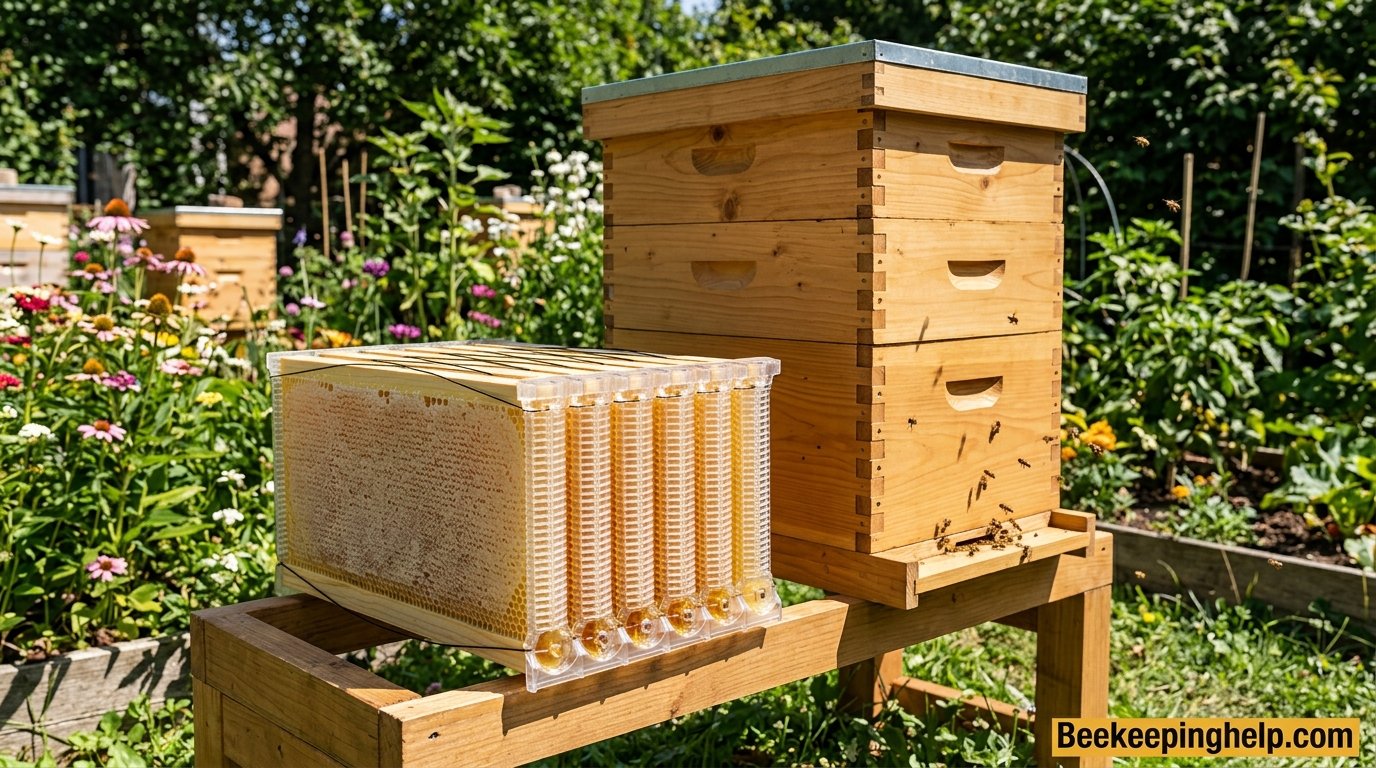
Flow Hive vs Langstroth: Which Beehive Is Actually Right for You?
An honest, deep-dive comparison of the two most talked-about hive systems in modern beekeeping — cost, harvesting, bee health, learning curve, and long-term value, all laid out plainly.
If you’ve spent any time browsing beekeeping forums, YouTube tutorials, or gift catalogs around the holidays, you’ve almost certainly run into the Flow Hive. It’s the beehive that promises honey “on tap,” turning a crank-style key and watching golden honey pour straight out of a jar spout without ever opening the hive or disturbing the bees. It looks like magic, and the marketing videos have racked up tens of millions of views.
On the other side of the debate sits the Langstroth hive — the boxy, stackable wooden hive that has been the backbone of commercial and hobbyist beekeeping for more than 150 years. It’s not flashy. It doesn’t have a viral video. But it is, by a wide margin, still what the vast majority of working beekeepers actually use.
So which one should you actually buy? That’s the question this guide is built to answer — not with hype, and not with knee-jerk skepticism either, but with a genuinely detailed look at how each hive works, what it costs over time, how it affects your bees, and who each system is really designed for. If you’re just getting started, it’s worth first reading our guide on how to start beekeeping so the hive decision fits into the bigger picture of what the hobby actually involves.
It’s also worth being upfront about something that gets glossed over in a lot of comparison content online: this isn’t really an “either/or” question in the way it’s usually framed. As you’ll see throughout this guide, the two systems overlap far more than the marketing on either side tends to admit. Nearly every Flow Hive in active use today is running on top of a standard Langstroth brood box, and a growing number of Langstroth beekeepers are experimenting with a Flow super for part of their harvest. So rather than thinking of this as choosing a tribe, it’s more useful to think of it as deciding how much of your beekeeping experience — specifically the harvest step — you want to hand over to a mechanical convenience, and how much you want to keep hands-on and traditional.
We’ll walk through the mechanics of each system, the real dollar costs (not just the marketing sticker price), what actually happens to your bees under each approach, how steep the learning curve really is, and — because it comes up in nearly every beekeeping forum thread on this topic — whether you can simply run both at once. By the end, you should have a genuinely clear sense of which setup fits your goals, your budget, your climate, and your appetite for hands-on work.
1. What Is a Flow Hive, Really?
The Flow Hive was developed by an Australian father-and-son team, Stuart and Cedar Anderson, after years of tinkering with the idea of a honeycomb structure that could be mechanically split open to release honey without cutting or crushing the comb. The core innovation isn’t the box itself — it’s the frame.
A Flow frame is made of partially formed plastic honeycomb cells. Bees draw out the wax on top of this plastic structure and fill the cells with honey just as they would in a normal frame. When you’re ready to harvest, you insert a tool (traditionally a small crank key, though newer versions use a lever or app-connected mechanism) into the top of the frame and turn it. This action shifts the vertical alignment of the plastic cell walls, effectively splitting each hexagonal cell down the middle. Honey drains downward through internal channels and exits through a spout at the back of the hive into a jar or container.
Crucially, the wax cappings and comb structure themselves are not destroyed — the bees simply reset the frame afterward by resealing the split cells with wax, and the cycle continues. This is the single biggest selling point: no smoker, no bee suit required at the moment of harvest (though you’ll still want one for regular inspections), no sticky uncapping knife, and no centrifugal extractor.
The Andersons launched the original product through a crowdfunding campaign that raised well over $12 million in its first weeks, which at the time was one of the largest crowdfunding campaigns of any kind, let alone in the agricultural equipment space. That kind of launch created enormous visibility for a product category — backyard beekeeping equipment — that had rarely, if ever, broken into mainstream consumer awareness before. It’s part of why so many people who’ve never kept bees have still heard of the Flow Hive specifically, even if they couldn’t name a single other piece of beekeeping equipment.
Since that original launch, the product line has gone through several iterations. The current generation, generally marketed as the Flow Hive 2 or Flow Hive 2+, includes refinements like a clear acrylic viewing window built into the side of the hive body (so you can peek in on the colony without cracking open the lid), a more robust roof and base design, and improved internal channeling to reduce the honey-jamming issues that plagued some earlier-generation frames. Flow also now offers a “Flow Hive Mini,” a smaller-capacity, lower-cost entry point aimed at absolute beginners or those with limited yard space, and various “Flow Classic” wood-body options in different timber species like Araucaria, cedar, and cypress, which affect both price and weather resistance.
One detail that surprises a lot of first-time buyers: the Flow Hive box itself, when you strip away the branding, is essentially a well-built wooden Langstroth hive body with a specific super designed to accept Flow frames instead of standard frames. That’s a deliberate design choice, not an accident — it means existing Langstroth beekeepers can, in many cases, buy just the Flow super and frames separately and add them to equipment they already own, without needing to replace their entire setup.

Flow Hive 2+ Complete Beehive
The current flagship Flow Hive setup with an observation window, Flow frames, and a cedar or Araucaria wood body.
Check Price on Amazon2. What Is a Langstroth Hive?
The Langstroth hive is named after Reverend Lorenzo Langstroth, an American beekeeper who in 1852 patented the concept of “bee space” — the discovery that if you leave a gap of roughly 6 to 9 millimeters between comb surfaces, bees will neither fill it with burr comb nor seal it with propolis. That single insight made it possible to build a hive with fully removable, inspectable frames, which had never really been achievable before.
A Langstroth hive is built from stacked rectangular boxes called “supers” — a deep or medium brood box (or boxes) where the queen lays eggs and the colony raises young, topped by one or more honey supers where the bees store surplus honey. Each box holds 8 or 10 removable wooden frames, and each frame holds either wax or plastic foundation that guides the bees to build straight, uniform comb.
This design became the global standard for a reason: it’s modular, endlessly expandable, compatible with an enormous ecosystem of tools and replacement parts, and it allows a beekeeper to fully inspect every frame in the hive — checking for the queen, brood pattern, pests, and disease — in a way that’s simply not possible with a sealed Flow frame.
If you want to see how Langstroth hives stack up against other traditional designs like top-bar and Warre hives, our breakdown of beehive types with pictures is a useful companion read before you commit to a system.
What’s easy to underestimate today is just how significant Langstroth’s original insight actually was. Before the discovery of bee space, beekeepers largely relied on fixed-comb hives — skeps, log gums, and box hives — where the only way to harvest honey was to destroy some or all of the comb, often killing a portion of the colony in the process. Langstroth’s patent effectively created the entire modern beekeeping industry as we know it, because it was the first design that let a beekeeper repeatedly open, inspect, and manage a colony without destructive harvesting. Every mass-produced hive system that came after it, including the Flow Hive, is built on the bee-space principle Langstroth documented in the 1850s.
Modern Langstroth equipment typically comes in two width configurations — 8-frame and 10-frame — and two common box depths, “deep” (used mainly for brood boxes, roughly 9-5/8 inches tall) and “medium” or “Illinois” (roughly 6-5/8 inches, often used for honey supers to keep the weight more manageable when full). Some beekeepers standardize on all-medium equipment specifically to avoid the back strain of lifting a full deep honey super, which can weigh 80–90 pounds when packed with honey. This modularity — mixing and matching box heights and frame counts based on your own strength, budget, and management style — is one of the quieter but genuinely important advantages of the Langstroth system that rarely gets mentioned in Flow Hive marketing comparisons.
Frame foundation within a Langstroth box can be wired beeswax, plastic coated in a thin layer of wax, or (less commonly today) foundationless, where bees build entirely natural comb guided only by a thin starter strip. Each choice has trade-offs in comb strength, ease of extraction, and how “natural” the resulting comb structure is — a level of customization that simply doesn’t exist within the fixed plastic-cell design of a Flow frame.

10-Frame Langstroth Beehive Starter Kit
A traditional assembled or unassembled cedar/pine Langstroth kit with frames, foundation, and telescoping cover.
Check Price on Amazon3. How Each Hive Actually Works, Side by Side
It helps to walk through the practical, week-to-week experience of each hive rather than just the engineering behind them. Below is a comparison of the core operational differences.
| Aspect | Flow Hive | Langstroth Hive |
|---|---|---|
| Frame material | Molded BPA-free plastic with a resin coating, pre-formed comb pattern | Wood or plastic frame holding wax or plastic foundation the bees draw out fully |
| Comb building | Bees only build a thin layer of wax over an existing structure | Bees build the entire comb from scratch (or draw it out from a thin foundation sheet) |
| Harvest method | Turn a key/lever; honey drains through internal channels to an external spout | Remove frames, uncap wax with a hot knife, spin in a centrifugal extractor |
| Hive inspection | Flow frames are opaque/sealed internally and generally not meant to be pulled apart for brood inspection | Every frame lifts out individually for full visual inspection |
| Compatibility | Fits Langstroth-dimension boxes; often used as a super on top of a standard Langstroth brood box | Universal standard, compatible with nearly all beekeeping equipment worldwide |
| Typical use case | Honey supers only — brood box is almost always still standard Langstroth frames | Both brood chamber and honey supers |
This last row is worth dwelling on because it’s widely misunderstood by newcomers. Even dedicated Flow Hive owners almost universally still run a standard Langstroth-style brood box underneath their Flow super. That’s because the queen needs comb she can actually walk across and lay in cell-by-cell, and brood needs to be inspectable for disease, mites, and queen health — none of which the sealed Flow frame design supports well. In other words, a “Flow Hive” in practice is usually a hybrid: Langstroth below, Flow frames above.
4. Harvesting Honey: Tap vs Extract
This is the single feature that sells almost every Flow Hive purchase, so it deserves a close, unglamorized look.
How Flow Hive harvesting actually goes
In an ideal scenario: the honey super frames are capped (meaning the bees have sealed the cells, indicating the honey is cured and ready), you attach tubing from the frame’s spout to a jar, insert the Flow key, and turn it about a quarter turn. Honey begins to flow, often within a minute or two, and a single frame can yield roughly 3 to 7 pounds of honey depending on the season and how fully it was drawn and filled.
In practice, several caveats show up constantly in real user reports:
- Honey needs to be reasonably warm (ideally above 70°F/21°C) to flow smoothly; in cooler climates or seasons, it can crystallize or move sluggishly through the internal channels, sometimes requiring a hive-safe heat source.
- Crystallized honey can jam the mechanism entirely, sometimes requiring a full frame removal and manual cleanup — at which point you’ve lost most of the “no disturbance” benefit anyway.
- Partially filled or partially capped frames don’t split cleanly, and can leak uncured (high moisture) honey that’s prone to fermentation.
- Some users report wax debris or propolis interfering with the plastic mechanism over several seasons of use.
How Langstroth harvesting actually goes
The traditional route is more labor-intensive but more predictable. You pull capped frames, use a hot knife or capping scratcher to remove the wax seal, then load the frames into a centrifugal extractor (hand-crank or electric) that spins the honey out by centrifugal force. The honey drains through a filter into a bucket, and the empty drawn comb frames go back into the hive for the bees to refill — saving them the energy cost of rebuilding wax from scratch.
It’s messier, it takes longer per session (often a half day for a full harvest versus roughly an hour with Flow frames for the same number of boxes), and it usually requires either buying or borrowing an extractor. But it gives you complete control over timing, honey moisture content (you can check with a refractometer before extracting), and it lets you harvest wax as a genuine byproduct, which many Langstroth beekeepers sell or use for candles, lip balm, and other products.
There’s also a social dimension to Langstroth harvesting that rarely gets discussed in comparison articles: extraction day is, for a lot of hobbyist beekeepers, one of the more communal and enjoyable parts of the hobby. Many local beekeeping clubs maintain a shared extractor that members can borrow or rent by the day, which turns harvest time into a small gathering — swapping tips, comparing yields, and troubleshooting problems together. New beekeepers who lean into that community aspect often find it accelerates their learning curve far more than any piece of equipment could. The Flow Hive’s solo-harvest convenience, by contrast, removes a friction point that many experienced beekeepers actually valued as a built-in mentorship opportunity.
It’s also worth understanding what “ready to harvest” actually means biologically, because it applies to both systems equally. Nectar is roughly 70–80% water when bees first bring it into the hive. Through evaporation — helped along by the bees fanning their wings over open cells — that moisture content drops to around 17–18%, at which point the honey is considered cured and the bees cap the cell with a thin wax seal to preserve it indefinitely. Harvesting honey before this capping process is complete, in either a Flow frame or a traditional frame, risks pulling honey with too much residual moisture, which can ferment in storage. This is one of the few genuinely universal rules in beekeeping that no hive design, however clever, can shortcut.
5. Upfront Cost & Setup
Cost is where the two systems diverge most sharply, and it’s often the deciding factor for new beekeepers working with a limited budget.
| Item | Flow Hive (complete kit) | Langstroth (complete kit) |
|---|---|---|
| Hive body + Flow super | $600–$900 | $150–$350 |
| Brood box frames/foundation | Included, standard Langstroth style | Included |
| Protective gear (suit, gloves, smoker) | $80–$200 (still required) | $80–$200 |
| Extraction equipment | Not needed for Flow super honey | $150–$500 (hand-crank to electric extractor), or borrow/rent locally |
| Approximate total to get started | $700–$1,200 | $400–$900 |
The Flow Hive’s price premium comes almost entirely from the injection-molded plastic Flow frames themselves, which are precision-manufactured and patented technology — that engineering cost gets passed directly to the buyer. A 6- or 7-frame Flow super alone often costs more than an entire basic Langstroth starter kit.
If budget is the primary constraint, it’s also worth comparing both of these against other entry points covered in our roundup of the best beekeeping hives for new beekeepers, since there are mid-range options that aren’t covered in this Flow-vs-Langstroth comparison alone.
It’s also worth factoring in a cost that neither price table above fully captures: bees themselves. Whichever hive you choose, you’ll still need to acquire a colony, typically through a 3-pound package of bees with a mated queen (roughly $150–$200), a nucleus colony or “nuc” (roughly $180–$260, and generally considered a stronger start for beginners), or by capturing a swarm for free if you have the skill and timing to do so. This cost is identical regardless of which hive system you choose, but it’s frequently left out of “how much does beekeeping cost” comparisons that focus only on the box itself — and it can easily add another $150–$250 to your true first-year total on top of whichever hive you pick.
Shipping is another quietly significant line item, particularly for Flow Hive purchases. Because complete Flow Hive kits are bulky, heavy (often 40–70 lbs for a fully assembled unit), and sometimes shipped from regional distribution centers rather than a local hardware store, freight costs can add $50–$150 to the total depending on your location — a cost that’s far less pronounced with Langstroth equipment, which is widely stocked by local farm supply stores, bee supply shops, and even some larger hardware chains in agricultural regions.
6. Long-Term Cost of Ownership
Upfront price only tells part of the story. Over a 5-to-10-year ownership window, a few other cost factors shift the picture:
Replacement parts and expansion
Standard Langstroth boxes, frames, and foundation are sold by dozens of manufacturers, which keeps prices competitive and replacement parts cheap and easy to find — often under $3–4 per frame. Flow frames are proprietary; replacing a cracked or degraded Flow frame means buying directly from Flow Hive (or an authorized reseller) at a noticeably higher per-unit price, and the ecosystem of third-party compatible parts is much smaller.
Wax and comb value
Langstroth beekeeping produces harvestable beeswax as a natural byproduct of uncapping, which some beekeepers sell or use for candles, cosmetics, and wood conditioning — a small but real secondary income stream that isn’t part of the Flow Hive experience, since the comb structure is reused rather than cut.
Longevity of equipment
Wooden Langstroth boxes, if properly painted or otherwise weatherproofed, commonly last 15–20+ years with basic maintenance. Painting your own boxes is a common cost-saving step — see our guide on how to paint a beehive for the right paints and techniques to extend that lifespan. Flow frames, being plastic and mechanical, have a less established long-term track record since the product is relatively newer to the market, though most owners report many years of reliable use with proper care.
DIY potential
Committed budget-conscious beekeepers sometimes build their own Langstroth boxes and frames from raw lumber, cutting the cost of a hive body down dramatically. There’s no realistic DIY equivalent for Flow frames since the precision-molded plastic mechanism can’t be reasonably replicated at home — though our guide on how to make a beehive walks through what’s achievable for the standard Langstroth-style build.
Scaling to multiple hives
Cost differences compound quickly once you move beyond a single backyard hive. A beekeeper running two or three Langstroth hives can often share a single extractor, a single set of protective gear, and buy foundation and frames in bulk at a meaningful discount. A beekeeper running two or three Flow Hives is paying the full proprietary-frame premium on every additional colony, with no real bulk-purchase relief, since Flow frames are sold in fixed-count boxes at fairly consistent per-unit pricing. This is the single biggest reason commercial and semi-commercial beekeepers — anyone running five, ten, or fifty-plus hives — overwhelmingly stick with Langstroth equipment: the economics simply don’t scale favorably for Flow frames past a certain hive count.
Resale and secondhand value
Because Langstroth is the dominant global standard, secondhand Langstroth equipment — boxes, frames, extractors — holds its value reasonably well and is easy to sell locally through beekeeping association classifieds or marketplace listings. Secondhand Flow Hive equipment does circulate, but the market is thinner, and buyers are understandably cautious about purchasing used plastic frames without being able to inspect the internal mechanism closely for wear, cracking, or propolis buildup that might affect the flow action.
7. Bee Health & Colony Management
This is arguably the most important — and most contested — part of the debate, because it’s less about your convenience and more about what’s genuinely good for the bees.
The central concern many experienced beekeepers raise about Flow frames is inspectability. Colony health management depends on being able to physically examine brood frames for signs of Varroa mite infestation, foulbrood and other brood diseases, adequate laying pattern from the queen, and general colony strength. Because Flow frames are used almost exclusively as honey supers (not brood chambers), this concern is somewhat softened in practice — brood inspection still happens on the standard Langstroth frames underneath. But some beekeepers do report reduced visibility into what’s happening in the honey super itself, including early signs of small hive beetle activity or wax moth larvae that might otherwise be caught during a manual frame pull.
There’s also an ongoing conversation in the beekeeping community about whether the reduced handling of Flow frames is a net positive (fewer disruptive inspections mean less stress on the colony) or a net negative (less frequent hands-on monitoring means problems can go unnoticed longer). The honest answer is that it depends heavily on the individual beekeeper’s overall inspection habits — a diligent Flow Hive owner who still does regular full-hive checks captures most of the same information as a Langstroth-only beekeeper.
Understanding baseline colony mechanics helps clarify this debate — our explainer on how does a beehive work and our breakdown of the parts of a beehive and their functions are both useful background reading if you’re newer to the biology side of this decision.
Arguments in favor of Flow for bee welfare
- Far fewer invasive harvest-time disturbances to the colony
- No smoke exposure needed at harvest time
- Comb isn’t destroyed, saving bees the substantial energy cost of rebuilding wax from scratch each cycle
Arguments in favor of Langstroth for bee welfare
- Full visual access to every frame for disease and pest monitoring
- Long, well-documented track record across generations of beekeeping practice
- Easier to catch and respond to problems early through routine hands-on inspection
Varroa destructor mites deserve a specific mention here because they’re the single biggest health threat facing managed honey bee colonies today, and they’ve been directly linked to significant annual colony losses across the beekeeping industry. Effective mite management depends on regular monitoring — commonly through an alcohol wash or sugar roll test performed on bees taken directly from brood frames — and this monitoring process is entirely unaffected by whether you’re running a Flow super or a traditional honey super, because it happens at the brood box level in both systems. Any beekeeper, regardless of hive type, who skips regular mite monitoring is taking on significant risk; this is genuinely one of those areas where hive choice matters far less than beekeeper diligence.
Ventilation and moisture control inside the hive is another health factor worth mentioning. Excess moisture buildup, particularly over winter, can lead to mold growth and chilled brood, and is a common cause of colony losses in cold climates. Both hive types can be fitted with moisture-management accessories like quilt boxes, ventilated inner covers, or upper entrances, so this isn’t a meaningful differentiator between the two systems — but it’s a good reminder that a large share of what determines colony survival has nothing to do with the Flow-vs-Langstroth debate at all.
8. Which Is More Beginner-Friendly?
This one is genuinely nuanced, and the honest answer is: it depends what “beginner-friendly” means to you.
If beginner-friendly means lower cognitive and physical barrier to harvesting honey, the Flow Hive wins decisively. There’s no extraction equipment to learn, no sticky mess to clean up, and the process is genuinely close to the “turn a key” simplicity shown in marketing videos, once a frame is properly capped and ready.
But if beginner-friendly means learning to actually keep bees alive and healthy, Langstroth has the edge, mostly because nearly all foundational beekeeping education — courses, local mentor programs, beekeeping association meetups, standard textbooks — is built around Langstroth equipment and terminology. A new beekeeper with a Langstroth hive can walk into almost any local bee club meeting and get hands-on help. A new beekeeper with a Flow Hive is working with a system that’s less universally understood by local mentors, particularly in areas where Flow Hives haven’t caught on as widely.
There’s also a subtler risk worth naming directly: because the marketing around Flow Hives emphasizes ease, some first-time buyers underestimate that they still need to learn actual beekeeping — swarm prevention, mite treatment, seasonal management, queen assessment — none of which the Flow mechanism touches at all. The “easy honey” of the Flow Hive can create a false impression that beekeeping itself is easy, which sets some beginners up for early colony losses that have nothing to do with which hive they bought. Reading through a full how to start beekeeping guide before purchasing either system is genuinely one of the highest-value steps a new beekeeper can take.
Local regulations are another beginner consideration that’s easy to overlook and applies equally to both hive types. Many municipalities have specific rules around hive setbacks from property lines, maximum colony counts per lot, mandatory water source requirements, and sometimes even hive registration with a state apiarist. None of this changes based on whether you choose a Flow Hive or a Langstroth hive, but it’s worth researching before you buy either one, since a beautiful new hive sitting unused because of a zoning issue is a common and entirely avoidable first-year mistake.
Assembly is a smaller but real beginner factor too. Most Langstroth kits ship partially or fully unassembled, requiring some basic woodworking — nailing or screwing together box joints, assembling frames, and installing foundation — which some beginners enjoy as part of the hobby and others find to be an unwelcome extra step. Flow Hive kits are generally available pre-assembled or with simpler assembly, which can be appealing if you’d rather skip straight to the beekeeping itself.
9. Honey Quality & Quantity
There’s no meaningful difference in the honey itself — bees produce the same honey chemically whether it’s stored in a Flow frame or a wax comb frame, since the nectar-to-honey conversion process happens inside the bee and inside the cell regardless of what the cell wall is made from.
Where differences do show up is in yield consistency and moisture control. Because Langstroth beekeepers uncap and inspect each frame individually before extraction, they can selectively harvest only fully-cured, low-moisture frames and leave under-ripe ones for later — reducing the risk of harvesting honey that’s too high in water content and prone to fermentation. Flow Hive harvesting is more all-or-nothing per frame; if part of a frame isn’t fully capped, you risk pulling in some less-cured honey along with the good.
On raw yield per hive per season, well-managed hives of either type produce broadly comparable totals — total honey production is driven far more by local forage availability, colony strength, weather, and hive placement than by frame type. A location or seasonal placement guide, like understanding where wild colonies naturally settle, covered in our piece on types of beehives in trees, can actually tell you more about forage-driven yield potential than the Flow-vs-Langstroth choice will.
10. Maintenance & Seasonal Work
Beyond harvest day, both hive types require essentially the same seasonal beekeeping calendar: spring buildup checks, swarm prevention, summer nectar flow management, mite monitoring and treatment, and winter preparation. The Flow super itself only meaningfully changes the harvest step — every other seasonal task is identical because it happens at the standard Langstroth brood box level.
A few maintenance-specific differences worth noting:
- Cleaning: Flow frames need periodic cleaning of their internal channels, particularly if honey has crystallized inside them or if propolis buildup interferes with the splitting mechanism. This typically means removing the frame and running warm water through the channels.
- Painting and weatherproofing: Both wooden hive bodies need the same exterior maintenance — repainting or resealing every few years depending on climate exposure.
- Pest exclusion: Small hive beetles and wax moths can exploit gaps around Flow frame components in some reported cases, so some owners add extra beetle traps as a precaution.
- Winterizing: Identical between the two systems — insulation, entrance reducers, and mite treatment timing don’t change based on the honey super type.
11. Pros and Cons Side-by-Side
Flow Hive — Pros
- Dramatically faster, cleaner harvest process
- No extraction equipment needed for the Flow super
- Minimal disturbance to bees at harvest time
- Comb is reused rather than destroyed each cycle
- Attractive, often includes an observation window for viewing bees without opening the hive
- Great novelty and educational value for families and hobbyists
Flow Hive — Cons
- Significantly higher upfront cost
- Proprietary parts are pricier and less widely available
- Honey flow can jam or slow in cool temperatures or with crystallization
- Still requires a standard Langstroth brood box underneath, so it’s not a full standalone system
- Less local mentor/community familiarity in many regions
- No meaningful beeswax byproduct
Langstroth — Pros
- Lower upfront and long-term cost
- Universal parts availability and DIY-friendly
- Full frame-by-frame inspectability
- Enormous body of community knowledge, mentorship, and educational resources
- Produces harvestable beeswax as a bonus
- Proven, 150+ year track record at every scale from hobbyist to commercial
Langstroth — Cons
- Harvesting is messier and more time-consuming
- Requires an extractor (purchase, rental, or borrowing)
- More invasive to the colony at harvest time
- Heavy lifting of full honey supers (40–60+ lbs) can be physically demanding
12. Can You Combine Both Systems?
Yes — and in practice, most Flow Hive owners are already doing exactly this without necessarily framing it that way. Because Flow supers are built to standard Langstroth dimensions, they sit directly on top of a normal Langstroth brood box using the same footprint. This means a very common and genuinely sensible setup looks like:
- A standard 8- or 10-frame Langstroth brood box (or two, in a strong colony) for the queen and brood, fully inspectable
- A traditional Langstroth honey super for part of the harvest, extracted the conventional way
- A Flow super added during peak nectar flow for an easy, low-disturbance secondary harvest
This hybrid approach lets you keep full inspection access and cost-efficiency where it matters most (the brood chamber) while still getting the convenience benefit of Flow harvesting for a portion of your honey crop. It’s a popular middle path for beekeepers who were on the fence about committing fully to either system, and it’s worth knowing about even if the marketing rarely frames it this way.
13. Who Should Actually Buy Which
| You are… | Better fit | Why |
|---|---|---|
| A complete beginner on a tight budget | Langstroth | Lower cost, more community support, easier to find a local mentor |
| A family wanting an educational backyard hive with kids | Flow Hive (with observation window) | Safer, lower-mess harvesting; visual engagement without heavy gear |
| Someone planning to scale to multiple hives or sell honey commercially | Langstroth | Cost efficiency and equipment standardization matter enormously at scale |
| Someone with physical limitations that make lifting/extracting difficult | Flow Hive | Reduces physical harvest labor significantly |
| A hands-on hobbyist who enjoys the full craft (wax, extraction, woodworking) | Langstroth | More opportunities to engage with every part of the process |
| Someone in a consistently warm climate wanting effortless harvest | Flow Hive | Warm climates minimize the crystallization/jamming issue |
14. Frequently Asked Questions
Is a Flow Hive actually worth the extra money?
For hobbyists who prioritize convenience and low-disturbance harvesting over cost, many owners say yes. For budget-focused or commercially-minded beekeepers, the price premium is harder to justify since it only affects the harvest step, not the overall beekeeping workload.
Do I still need a bee suit with a Flow Hive?
Yes. You’ll still need protective gear for regular hive inspections and general colony management. The reduced-disturbance benefit applies specifically to the harvest moment, not to beekeeping as a whole.
Can beginners use a Flow Hive as their very first hive?
Technically yes, but most experienced beekeepers recommend learning the fundamentals on a standard Langstroth setup first, since nearly all local mentorship and beginner courses are built around that system.
Does the Flow Hive produce less honey than a Langstroth hive?
Not inherently. Total honey yield is driven mainly by forage availability, colony strength, and weather rather than frame type.
Is Flow Hive honey lower quality?
No — the honey itself is chemically identical. The main quality risk is harvesting a frame that isn’t fully capped/cured, which is a risk in either system if you’re not careful.
Can I put Flow frames in any Langstroth hive I already own?
In most cases yes, as long as your existing boxes match standard Langstroth dimensions (8-frame or 10-frame), since Flow supers are designed to be compatible with that standard.
How long do Flow frames last?
Many owners report several years to well over a decade of use with proper cleaning and care, though as a newer product the very long-term (20+ year) track record is still being established compared to wooden Langstroth equipment.
Do bees behave differently on Flow frames versus wax comb?
Bees generally accept and use Flow frames well once they’re introduced to the colony, though some beekeepers report bees take slightly longer to fully draw out and utilize a brand-new Flow frame compared to a traditional wax foundation frame.
What climate is best suited to a Flow Hive?
Warm, consistently temperate climates tend to give the smoothest harvest experience, since honey flows more easily when it’s warm. Cooler or highly seasonal climates may need extra care (or gentle warming) at harvest time to avoid crystallization jams.
Is it harder to inspect for Varroa mites with a Flow Hive?
Mite monitoring typically happens at the brood box level regardless of which hive type you use, since that’s where brood — and therefore mites — concentrate. Because most Flow Hive setups still use a standard Langstroth brood box, mite inspection routines are largely unaffected.
Can I switch from Langstroth to Flow later, or vice versa?
Yes, this is one of the more appealing aspects of the compatibility between the two systems — you can add a Flow super to an existing Langstroth hive, or simply run a Langstroth honey super instead of a Flow super, without replacing your entire setup.
Which hive is better for someone who wants to sell honey commercially?
Langstroth remains the far more common choice at commercial scale, primarily due to lower per-unit equipment cost and the ability to standardize equipment across many hives efficiently.
15. Final Verdict: Flow Hive or Langstroth?
There isn’t a single universally “correct” answer here, and anyone who tells you otherwise is probably selling something. What the comparison really comes down to is what you personally value most as a beekeeper.
If you want the lowest possible cost, the deepest community support, full inspectability of every frame, and you don’t mind the extra time and mess of traditional extraction, the Langstroth hive remains the smarter default — especially as a first hive. It’s the system nearly every mentor, class, and local bee club is built around, and that support network matters enormously in your first couple of seasons.
If you’re drawn to the reduced-disturbance harvest, you’re not deterred by the higher upfront cost, and you live somewhere with a warm-enough climate to avoid crystallization headaches, the Flow Hive genuinely delivers on its core promise — and the hybrid approach of running a Langstroth brood box with a Flow super on top gives you a strong best-of-both setup.
Whichever direction you choose, the equipment matters far less than the fundamentals — colony health monitoring, swarm prevention, and seasonal management are the same work either way. Start there, and the hive choice becomes a much easier decision.
Browse Beehive Kits on Amazon