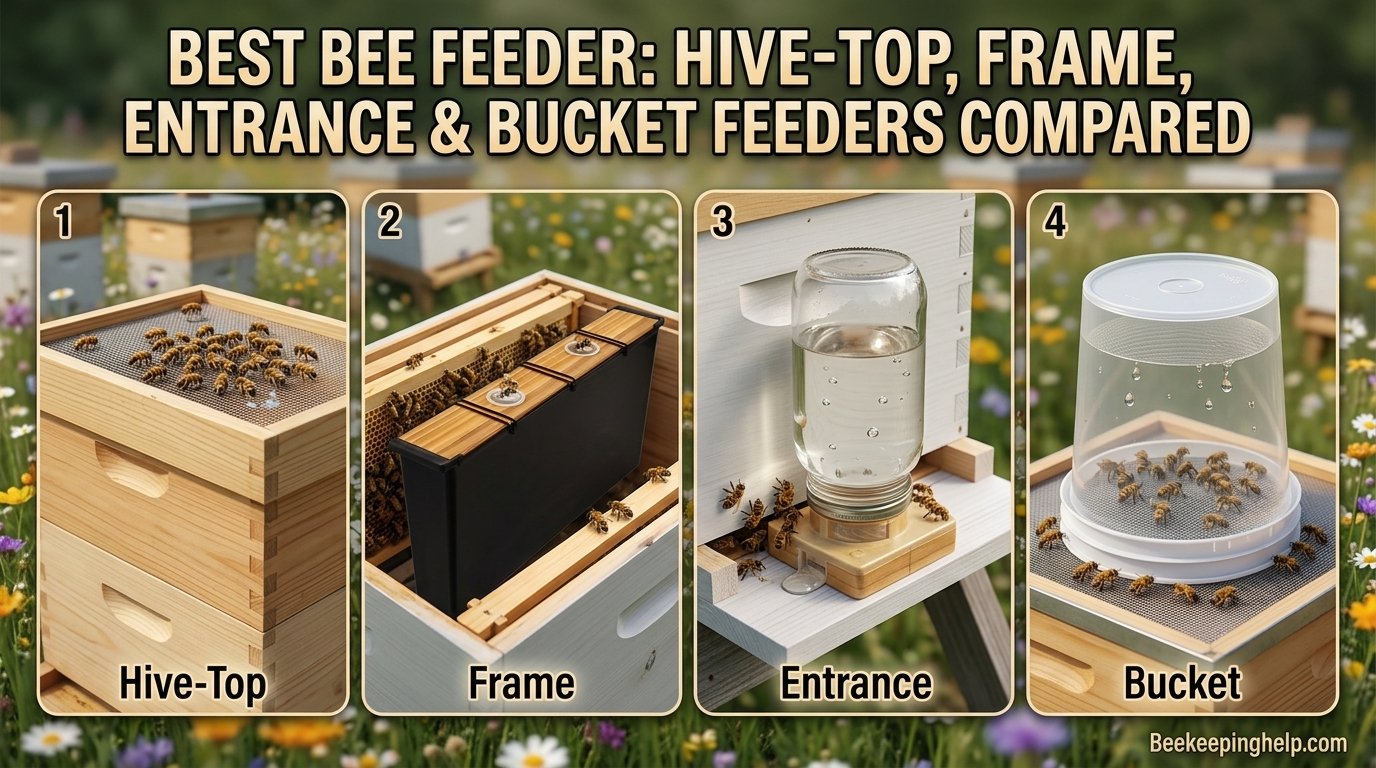
Best Bee Feeder: Hive-Top, Frame, Entrance & Bucket Feeders Compared
Seven feeders tested against the things that actually matter to a working apiary — capacity, drowning risk, robbing risk, cold-weather performance and how much you have to disturb the colony to keep syrup flowing.

Ask ten beekeepers which feeder is best and you will get ten answers, three arguments and at least one story about a hundred drowned bees floating in a mason jar. That is not because beekeepers are contrary. It is because the question is incomplete. A feeder is not judged on its own merits — it is judged against a season, a climate, a colony size and a keeper’s tolerance for lifting heavy things.
A four-gallon hive-top feeder is magnificent in September when you are pushing three colonies up to winter weight and you would rather refill once than five times. That same feeder is a liability in March on a weak nuc, where the syrup sits above the cluster, goes cold, and the bees will not break formation to reach it. A Boardman entrance feeder is the friendliest thing in the world for a brand-new beekeeper who wants to see the syrup level without opening anything — and it is also the single most reliable way to start a robbing frenzy during a dearth.
So this guide does something slightly different from a normal list. It reviews seven genuinely useful feeders in depth, but it also teaches you the framework underneath them: the five feeder families, the four failure modes (drowning, robbing, freezing, fermenting), and the seasonal logic that tells you which tool to reach for in which month. By the end you should be able to look at any feeder on any shelf and predict how it will behave in your apiary — which is a far more durable skill than memorizing one product name.
The 30-second version
- Best overall / biggest capacity: Mann Lake 10-Frame Hive Top Feeder — 4 gallons, refill without touching brood.
- Best for cold weather & weak colonies: BeeCastle Bee Pro Deep Frame Feeder — syrup lives inside the cluster’s warmth.
- Best for absolute beginners on a budget: Little Giant Boardman Entrance Feeder — cheap, visible, but dearth-sensitive.
- Best zero-contact refill: Rapid Round Bee Feeder — lift the cover, pour, done.
- Best value for a multi-hive apiary: HiveSweet 3.5L Division Board Feeders 4-pack.

1. Why Feeding Bees Is a Skill, Not a Chore
There is a romantic idea that a healthy colony never needs feeding, and that anyone reaching for a sugar bag has already failed. It is a tidy story and it is wrong. Wild colonies in hollow trees starve regularly; we simply never see the empty cavities. Managed colonies are asked to do unnatural things — draw a full box of foundation in six weeks, recover from a split, survive a wet June that grounds every forager — and feeding is the tool that bridges those gaps.
What feeding actually does is manipulate the colony’s read on its own environment. Bees do not calculate calories; they respond to flow. When syrup is arriving steadily, the colony behaves as if nectar is coming in: the queen lays harder, wax glands activate, foundation gets drawn, and the whole organism shifts into expansion mode. Cut the flow and they contract. That is the real lever you are pulling. You are not just preventing starvation — you are sending a season signal.
The four jobs feeding does
- Rescue. A colony with under two frames of stores in a cold snap is days from death. This is emergency feeding and it overrides every other consideration, including robbing risk.
- Stimulation. Thin syrup in early spring mimics a light nectar flow and pushes the queen to expand the brood nest ahead of the real flow, so you have foragers ready when the maples and dandelions open.
- Comb drawing. Bees will not build wax without a perceived surplus. A package on bare foundation without feed is a package that sits still. This is the single most common reason a first-year hive fails to establish.
- Winter provisioning. Heavy fall syrup gets cured and capped as stores. You are essentially letting the bees bank your sugar in a form they can use at 20°F.
Each of those jobs has a different ideal feeder. Rescue feeding in February wants the syrup pressed against the cluster — a frame feeder or fondant directly over the bees. Comb drawing in May wants volume and continuity, which is where a hive-top or bucket feeder shines. Stimulation in March wants small, frequent doses, which is exactly what an entrance feeder or a small round feeder delivers without accidentally plugging the brood nest with syrup.
The cost of getting it wrong
Overfeeding is a real and under-discussed failure. Pour four gallons into a strong colony during a spring flow and the bees will backfill the brood nest with syrup, leaving the queen nowhere to lay. The colony becomes honey-bound, reads the congestion as a signal to reproduce, and swarms — taking half your bees with it. Underfeeding is more obvious and more fatal, but overfeeding is the one that quietly ruins good colonies in April.
Then there is the contamination question. Syrup fed during a nectar flow can end up stored in supers you later harvest, which means your “wildflower honey” is partly sugar water. The rule is simple and absolute: feeders come off before supers go on. If you are running a hive-top feeder and a flow starts, pull the feeder, let them clean up the residue, then super.
Feeding is also a hive-management decision
Every feeder you install changes the architecture of the hive. A frame feeder removes a frame of comb. A hive-top feeder adds four inches of height and a substantial weight load. A bucket feeder demands an empty super to sit inside. If you do not yet have a clear mental model of how the boxes stack and what each part does, it is worth reading up on the parts of a beehive and their functions before you start rearranging things — a feeder installed in the wrong position will simply be ignored by the bees.
One more framing point. Bees do not forage inside their own hive. They rob. That distinction matters enormously for feeder design. Syrup placed inside the hive body is treated as stores and handled calmly. Syrup placed at or outside the entrance is treated as a found resource — and found resources trigger the recruitment behaviour that escalates into robbing. Almost every design decision in the feeders below traces back to that one biological fact.
2. The Five Feeder Families Explained
Before comparing individual products it helps to understand that there are really only five designs in commercial production, and every feeder you will ever see is a variation on one of them. Learn the families and the individual products become easy to evaluate.
Family 1: Hive-top feeders
A shallow tray the size of the hive footprint that sits directly on the top box, under the outer cover. Bees access syrup through a central slot or side channels, protected by screen or a cap. These are the volume champions — two to four gallons is typical — and the refill experience is excellent because you never open the brood chamber.
The trade-off is thermal. Heat rises, but syrup is a heat sink, and a large cold tray sitting above the cluster in March acts as a chilled ceiling. Bees will not leave the cluster to cross cold syrup. Hive-top feeders are therefore warm-weather tools: brilliant from late April through early October, questionable outside that window in cold climates.
Family 2: Frame feeders (division board feeders)
A hollow plastic reservoir shaped like a deep or medium frame, dropped into a frame slot in the brood box. Capacity runs roughly one to two gallons depending on width. Because the reservoir is surrounded by bees and comb, the syrup stays at hive temperature — which is why these are the go-to for early spring and late fall feeding in cold regions.
Two downsides. First, you lose comb space, which matters most in a single-box colony. Second, refilling means cracking the hive open, smoking the bees and lifting frames — not something you want to do weekly in poor weather. Drowning used to be the classic complaint; modern versions with textured walls and internal ladders have largely solved it, but cheap versions with smooth interiors still kill bees.
Family 3: Entrance (Boardman) feeders
An inverted jar sitting in a plastic tray that slides into the hive entrance. The jar’s perforated lid holds syrup by vacuum; bees feed from the tray. Cheap, simple, and the syrup level is visible from ten feet away without touching anything, which is why they ship with nearly every beginner starter kit.
They are also the most criticised design in beekeeping, for two solid reasons. The syrup sits at the entrance, effectively advertising a free resource to every scout bee in the neighbourhood — a robbing invitation during dearth. And being outside the thermal envelope, the syrup chills fast and can freeze solid on a cold night. Used correctly — strong flow periods, small volumes, established colonies, refilled at dusk — they are perfectly serviceable. Used carelessly in August, they can get a weak hive killed.
Family 4: Round / inner-cover feeders
A circular reservoir that sits over the inner cover hole, with a central cone or chimney the bees climb up through. They feed on the underside of a clear dome, visible and safe, with essentially zero drowning risk. Refilling requires only lifting the telescoping cover — no smoke, no disruption, no opening the brood nest. Capacity is modest, usually a quart or two, and you must surround the feeder with an empty box to protect it.
Family 5: Bucket / pail feeders
A food-grade pail with a fine mesh screen set into the lid, filled and inverted over the inner cover hole. Atmospheric pressure holds the syrup; bees draw from the screen. Large capacity, no drowning at all, fully sheltered from robbers, and cheap per gallon. The awkward part is the inversion — done slowly you get a puddle, done confidently you get a clean vacuum seal. Like round feeders, they need an empty super to enclose them.
| Family | Typical capacity | Drowning risk | Robbing risk | Cold weather | Refill disturbance |
|---|---|---|---|---|---|
| Hive-top | 1.5–4 gal | Low–Medium | Very low | Poor | Minimal |
| Frame / division board | 0.9–2 gal | Low (with ladder) | Very low | Excellent | High |
| Entrance (Boardman) | 1 qt | Very low | Very high | Very poor | None |
| Round / inner cover | 1–1.5 qt | Very low | Low | Fair | Minimal |
| Bucket / pail | 1–5 gal | None | Low | Fair | Low |
If you like building rather than buying, several of these designs — particularly the bucket and jar styles — are genuinely simple to make at home from food-grade containers and a fine drill bit. There is a full walkthrough in this guide to making a bee feeder, and for a multi-hive apiary the savings add up quickly.

3. Quick Comparison: All Seven Feeders Side by Side
Here is the whole field at a glance. Scan the table first, then read the individual reviews for the detail that actually determines whether a feeder suits your apiary — because capacity numbers hide a lot.
| Feeder | Type | Capacity | Best season | Refill without opening hive? | Best for |
|---|---|---|---|---|---|
| Mann Lake 10-Frame Hive Top | Hive-top | 4 gallons | Spring & fall (mild) | Yes | Heavy feeding, fewest refills |
| BeeCastle Bee Pro Deep Frame | Frame feeder | ~1.5 gallons | Cold weather | No | Weak colonies, early spring |
| Little Giant Boardman Entrance | Entrance | 1 quart | Strong flow only | Yes | New nucs, visible monitoring |
| KAGZ 1.5-Gallon Hive Top | Hive-top | 1.5 gallons | Spring & fall | Yes | Backyard hobbyists |
| HiveSweet 3.5L Division Board (4-pack) | Frame feeder | 0.9 gal each | Cold weather | No | Multi-hive value |
| Rapid Round Feeder | Round / inner cover | ~1.5 quarts | All temperate | Yes | Zero-contact refills |
| Little Giant 2-Gallon Bucket | Pail | 2 gallons | Spring & fall | Yes (lift cover) | Leak-free bulk feeding |
Risk profile comparison
Capacity is the headline number, but risk is what actually costs you colonies. This second table rates each feeder on the four failure modes.
| Feeder | Drowning | Robbing | Freezing | Mold / ferment | Weight when full |
|---|---|---|---|---|---|
| Mann Lake 4-gal Hive Top | Low (screens) | Very low | High | Medium | ~32 lbs |
| BeeCastle Deep Frame | Low (ladder) | Very low | Very low | Low | ~12 lbs |
| Boardman Entrance | Very low | Very high | Very high | Medium | ~2 lbs |
| KAGZ 1.5-gal Hive Top | Low (floats) | Very low | High | Medium-high | ~12 lbs |
| HiveSweet 3.5L Frame | Low (textured) | Very low | Very low | Low | ~8 lbs |
| Rapid Round | Very low | Low | Medium | Low | ~4 lbs |
| Little Giant Bucket | None | Low | Medium | Low | ~17 lbs |

4. The 7 Best Bee Feeders Reviewed in Depth
Each review below covers the specs, what the design does well, where it fails, and — most importantly — the specific scenario in which it is the right answer. No feeder here is bad. They are simply built for different problems.
Mann Lake 10-Frame Hive Top Feeder
- Capacity: 4 gallons
- Material: High-density polyethylene
- Safety: Integrated stainless steel screens
- Fit: 10-frame Langstroth hives
- Weight full: Approximately 32 lbs
This is the feeder you buy when refilling is the bottleneck. Four gallons of 2:1 syrup is roughly a third of everything a colony needs to reach winter weight, delivered in a single pour. For anyone running more than two or three hives — or anyone whose apiary is a twenty-minute drive away — that alone justifies the price.
The build is the part that separates it from generic hive-top trays. High-density polyethylene does not warp or craze the way thin injection-moulded plastic does after two summers in direct sun, and the stainless steel screens are a meaningful upgrade over the plastic or galvanised mesh you find on budget units. Galvanised mesh corrodes in acidic syrup and leaves a sediment; stainless does not. The screens do two jobs simultaneously: they keep bees out of the open reservoir, so drowning drops to near zero, and they keep the bees confined to the access channel so you can lift the outer cover and pour without a cloud of bees coming up at you.
In practice the workflow is genuinely pleasant. Crack the telescoping cover, slide it back, pour syrup into the reservoir at the end away from the access slot, replace the cover. The colony barely registers it. No smoke, no hive tool, no frames lifted, no brood chilled. Over a six-week fall feeding programme that difference compounds into hours saved and a noticeably calmer apiary.
Pros
- Massive syrup capacity dramatically reduces refill frequency during heavy spring and fall feeding
- Refills without opening the brood chamber — no smoke, no chilled brood
- Stainless steel screens keep bees from drowning and stay corrosion-free
- HDPE construction resists UV warping and cracking over multiple seasons
- Covers the entire hive footprint, adding insulation-like dead air above the cluster
Cons
- Extremely heavy when full at roughly 32 lbs — awkward to install pre-filled
- Requires a level hive stand or syrup pools to one side
- Needs an outer cover with enough clearance to sit properly
- Higher upfront cost than frame or entrance feeders
- Poor cold-weather performance — syrup chills above the cluster
The level-stand issue deserves emphasis. A hive-top feeder is a shallow tray, and a stand that leans even a couple of degrees will send the syrup to one end, leaving the access channel dry while there are still gallons in the reservoir. Bring a torpedo level the first time you set it. Tilting the whole hive very slightly forward for rain drainage is standard practice — with this feeder, keep that tilt minimal and make sure the side-to-side plane is dead flat.
On weight: never carry it full. Set the empty feeder on the hive, then fill it in place with a jug or a pump. Thirty-two pounds of liquid at chest height over an open hive is how feeders get dropped and colonies get drenched.
BeeCastle Bee Pro Deep Frame Feeder
- Type: Replaces one deep frame in the brood box
- Capacity: Approximately 1.5 gallons
- Safety: Textured internal ladder and cap system
- Material: Food-grade plastic
- Weight full: Approximately 12 lbs
If you keep bees somewhere with a real winter, this is the feeder that earns its keep. Sitting inside the brood box, the syrup is surrounded by bees and held at cluster temperature, so the colony will take feed on days when a hive-top tray would be a cold slab they refuse to cross.
The physics matter here. A cluster maintains its core around 90°F when brood is present, and bees will not break cluster to travel across a cold gap. Syrup at 40°F is not just unappealing — consuming it costs the colony energy to warm the liquid to body temperature, which in a starving hive can be a net negative. A frame feeder side-loaded next to the cluster removes that barrier entirely. The bees expand a few inches sideways into warm air, drink, and return. This is why experienced keepers in northern climates reach for frame feeders in March and October while their hive-top feeders sit in the shed.
The second advantage is invisibility. Because the syrup is fully enclosed within the hive body, there is no scent plume at the entrance and nothing for scout bees from neighbouring colonies to find. During a late-summer dearth, when robbing pressure is at its peak and an entrance feeder can get a weak colony torn apart in an afternoon, a frame feeder is effectively robbing-proof. That combination — warm and hidden — makes it the correct choice for nucs, recent splits, requeened colonies and anything else that is currently fragile.
The internal ladder system is the make-or-break feature on any frame feeder, and BeeCastle’s textured wall plus cap arrangement works. Bees walk down the rough surface, drink at the meniscus, and walk back up. The failure mode on cheap smooth-walled frame feeders is brutal: a bee that slips onto the surface cannot get purchase on wet plastic, and the resulting casualty count can run into hundreds per refill. Textured walls solve it almost completely.
Pros
- Syrup remains inside the cluster’s thermal envelope, staying warm in cool weather
- Virtually eliminates robbing — no external scent or access point
- Internal ladders and textured walls prevent bee drowning
- Food-grade plastic is easy to scrub and sanitise between seasons
- Adds no height to the hive stack and no wind load
Cons
- Takes up comb space in the brood box — a real cost in a single-box colony
- Requires opening the hive to check levels and refill
- Refilling in cold weather chills the brood nest, so timing matters
- Capacity is modest compared with hive-top or bucket feeders
Managing the comb-space cost. In a ten-frame deep you are running nine frames plus the feeder, which is fine for an established colony but tight for a package trying to build up. The usual workaround is to run the feeder in the outermost slot where the bees would draw comb last anyway, and to remove it the moment the flow starts so they can fill that position properly. In a double-deep setup the cost is negligible.
On refill timing: open the hive on the warmest part of the warmest day available, work fast, and pre-warm the syrup to lukewarm. Pouring 40°F syrup into a frame feeder in March partially defeats the purpose. A jug left in a sunny window for an hour is enough.
Little Giant Boardman Entrance Feeder

- Base: High-impact plastic tray
- Lid: Perforated metal
- Jar: Fits standard 1-quart glass Mason jars
- Mounting: Front hive entrance notch
- Capacity: 1 quart
The most misunderstood feeder in beekeeping. It is neither the beginner-friendly miracle the starter kits imply nor the disaster the forums claim. It is a small, cheap, highly visible feeder with one very specific weakness, and if you respect that weakness it works fine.
Start with what it does well. For a brand-new beekeeper, the psychological value of being able to walk past the hive and see exactly how much syrup remains is enormous. New keepers open hives too often, mostly out of anxiety, and every unnecessary inspection costs the colony heat and comb repair. A Boardman feeder answers the “are they eating?” question from a distance, which paradoxically makes it a colony-welfare feature. Swapping a jar takes ten seconds and requires no protective gear.
It is also excellent for a freshly installed nuc or package during a decent flow. The colony is small, its consumption is modest, a quart at a time is plenty, and a new colony is right at the entrance anyway. The high-impact plastic tray on this Little Giant unit is noticeably sturdier than the brittle white trays that come free with starter kits — those crack the first time you knock them with a hive tool.
The cold-weather limitation is equally real. A quart jar hanging in open air outside the hive’s thermal envelope will drop to ambient temperature within an hour and can freeze overnight in shoulder-season weather. Frozen syrup expands, which can crack a glass jar; more often it simply means the bees have no accessible feed on exactly the cold morning they need it most. Entrance feeders are warm-weather tools.
Pros
- Lowest cost of any feeder here and the simplest possible setup
- External jar makes checking the syrup level effortless — no suit, no smoke
- Ideal for new nucs, packages and spring starter colonies
- Uses standard Mason jars you likely already own
- Adds no height, no weight and no internal hive space cost
Cons
- High risk of triggering robbing during nectar dearths
- Vulnerable to freezing during cold snaps — syrup becomes inaccessible
- Small 1-quart capacity requires frequent refills
- Syrup in direct sun can ferment faster than in-hive feeders
- Not suitable for heavy fall provisioning
Two habits that make it safer. First, refill at dusk rather than midday — foraging and scouting activity drops sharply at sunset, so the new syrup scent disperses overnight rather than broadcasting at peak traffic. Second, pair it with a reduced entrance. A colony defending a two-inch gap can repel robbers; a colony defending a fifteen-inch opening cannot. Most robbing disasters attributed to entrance feeders are really entrance-reducer failures.
KAGZ 1.5-Gallon Hive Top Feeder

- Capacity: 1.5 gallons (~6 L)
- Access: Transparent central cone
- Safety: Anti-drowning sponge float rings
- Fit: 10-frame Langstroth hives
- Weight full: Approximately 12 lbs
The hive-top feeder scaled down to a size one person can comfortably manage. A gallon and a half is enough to run a colony for the better part of a week in most feeding situations, while keeping the full weight at a manageable twelve pounds instead of thirty-two.
The transparent access cone is the standout feature and it changes the experience more than the spec sheet suggests. Lift the outer cover and you can see bees working the syrup through clear plastic without exposing them or yourself. For a hobbyist with two or three hives, that visual confirmation — are they taking it, how fast, is the level dropping — replaces a lot of guesswork. It is also, frankly, delightful to watch, and enjoyment is a legitimate reason to keep bees.
Capacity is well judged for the backyard case. Four gallons is overkill for a single hive and increases the chance syrup sits long enough to ferment; 1.5 gallons turns over fast enough to stay fresh while still cutting refill trips to roughly one or two a week during active feeding. Refills happen without touching frames, so the colony’s routine is undisturbed.
Two maintenance notes keep this feeder in good shape. The sponge float rings that prevent drowning are effective but they are porous, and porous material plus sugar plus warmth equals mold if left unattended. Rinse them thoroughly whenever you empty the feeder, and let them dry completely before storage. Second, the plastic is thinner than the Mann Lake’s HDPE. Left out in full summer sun without the protection of an outer cover, it can warp enough to affect the seal. Store it in the shade and always keep it enclosed under the telescoping cover.
Pros
- Moderate capacity well suited to backyard hobbyists — no wasted or stale syrup
- Refillable without disturbing brood frames
- Clear dome allows a direct visual check on feeding bees
- Twelve pounds full is manageable for one person
- Float rings meaningfully reduce drowning losses
Cons
- Float rings require periodic cleaning to avoid mold buildup
- Plastic can warp if left exposed to hot sunlight without enclosure
- Same cold-weather limitation as all hive-top designs
- Needs a level stand for even syrup distribution
HiveSweet 3.5L Division Board Frame Feeders (4-Pack)

- Capacity: 3.5 L (~0.9 gallon) per feeder
- Interior: Textured walls for bee grip
- Material: Food-grade polyethylene
- Fit: Replaces one standard deep frame
- Quantity: 4 feeders per pack
Four frame feeders in one purchase, at a per-unit cost that makes equipping an apiary genuinely affordable. If you run four or more colonies and want every one of them on an in-hive feeder for spring build-up, this is the economical way to do it.
The design follows the standard division board template and does the important things right. Textured interior walls give bees reliable footing all the way down to the syrup surface, which is the difference between a feeder that costs you a handful of bees per season and one that costs you hundreds. Food-grade polyethylene is chemically stable against acidic syrup and scrubs clean without retaining odours.
At 3.5 litres per feeder the capacity is modest — roughly a gallon short of what a Mann Lake hive-top holds — and that is the honest trade. In practice it means more frequent top-offs, and because these are in-hive feeders, each top-off requires opening the box. For a keeper doing weekly spring inspections anyway, that is zero extra work; you are already in the hive, so you top off while you are there. For someone who inspects monthly it is a genuine burden.
Where the multi-pack really earns its place is early spring across several colonies. Every hive gets a warm, robbing-proof feed source, inspections and refills happen on the same visit, and consumption differences between colonies give you a useful diagnostic — the hive that stops taking syrup while its neighbours drain theirs is telling you something worth investigating. If you are still assembling your equipment list, it is worth cross-referencing against a good rundown of beekeeping hives so your feeders and boxes match dimensionally from day one.
Pros
- Excellent value multi-pack for apiaries running several hives
- Protected inside the hive body, away from robbers and pests
- Textured walls give bees secure grip and reduce drowning
- Keeps syrup at cluster temperature for cold-weather feeding
- Uniform equipment across hives simplifies comparison and management
Cons
- Smaller capacity per hive requires more frequent top-offs
- Must disrupt the hive to refill
- Occupies a frame slot in each brood box
- Four units means four items to clean and store each season
Rapid Round Bee Feeder
- Capacity: Approximately 1.5 quarts
- Access: Clear central cone cover
- Placement: Directly on the inner cover hole
- Requires: Empty super to enclose
- Weight full: Approximately 4 lbs
The most pleasant feeder to live with. Bees climb up through the central cone, feed on the underside of the clear dome where they cannot fall in, and never come into contact with you during a refill. Lift the cover, pour, replace. Thirty seconds, no gloves.
The cone geometry is genuinely clever. Bees ascend the chimney, emerge under a transparent dome, and feed from the syrup’s edge while standing on dry plastic. There is no open liquid surface a bee can fall onto, so drowning is effectively eliminated by design rather than by an add-on float or screen. The dome also means you can watch the feeding process — useful for gauging whether the colony is actually taking syrup or ignoring it in favour of a natural flow.
Because it sits over the inner cover hole inside an enclosed super, the robbing risk is low and the syrup stays within the hive’s warm-air column, giving it better cold tolerance than a hive-top tray though not matching a frame feeder. Refilling does not open the brood nest at all, so there is no chilling and no comb disruption.
The limitations are capacity and the empty-box requirement. A quart and a half will run out every two to three days during peak feeding, which rules it out as a primary fall provisioning feeder. And you must keep an empty medium or deep on top of the hive to enclose it, which means an extra box per hive in your inventory, extra height, and slightly more wind exposure. For a hobbyist who already has spare boxes, that is nothing. For someone with exactly the equipment they need, it is a real added cost.
Pros
- Refillable with zero bee contact — lift the telescoping cover and pour
- Clear cone design structurally prevents bees from drowning
- Low robbing risk thanks to fully enclosed placement
- Lightweight and easy to handle even when full
- Excellent visibility of feeding activity
Cons
- Small capacity requires refills every two to three days during peak feeding
- Requires an empty medium or deep box on top to enclose it
- Not practical as a sole feeder for heavy fall provisioning
- Adds height to the stack, increasing wind exposure
Little Giant 2-Gallon Bucket Bee Feeder
- Capacity: 2 gallons
- Build: Food-grade plastic pail, rubber gasket lid
- Screen: Fine central stainless steel mesh
- Setup: Inverted over the inner cover hole
- Weight full: Approximately 17 lbs
The design beekeepers have trusted for a century, executed properly. A sealed pail inverted over the inner cover hole holds two gallons by vacuum and releases syrup only as fast as the bees draw it through a fine stainless screen. No open liquid, no drowning, nothing to float.
The rubber gasket is what separates a good pail feeder from a frustrating one. The vacuum seal depends entirely on the lid being genuinely airtight; a marginal seal leaks syrup steadily into the hive, soaking the top bars, sparking robbing and generally making a mess. Little Giant’s gasketed lid holds the seal reliably, and the stainless mesh will not corrode in acidic syrup the way plated screens do.
Two gallons is the sweet spot for fall feeding on a single hive: substantial enough that refills stay infrequent, light enough at seventeen pounds that one person can manage the inversion. And because the pail sits inside an empty super under the outer cover, the syrup is completely sheltered from robbers and rain.
The only genuine drawbacks are weight and the empty-box requirement, both shared with the round feeder family. Seventeen pounds is fine at waist height and awkward at chest height, so keep your hive stands low if you plan to use pail feeders routinely. And as with the Rapid Round, you need a spare medium or deep to enclose it.
Pros
- Vacuum-seal design prevents leaking when properly seated
- Large 2-gallon reservoir suits serious fall provisioning
- Completely sheltered inside an empty super, away from robbing bees
- Zero drowning risk — bees never contact open liquid
- Stainless mesh resists corrosion and clogging
Cons
- Heavy when full at roughly 17 lbs
- Requires a quick, confident inversion technique to set the vacuum without dripping
- Needs an empty hive body to cover it
- Level of remaining syrup is not visible without lifting the pail
5. How to Choose the Right Bee Feeder for Your Apiary
Instead of asking which feeder is best, ask five questions about your own situation. The answers will point at one or two designs and eliminate the rest.
Question 1: What is your climate doing when you feed most?
If your heaviest feeding happens in mild weather — a spring flow in a temperate region, or an early-autumn build-up while daytime highs are still in the sixties — hive-top and bucket feeders are ideal. If your critical feeding window falls in genuinely cold weather, frame feeders and fondant are the only designs that reliably work. Northern keepers who buy one feeder almost always buy the wrong one first, because the online consensus is written largely by people in mild climates.
Question 2: How many hives, and how far away?
One hive in the garden: capacity barely matters, so optimise for ease and enjoyment — the Rapid Round or KAGZ. Four hives: standardise on frame feeders bought in a multi-pack, or hive-tops if your climate allows. Ten or more, or an out-apiary: capacity is everything, because each trip has a fixed cost in time and fuel. Four-gallon hive-tops or two-gallon pails pay for themselves quickly.
Question 3: How strong are the colonies you are feeding?
Strong colonies can handle any feeder. Weak colonies — nucs, late splits, colonies recovering from queen failure — need in-hive feeding, without exception. A weak colony cannot defend an entrance feeder, cannot cross a cold hive-top tray, and cannot afford the disruption of a badly timed inspection. Frame feeder, warm syrup, minimal opening.
Question 4: How much lifting are you comfortable with?
This is not a trivial question. A full four-gallon hive-top feeder weighs about as much as a full deep super. If you have any back issues, or you work your hives alone, choose a feeder you can handle full or commit to a fill-in-place workflow with a jug. There is no prize for the biggest reservoir if you end up dropping it.
Question 5: Are you in or near a dearth?
During a dearth, any feeder with an external or entrance-adjacent access point is a liability. Move everything inside the hive, reduce entrances, and feed at dusk. During a strong flow, robbing pressure is low and you can use whatever is convenient — though during a genuine flow you probably should not be feeding at all.
| Your situation | Recommended feeder | Why |
|---|---|---|
| First-year beekeeper, one hive, mild spring | Boardman entrance or KAGZ hive-top | Simple, visible, low commitment |
| Cold climate, early spring build-up | BeeCastle deep frame feeder | Syrup stays at cluster temperature |
| Heavy fall provisioning, 3+ hives | Mann Lake 4-gal hive-top | Fewest refill trips |
| Growing apiary, 4–8 hives | HiveSweet 4-pack frame feeders | Best cost per hive, robbing-proof |
| Nectar dearth, robbing pressure high | Any in-hive feeder + entrance reducer | No external scent trail |
| Want minimum disturbance | Rapid Round or Little Giant pail | Refill without opening brood nest |
| Medication or supplement delivery | Rapid Round | Small, precise, fast-consumed doses |
One final consideration that people forget: hive type. Everything reviewed here assumes a Langstroth. Top-bar and Warré hives need entirely different approaches — usually a jar or a division board sized to the specific hive. If you are still deciding on equipment, this comparison of Flow Hive and Langstroth systems and this illustrated guide to beehive types will help you understand which feeders will and will not fit your setup.
6. Sugar Syrup Ratios, Recipes and What Not to Add
The feeder is the delivery system; the syrup is the product. Getting the ratio wrong wastes both.
1:1 syrup — the spring ratio
Equal parts white granulated sugar and water by weight (close enough by volume for practical purposes). At roughly 50% sugar, this approximates a light natural nectar. It stimulates brood rearing and wax production, and because it is thin, the bees process and consume it quickly rather than storing it. Use it for spring build-up, package installation, comb drawing, and any time you want to trigger expansion.
To mix: heat water until hot but not boiling, remove from heat, stir in sugar until fully dissolved and the liquid runs clear. Do not boil sugar — caramelisation produces compounds that are toxic to bees.
2:1 syrup — the fall ratio
Two parts sugar to one part water by weight. At roughly 67% sugar, it is close to ripened honey in density, which means the bees expend far less energy evaporating water before capping it. This is winter provisioning syrup. Feed it from late summer through early autumn while temperatures still allow the bees to cure and cap it — syrup fed too late sits uncapped and can ferment.
2:1 needs hot water to dissolve fully and will crystallise if the water cools too fast or the sugar is not completely dissolved. Stir until the solution is perfectly clear, then let it cool to lukewarm before pouring.
| Ratio | Sugar % | Season | Purpose | Bee behaviour triggered |
|---|---|---|---|---|
| 1:1 | ~50% | Spring / early summer | Stimulation, comb drawing | Brood expansion, wax production |
| 2:1 | ~67% | Late summer / fall | Winter store building | Rapid capping and storage |
| 1:2 (very thin) | ~33% | Emergency spring | Water + light energy | Consumed immediately, not stored |
| Fondant / candy | ~90%+ | Deep winter | Emergency rescue | Direct consumption at cluster |
What to use
- Plain white granulated cane or beet sugar. That is it. Pure sucrose, no additives, no colour.
- Clean water. Tap water is fine in most areas; heavily chlorinated water is better left to stand overnight.
- Optional: a small amount of commercial feeding stimulant or essential oil blend (lemongrass and spearmint are common), or a splash of apple cider vinegar to lower pH and slow mold growth.
What never to use
- Brown sugar, raw sugar, molasses, turbinado — the impurities and ash content cause dysentery.
- Honey from an unknown source — the single fastest way to introduce American foulbrood spores into your apiary.
- High-fructose corn syrup that has been heated or stored warm — degrades into hydroxymethylfurfural (HMF), which is toxic to bees.
- Artificial sweeteners, powdered sugar with cornstarch, fruit juices — no nutritional value, and the additives cause digestive problems.
- Boiled or caramelised sugar — heat-degradation compounds are harmful.
For a more complete treatment of bee nutrition — including protein sources, when pollen substitute actually helps, and the seasonal logic behind each feed type — see this detailed guide on what to feed a bee.
Batch sizing and storage
Mix only what you will use within about a week in warm weather, or two weeks refrigerated. Syrup ferments, and fermented syrup gives bees dysentery. If you are feeding several hives, mixing a five-gallon batch is efficient — just add a mold inhibitor and keep it out of the sun. A visible film, sour smell or cloudiness means dump it.
7. A Season-by-Season Feeding Calendar
Feeding is a calendar activity. Here is the rhythm most temperate-climate apiaries follow, with the feeder that fits each window.
Late winter into early spring
The highest-risk period of the year. Colonies have been consuming stores for months, brood rearing has restarted (which massively increases consumption), and there is no forage yet. Starvation losses peak here — often in colonies that looked fine in December.
Feeder: Fondant or candy board directly over the cluster if it is genuinely cold; a frame feeder with pre-warmed syrup once daytime temperatures allow brief openings. Do not install a hive-top feeder yet.
Check: Heft the back of the hive. A colony that lifts easily is in trouble. This takes two seconds and tells you more than an inspection.
Mid spring
Build-up season. The goal is a colony at peak foraging strength when the main flow opens. Light 1:1 syrup, fed steadily, keeps the queen laying hard and gets foundation drawn.
Feeder: Frame feeder or small hive-top. Keep doses modest to avoid backfilling the brood nest.
Watch for: Swarm preparation. A well-fed colony in April is a colony thinking about swarming. Give them space before they need it.
Late spring and early summer — the main flow
Feeder: None. Remove feeders entirely before supering. Any syrup stored now ends up in your harvest.
The exception is a package installed on bare foundation, which should keep feeding until the majority of frames are drawn regardless of what is blooming.
Midsummer dearth
In many regions there is a hot, dry gap between the spring flow and the fall flow. Colonies are at maximum population with minimum income, and robbing pressure peaks.
Feeder: In-hive only. Frame feeder or enclosed pail. Reduce entrances. Feed at dusk. Absolutely no entrance feeders.
Late summer into autumn
The most consequential feeding of the year. The colony needs to reach winter weight — typically sixty to ninety pounds of stores depending on climate — and it needs enough warm days remaining to cure and cap the syrup.
Feeder: Maximum capacity. Mann Lake hive-top or the Little Giant pail. Feed 2:1 continuously until they stop taking it or you hit target weight.
Late autumn into winter
Liquid feeding becomes counterproductive — too cold to cure, and added moisture in a winter hive causes condensation problems that kill more colonies than cold does.
Feeder: Switch to solid. Fondant, candy board, or dry sugar on newspaper over the top bars. Pull, clean and store liquid feeders.
| Season | Feed type | Best feeder | Main risk |
|---|---|---|---|
| Late winter | Fondant / candy | Candy board over cluster | Starvation |
| Early spring | 1:1 syrup, warmed | Frame feeder | Chilled brood |
| Mid spring | 1:1 syrup | Frame or small hive-top | Swarming, backfilling |
| Main flow | None | Remove all feeders | Contaminated honey |
| Summer dearth | 1:1 if needed | In-hive only | Robbing |
| Autumn | 2:1 syrup | Large hive-top or pail | Feeding too late to cure |
| Winter | Dry sugar / fondant | Solid feed over bars | Condensation, moisture |
Your inspection routine drives all of this, and inspections mean smoke. If your smoker work is inconsistent, a reliable smoker plus the right fuel makes refill visits dramatically calmer for both you and the colony.
8. Robbing: How Feeders Cause It and How to Stop It
Robbing is the failure mode that turns a feeding programme into a disaster. It is worth understanding properly, because the difference between a safe feeding session and a catastrophic one usually comes down to two or three small decisions.
What robbing actually is
During a dearth, foragers with nothing to collect begin probing neighbouring hives for weakness. A scout that gets in and out with a load of honey returns and recruits. Within an hour a few dozen visitors can become thousands. The target colony’s guards are overwhelmed, the invaders tear open capped cells, and a weak hive can be stripped bare and its queen killed in a single afternoon. Robbing also spreads disease and mites between colonies at high speed.
Signs robbing has started
- Bees fighting on the landing board, wrestling in pairs and falling
- A hovering, zigzagging flight pattern in front of the hive rather than direct arrivals
- Bees probing cracks and seams rather than using the entrance
- Wax cappings and debris scattered on the ground below the entrance
- An unusual buzzing intensity and dead bees accumulating in front
How feeders contribute
Any syrup accessible from outside the hive — an entrance feeder, a leaking pail, a hive-top feeder with a badly fitting cover, spilled syrup on the hive body — advertises free calories to the entire neighbourhood. The scent travels, scouts arrive, and the colony is now defending against traffic it did not invite. This is why every experienced keeper moves to in-hive feeding during a dearth.
- Feed inside the hive during any dearth — frame feeder, enclosed pail or round feeder only.
- Reduce entrances on every colony, especially weak ones. A small entrance is defensible.
- Never spill syrup on or around the hive. Wipe up immediately if you do.
- Refill at dusk, when foraging and scouting have stopped.
- Work quickly and keep hives closed as briefly as possible during dearth.
- Never leave burr comb, scrapings or wet supers exposed in the apiary.
- Feed all colonies in the yard at once, not one at a time — uneven feeding creates targets.
Stopping robbing in progress
Act immediately; robbing escalates. Reduce the entrance to a single bee-width or close it entirely with screen for a day. Drape a wet sheet over the hive — robbers will not push through damp fabric, but resident bees find their way in and out along the ground. Remove any external feed source instantly. A robbing screen, which relocates the apparent entrance so robbers cannot find the real one, is the most reliable permanent fix for a chronically targeted colony.
Wasps and hornets are a related problem at the same time of year, and they are considerably more dangerous to you personally than honey bees are. If you are working hives during a dearth in wasp country, it is worth knowing whether your bee suit actually protects against wasps before you find out the hard way.
9. Drowning Prevention and Bee Safety in Feeders
A feeder that kills a hundred bees per refill is running a slow, invisible tax on your colony. Over a six-week feeding programme that is thousands of bees — enough to measurably slow build-up.
Why bees drown
A bee that lands on a liquid surface has to break the surface tension holding her down and get purchase on something to climb out. Wet vertical plastic gives no grip at all. Sugar syrup is also more viscous than water, so it coats wings and legs and makes flight impossible. Once a few bees are struggling, others land to investigate, and the loss compounds.
How each design addresses it
| Design | Anti-drowning mechanism | Effectiveness | Maintenance needed |
|---|---|---|---|
| Hive-top with screen | Stainless mesh over the reservoir | High | Check mesh for gaps |
| Hive-top with floats | Sponge or foam float rings | High | Rinse and dry regularly |
| Frame feeder | Textured walls and internal ladder | High | Scrub texture clean |
| Boardman jar | Vacuum — no open surface | Very high | Check lid perforations |
| Round cone | Geometry — bees feed from dry footing | Very high | Keep cone clear |
| Pail feeder | Vacuum + mesh — no open surface | Complete | Check gasket seal |
Retrofits for feeders that drown bees
- Floating material: Clean wine corks, thin untreated wood strips, or a handful of straw floated on the surface give bees something to stand on. Cheap and surprisingly effective.
- Hardware cloth ladder: A strip of 1/8-inch mesh bent to sit against the inner wall and reach below the syrup line converts a smooth-walled frame feeder into a safe one for the price of a scrap offcut.
- Silicone caulk beads: Vertical lines of cured caulk on smooth interior walls create permanent grip texture.
- Reduce fill depth: Shallower syrup means a shorter climb. Refill more often rather than filling to the brim.
Other feeder hazards
Fermentation. Syrup left too long grows yeast and turns sour. Fermented syrup causes dysentery, which in winter is often fatal. Empty and rinse feeders that have sat unused, and do not leave partial loads in a feeder for weeks.
Mold. Especially on sponge floats and textured surfaces. Mold spores in feed stress the colony’s immune response. Wash and fully dry every component between uses.
Chilled brood. Opening a hive to refill on a cold day can kill the outer edges of the brood nest. This is the hidden cost of frame feeders and the main argument for keeping a no-open feeder available in shoulder seasons.
Ants and pests. Sweet liquid attracts ants, wasps and small hive beetles. Hive stand legs standing in shallow oil or water trays solve ant problems permanently. If you want to understand how the internal hive environment reacts to added moisture and heat sources, this explanation of how a beehive works is worth reading.
10. Beyond Syrup: Pollen Substitute, Fondant and Dry Sugar
Syrup supplies carbohydrate. It supplies no protein whatsoever, and protein is what raises brood. A colony with plenty of syrup and no pollen will stop laying.
Pollen and pollen substitute
Nurse bees convert pollen into brood food. Each larva consumes a meaningful quantity of protein during development, so a colony expanding rapidly in spring has a substantial protein demand. In regions with a late spring or a poor pollen environment, supplementing makes a real difference to build-up speed.
Substitute comes in two forms. Patties — soy, brewer’s yeast or specialised protein blends mixed with sugar — are placed directly on the top bars where nurse bees can reach them. Dry powder is offered in an open feeder away from the hive and collected like natural pollen; this only works in dry weather and when natural pollen is genuinely scarce, since bees strongly prefer the real thing.
Fondant and candy boards
Solid sugar feed for cold weather, when liquid is unusable. Fondant is soft sugar paste placed directly over the cluster; a candy board is a rigid slab of hardened sugar set in a shallow frame that sits under the outer cover. Both work because bees can access them without leaving the cluster’s warmth, and because they add no moisture to a winter hive.
The candy board has a second function that is easy to overlook: the sugar slab absorbs condensation rising from the cluster, reducing the risk of cold water dripping onto the bees. Since winter condensation kills more colonies than cold itself, that is a meaningful bonus.
The mountain camp method
The simplest emergency winter feed there is. Lay a sheet of newspaper over the top bars, pour several pounds of dry granulated sugar on it, mist lightly with water to crust the surface, and close up with a shim for space. Bees consume the sugar as needed and the dry sugar absorbs excess humidity. It costs almost nothing, takes ninety seconds, and has saved an enormous number of colonies in February.
| Feed type | Provides | Season | Delivery |
|---|---|---|---|
| 1:1 syrup | Light carbohydrate | Spring | Any liquid feeder |
| 2:1 syrup | Dense carbohydrate | Autumn | Large-capacity feeder |
| Pollen patty | Protein, lipids, vitamins | Late winter / spring | On top bars |
| Dry pollen sub | Protein | Spring | Open feeder in apiary |
| Fondant | Carbohydrate | Winter | Over cluster |
| Candy board | Carbohydrate + moisture control | Winter | Under outer cover |
| Dry sugar | Emergency carbohydrate | Deep winter | Newspaper on top bars |
11. Cleaning, Mold Control, Storage and Longevity
Feeders are the dirtiest equipment in the apiary. They hold sugar, they sit in warmth, and they get ignored for months. A neglected feeder is a disease vector.
Routine cleaning between refills
Any time a feeder empties during the season, rinse it before refilling. Sugar residue at the bottom is where fermentation starts, and adding fresh syrup on top of a sour film contaminates the whole batch. Plain hot water and a brush is enough for a mid-season rinse.
End-of-season deep clean
- Scrape propolis and burr comb with a hive tool. Bees propolise everything, and frame feeders in particular come out heavily glued.
- Soak in hot water with a small amount of washing soda to cut sugar film and propolis residue.
- Scrub every surface, paying particular attention to textured walls, ladder channels and float rings where residue hides.
- Sanitise with a dilute bleach solution — roughly one part household bleach to nine parts water — left for ten to fifteen minutes.
- Rinse thoroughly. Several changes of clean water. Bleach residue is harmful to bees.
- Dry completely in sun and air. Sunlight is a free and effective sanitiser, and complete dryness is the single best mold preventative.
Mold prevention during the season
- Do not fill a feeder with more syrup than the colony will consume in roughly a week
- Add a small splash of apple cider vinegar to each batch to lower pH
- Keep feeders shaded — under the outer cover, never in direct sun
- Remove and rinse sponge floats and any porous component after every emptying
- Never top up a partially used feeder without checking and smelling the old syrup first
Storage
Store bone dry, out of sunlight, in a sealed tub or closed shed. UV degrades polyethylene and polypropylene over time, making plastic brittle and prone to cracking. Stacking frame feeders nested saves space but keep a sheet of paper between them so any residual moisture cannot pool. Mice will chew plastic feeders for nesting material, so sealed storage matters.
Expected lifespan
| Feeder type | Typical lifespan | Main failure mode | Extending it |
|---|---|---|---|
| HDPE hive-top | 8–15 years | UV embrittlement | Always keep under an outer cover |
| Thin-plastic hive-top | 3–6 years | Warping, cracking | Shade storage, never sun exposure |
| Frame feeder | 5–10 years | Cracking at stress points | Gentle prying, no forcing |
| Boardman tray | 3–8 years | Tray cracking, lid rust | Replace lids as they corrode |
| Round feeder | 5–10 years | Cone clouding or cracking | Avoid hot-water shock |
| Bucket feeder | 5–12 years | Gasket hardening | Replace gasket when the seal fails |
Feeder maintenance sits alongside the rest of your equipment care — the suit, the smoker, the boxes. If you are building a full maintenance routine, washing your bee suit correctly and painting your hive bodies properly are the other two jobs worth doing well.
12. Twelve Feeding Mistakes That Cost Beekeepers Colonies
Most feeding failures are not exotic. They are the same dozen errors, repeated across apiaries every year.
1. Feeding during a strong nectar flow
Wastes sugar, backfills the brood nest, and risks sugar ending up in harvestable honey. If the bees are bringing in nectar, stop feeding.
2. Using an entrance feeder during a dearth
The classic beginner mistake, and the one most likely to actually kill a colony. In-hive feeding only when forage is scarce.
3. Feeding the wrong ratio for the season
Thin syrup in autumn means the bees cannot cure it before cold weather; thick syrup in early spring is harder for them to process when they need stimulation rather than storage.
4. Boiling the syrup
Heat degrades sucrose into compounds that are toxic to bees. Hot water, off the heat, stirred until clear. Never a rolling boil.
5. Feeding honey from an unknown source
Store-bought or gifted honey can carry American foulbrood spores that survive indefinitely. This can contaminate equipment permanently. Never do it.
6. Leaving syrup in a feeder for weeks
Fermented syrup causes dysentery. Fill for about a week’s consumption, no more.
7. Ignoring the level stand
A tilted hive-top feeder strands syrup at one end while the access channel runs dry. The bees starve with gallons three inches away.
8. Opening the hive to refill on a cold day
Chilled brood is dead brood. In cold weather, use a feeder that refills without opening the brood chamber, or wait for a warm window.
9. Spilling syrup around the hive
Spilled syrup is a robbing invitation and an ant magnet. Wipe up every drip immediately.
10. Feeding only the weak colony
Feeding one hive in a yard of five makes it the only scented target. Feed the whole apiary or feed strictly inside the hive.
11. Forgetting to pull feeders before supering
Leaving a feeder on under supers means sugar syrup gets stored in honey frames. Feeder off, let them clean up, then super.
12. Assuming a heavy hive in autumn is safe
Weight in October tells you little about February. Brood rearing restarts in midwinter and consumption spikes. Heft your hives through late winter and keep fondant on hand.
Frequently Asked Questions About Bee Feeders
What is the best type of bee feeder for beginners?
How much syrup does one colony actually need?
Can I leave a feeder on the hive all year?
Why are my bees ignoring the feeder?
Will feeding sugar syrup contaminate my honey?
How do I stop bees drowning in the feeder?
Is it too late in the year to feed syrup?
Can I use the same feeder on different hives?
What is the difference between 1:1 and 2:1 syrup?
Do I need a feeder if my hive already has plenty of honey?
How often should I refill a bee feeder?
Can I make my own bee feeder instead of buying one?
Final Verdict: Which Bee Feeder Should You Buy?
If you take one idea away from all of this, make it this one: the best bee feeder is the one matched to the season, the climate and the strength of the colony in front of you. The Mann Lake four-gallon hive-top is superb in September and a poor choice in March. The BeeCastle frame feeder is the right answer in March and unnecessary in September. Neither is better than the other in any absolute sense — they are answers to different questions.
For most beekeepers, the durable solution is a pair. One large warm-season feeder for build-up and autumn provisioning, and one in-hive feeder for cold weather, weak colonies and dearth periods. Between those two you can handle essentially every feeding situation the year throws at you, and you will never be forced to use the wrong tool because it is the only one you own.
The short recommendations
- Buying one feeder, backyard hobbyist: KAGZ 1.5-Gallon Hive Top Feeder — right size, easy refills, clear monitoring dome.
- Buying one feeder, cold climate: BeeCastle Bee Pro Deep Frame Feeder — the only design that reliably works when it is genuinely cold.
- Serious autumn provisioning: Mann Lake 10-Frame Hive Top Feeder — four gallons, fewest trips, built to last.
- Growing apiary on a budget: HiveSweet 3.5L 4-Pack — every hive gets a safe in-hive feeder for one reasonable price.
- Best all-round safety and capacity: Little Giant 2-Gallon Bucket Feeder — no drowning, no robbing, no leaks.
Whatever you choose, remember that the feeder is only the vehicle. Clean syrup at the right ratio, delivered at the right time of year, without triggering robbing or chilling brood — that is the actual skill. Get those four things right and almost any decent feeder will serve you well. Get them wrong and the most expensive feeder on the shelf will not save the colony.
Feed thoughtfully, watch how your bees respond, and adjust. They will tell you what they need if you pay attention.