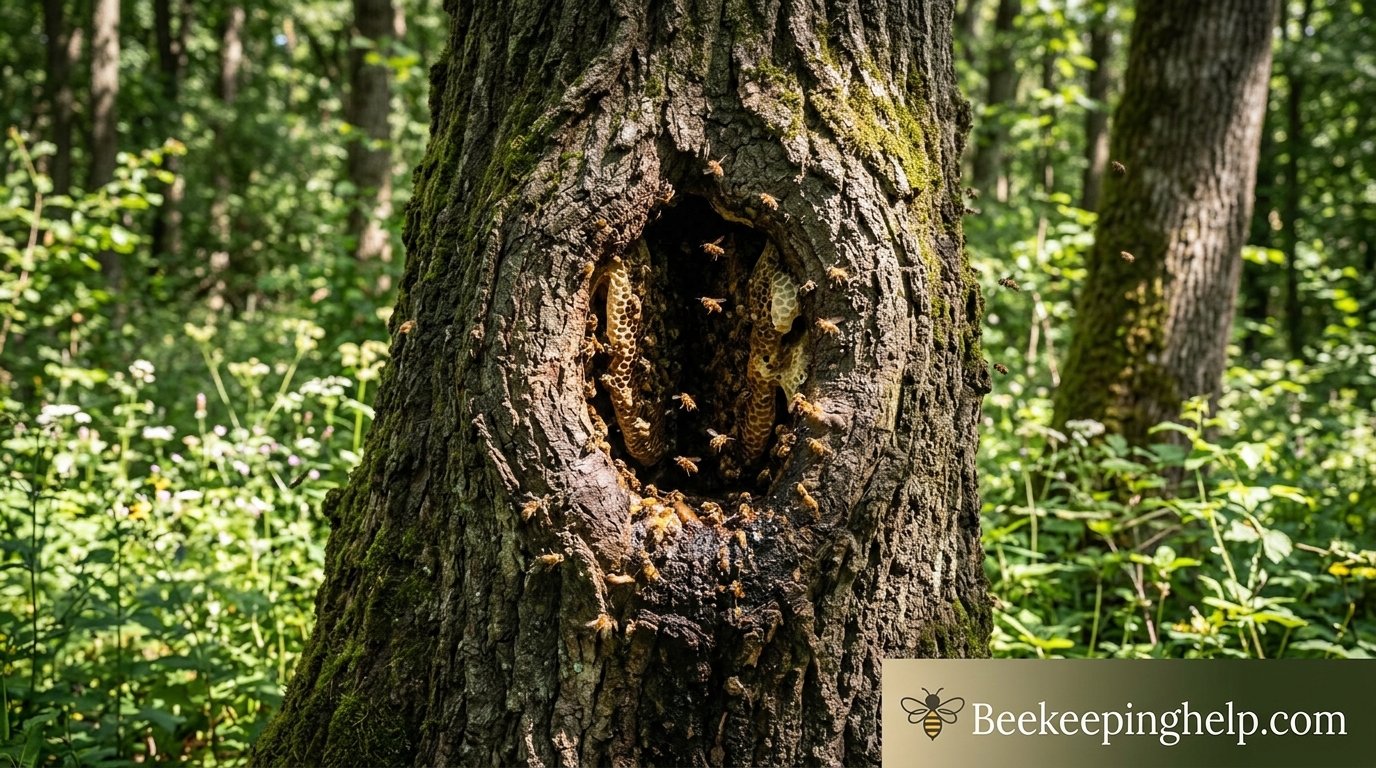
Types of Beehives in Trees: A Complete Guide to Wild Honey Bee Nests
How honey bees choose, build, and defend their homes inside hollow trees — and what every beekeeper, hiker, and nature lover should know about them.
Why Honey Bees Choose Trees in the First Place
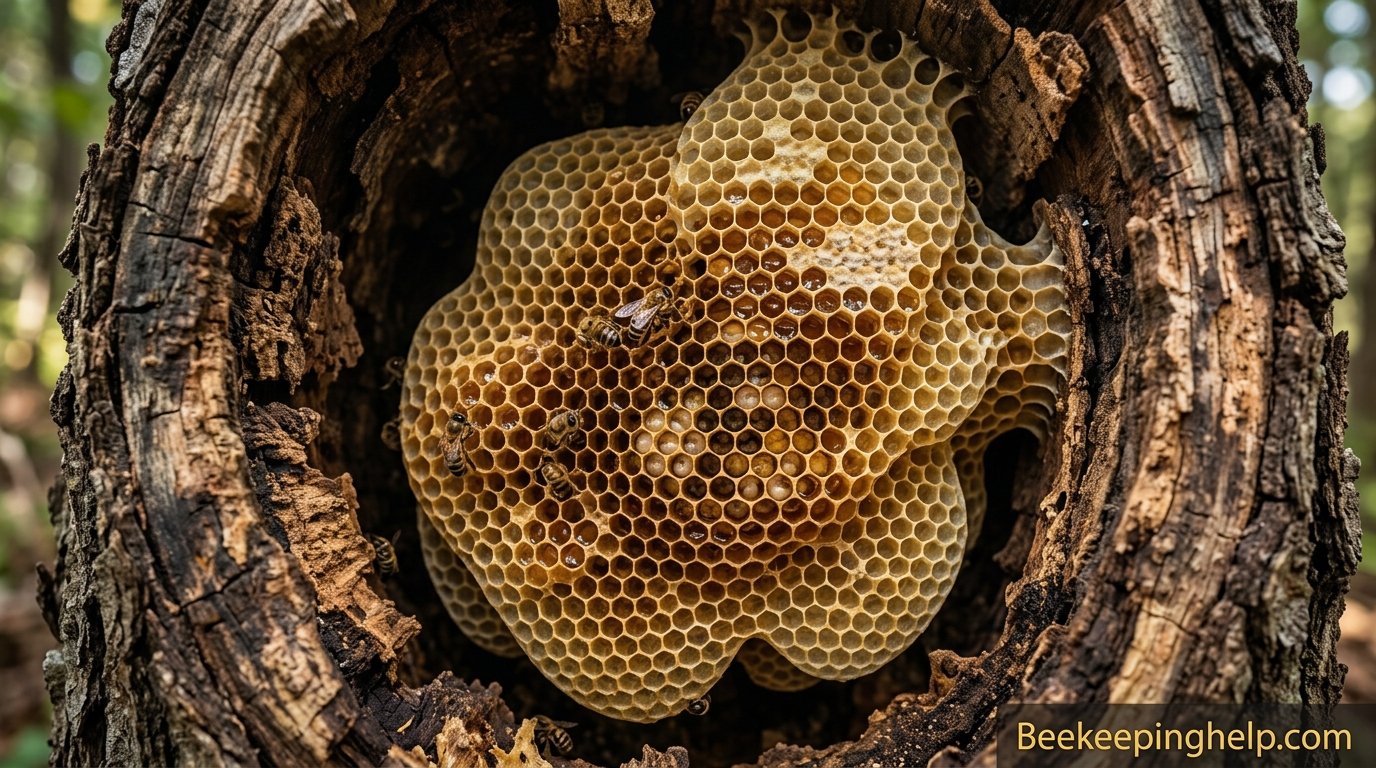
Long before wooden Langstroth boxes existed, honey bees were already master architects of the forest. Wild colonies have nested inside trees for millions of years, and that instinct hasn’t gone anywhere just because humans invented modern hives. If you’ve ever wondered why a “bee tree” seems to draw a swarm out of nowhere, the answer comes down to insulation, defensibility, and space — three things a hollow trunk offers better than almost anywhere else in nature.
Understanding the different types of beehives in trees isn’t just a curiosity for nature lovers. It matters for beekeepers scouting swarm traps, homeowners worried about a hive in the backyard oak, and conservationists trying to protect feral bee populations that carry valuable genetic diversity. This guide walks through every major type of tree hive, how to identify them, and what to do if you find one. For anyone getting started with bees more broadly, our guide on how to start beekeeping is a good companion read.
It also helps to think about why a tree, specifically, beats almost every other natural option a scout bee might stumble across. Rock crevices exist, but they conduct heat and cold far more aggressively than living wood, which acts almost like a built-in climate-control system. Underground cavities are an option for some solitary bee species, but honey bee colonies build vertical wax comb that needs to hang freely, which rules out most below-ground spaces. Man-made structures — wall voids, chimneys, sheds — are a distant second choice that scout bees generally only settle for when no suitable tree is nearby. Trees simply check more boxes at once: they’re tall enough to be defensible from ground predators, thick enough to buffer temperature swings, and, in old-growth or mature second-growth forest, common enough that a colony rarely has to search far to find one.
There’s also a longevity argument that’s easy to overlook. A well-chosen tree cavity can outlast several generations of a single colony’s queen lineage, meaning the “address” itself becomes a multi-year, sometimes multi-decade investment. Swarms that split off from a strong tree colony will often scout for a similarly-shaped cavity nearby, which is part of why experienced woodland beekeepers can sometimes predict, with real accuracy, which trees in a given patch of forest are likely to end up hosting bees over time.
Thinking about capturing a swarm from a tree hive? A proper suit and hive tool kit makes the job dramatically safer.
Check Price on Amazon1. Natural Hollow-Trunk Hives
The classic “bee tree” is a hollow trunk cavity, usually formed after a branch breaks off and fungal decay slowly eats out the heartwood while the outer shell of living wood keeps growing. The result is a naturally insulated chamber with a small entrance — exactly what a scout bee is trained to look for.
These cavities are prized because the surrounding live wood acts as a thermal buffer, keeping the inside remarkably stable through both summer heat and winter cold. Oaks, maples, and old-growth beech trees are common hosts because they live long enough to develop this kind of internal decay without collapsing.
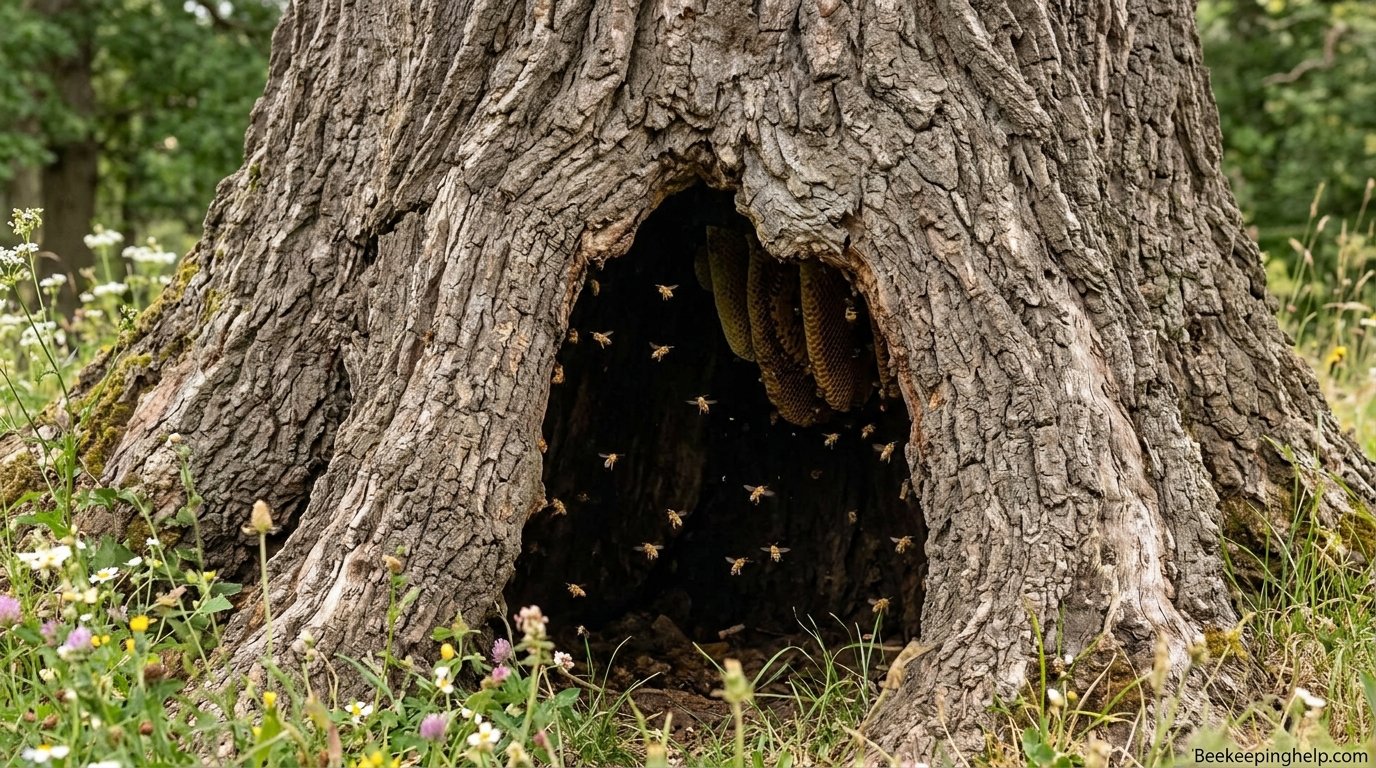
The internal shape of a hollow-trunk hive is rarely a simple cylinder. Decay tends to follow the path of least resistance through the heartwood, which means the cavity often widens dramatically a foot or two above the entrance and then narrows again higher up, creating a rough teardrop profile. Bees build comb downward from the ceiling of this cavity, and because the chamber is wider than it is tall in many trunks, colonies in hollow-trunk hives often end up with several parallel combs spaced with surprising precision — close enough for bees to move freely between them, but wide enough to avoid comb-to-comb contact.
Advantages for the Colony
- Excellent natural insulation
- Small, easily defended entrance
- Protection from wind and rain
- Long-term stability if the tree survives
Risks
- Vulnerable if the tree falls or is cut
- Hard to inspect or treat for pests
- Predators like bears can tear into the trunk
One detail that surprises a lot of first-time observers: bees rarely fill an entire hollow-trunk cavity with comb, even in a tree with an enormous internal volume. Instead, colonies tend to build only as much comb as they can reliably defend, heat in winter, and keep ventilated in summer. A cavity that’s far larger than the colony currently needs isn’t wasted, though — it gives the colony room to grow across multiple seasons without needing to relocate, and it provides a buffer of dead air space that further improves insulation performance compared with a tightly-fitted cavity.
For readers comparing this natural setup to man-made options, our breakdown of beehive types with pictures shows just how much design has been borrowed from these tree cavities.
2. Exposed Branch Hives
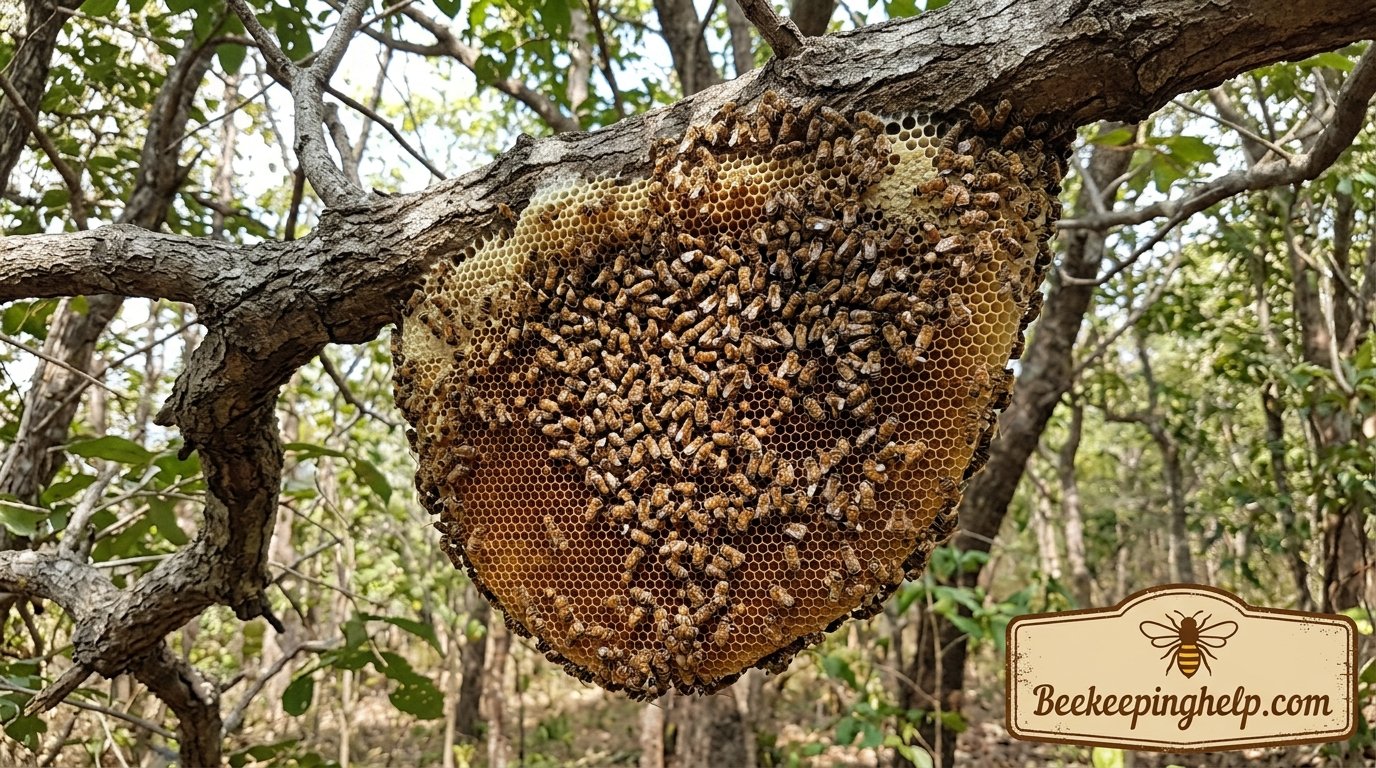
Not every tree colony hides inside the wood. Some species — especially in warmer climates — build a single, open honeycomb hanging directly from a sturdy branch, fully exposed to the elements. This is common with certain Apis species outside North America, but even European honey bees will occasionally build an exposed “bivouac-style” comb when no cavity is available and swarm season pressure is high.
| Feature | Exposed Branch Hive |
|---|---|
| Insulation | Minimal — relies on bee body mass for warmth |
| Defense | Entirely behind a “curtain” of guard bees |
| Lifespan | Often temporary, especially in temperate climates |
| Visibility | Very high — easy to spot from the ground |
Because these hives have no shell of wood protecting them, they’re extremely vulnerable to storms and rarely survive a cold winter. They’re most often seen as a short-term solution while scouts continue searching for a proper cavity.
What’s genuinely remarkable about exposed branch colonies is the behavioral adaptation that lets them survive at all. In species that build this way as a primary strategy, thousands of bees form a living blanket, or “curtain,” across the outer surface of the comb. That curtain isn’t decorative — it’s an active thermoregulation system. Bees on the outer layer angle their bodies to shed rain, while bees closer to the comb vibrate their flight muscles to generate heat during cooler nights, passing warmth inward the same way a stadium crowd huddles for warmth during a cold game. During the hottest part of the day, the same curtain can shift into “bearding” mode, spreading out and fanning to pull heat away from the comb instead of trapping it.
In temperate zones, exposed branch comb is almost always a stopgap rather than a long-term home. A late-season swarm that hasn’t found a hollow cavity before nightfall will sometimes begin drawing comb on an exposed branch simply because building something is safer than building nothing, even knowing the site is unlikely to survive the first hard frost. Beekeepers who spot one of these temporary combs during a hive-hunting walk often treat it as a strong signal that a more permanent cavity — the kind worth checking for a full colony — exists somewhere nearby, since the same swarm’s scouts are usually still actively searching.
3. Ground-Level Stump Hives
When a tree has died and been cut down but the root system and stump remain, decay can hollow out a cavity right at ground level. Bees will readily move into a rotted stump, especially if the entrance is a narrow crack near the base.
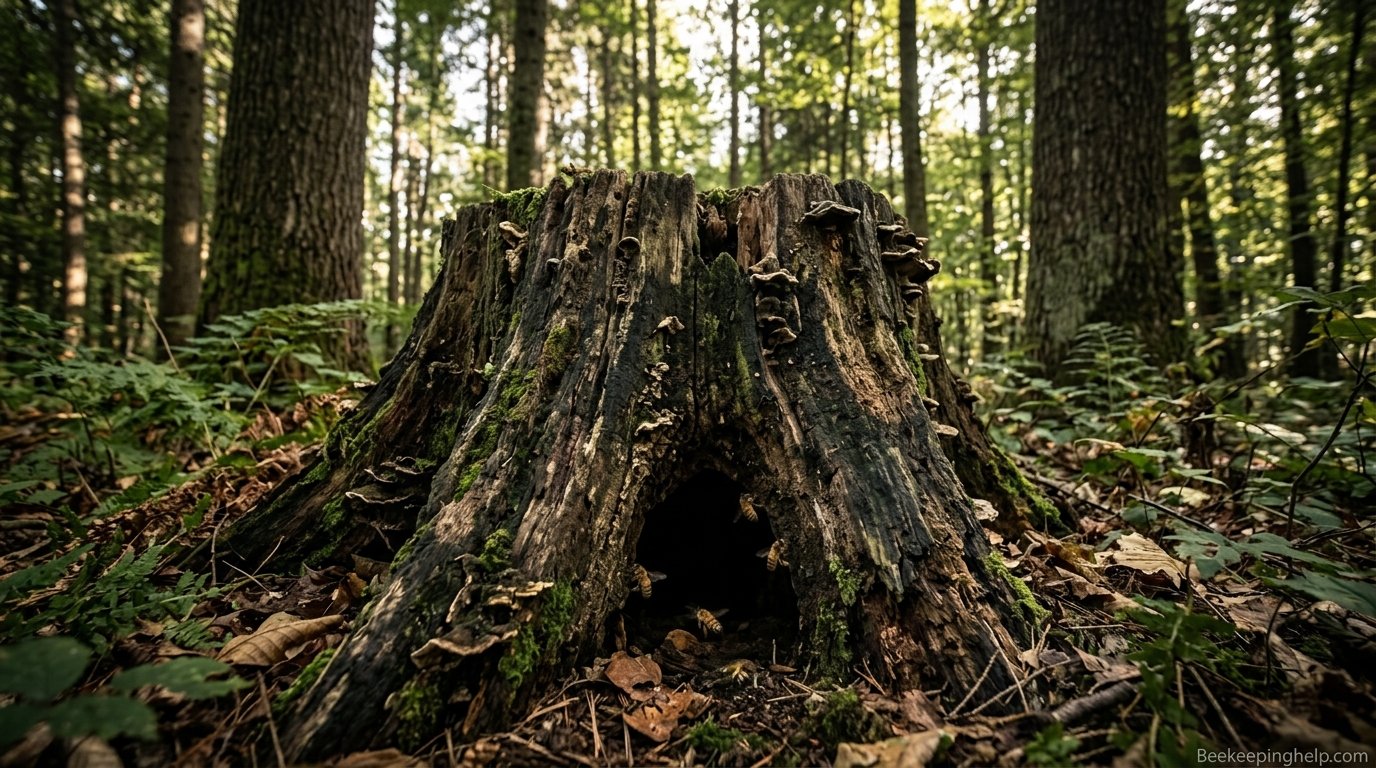
These colonies are fascinating because they mimic the way some traditional log hives and skeps were designed — low to the ground, heavily insulated by surrounding soil and root mass, and often surprisingly resilient. If you’re interested in how humans have replicated this style intentionally, see our guide on how to make a beehive.
Ground-level positioning cuts both ways for a colony. On one hand, soil contact keeps temperature swings gentler than an exposed above-ground cavity would experience, and the surrounding root mass often channels rainwater away from the actual comb chamber rather than into it, provided the stump hasn’t rotted through completely. On the other hand, ground-level entrances put a colony within easy reach of a much wider range of predators — skunks, in particular, are notorious for scratching at low hive entrances at dusk and eating the guard bees that come out to investigate. Colonies in stump hives tend to compensate with unusually aggressive guarding behavior right at the entrance, which is one more reason to observe rather than approach a suspected stump hive too closely.
4. Knot-Hole and Woodpecker-Cavity Hives
Old woodpecker nests are one of the single most common entry points for a wild tree colony. Once a woodpecker abandons its excavated cavity, the hole is already the perfect size and shape for a scout bee to approve. Knot holes left behind by a fallen branch work the same way.
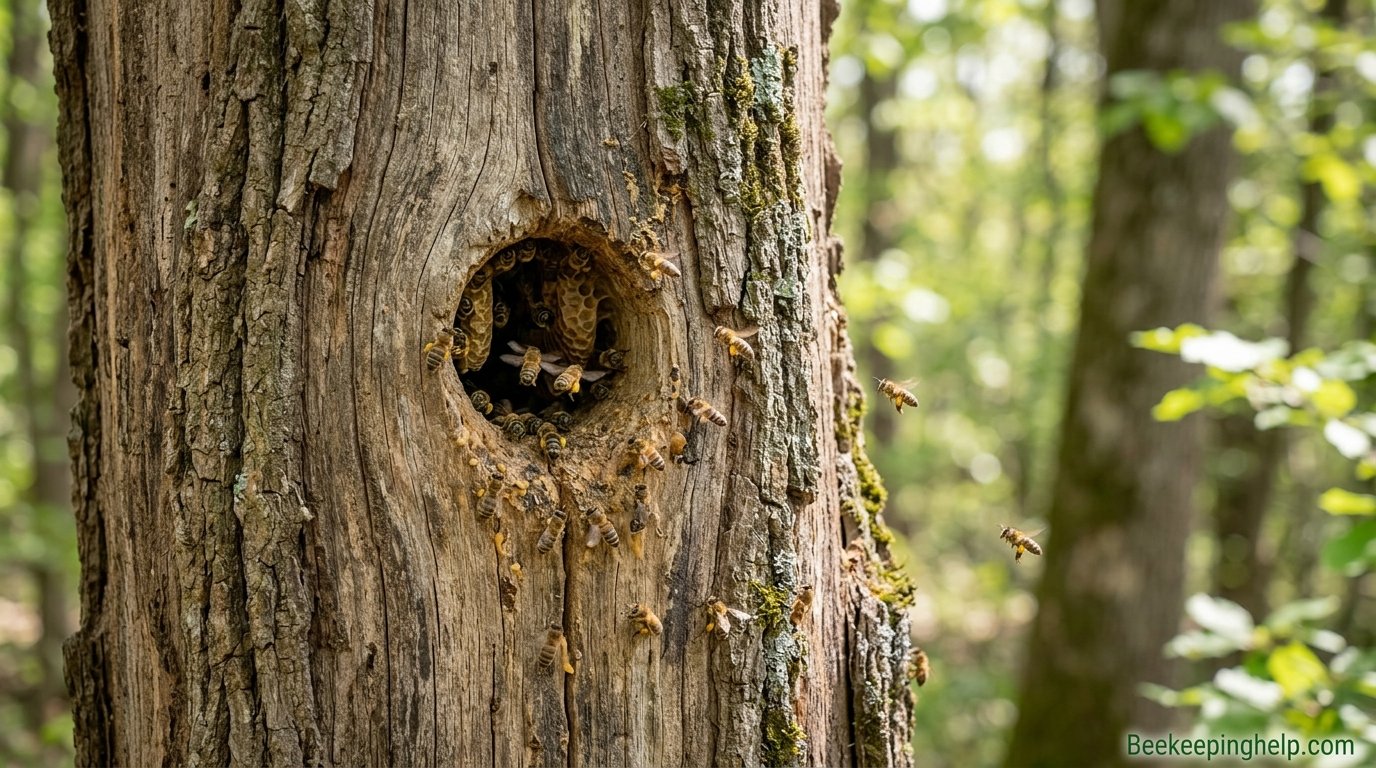
These hives tend to be smaller than deep hollow-trunk hives simply because the cavity itself is more modest in size, but they’re extremely common in mixed hardwood forests and orchards.
There’s a neat ecological relay happening here that’s worth appreciating on its own. Woodpeckers excavate a cavity for one nesting season, sometimes returning to enlarge it in following years, and once they move on, a whole chain of secondary cavity users takes over — flying squirrels, screech owls, and, frequently, honey bees. Because the cavity has already been shaped by a bird’s beak rather than by slow decay, knot-hole and woodpecker hives often have unusually smooth interior walls compared with a naturally rotted hollow-trunk cavity, and the entrance tends to be closer to a perfect circle, which some beekeepers believe makes it easier for a colony to build efficient propolis seals around the rim.

Want to attract a swarm from a knot-hole colony instead of removing it destructively? A simple swarm trap baited with lemongrass oil works remarkably well.
See Swarm Traps on Amazon5. Dead Snag Colonies
A “snag” is a standing dead tree, and it’s a favorite among wild colonies because the outer bark and dry, non-living wood provide surprisingly good insulation without the tree needing to be alive. Snags are also common woodpecker territory, which links back to the knot-hole hives above.
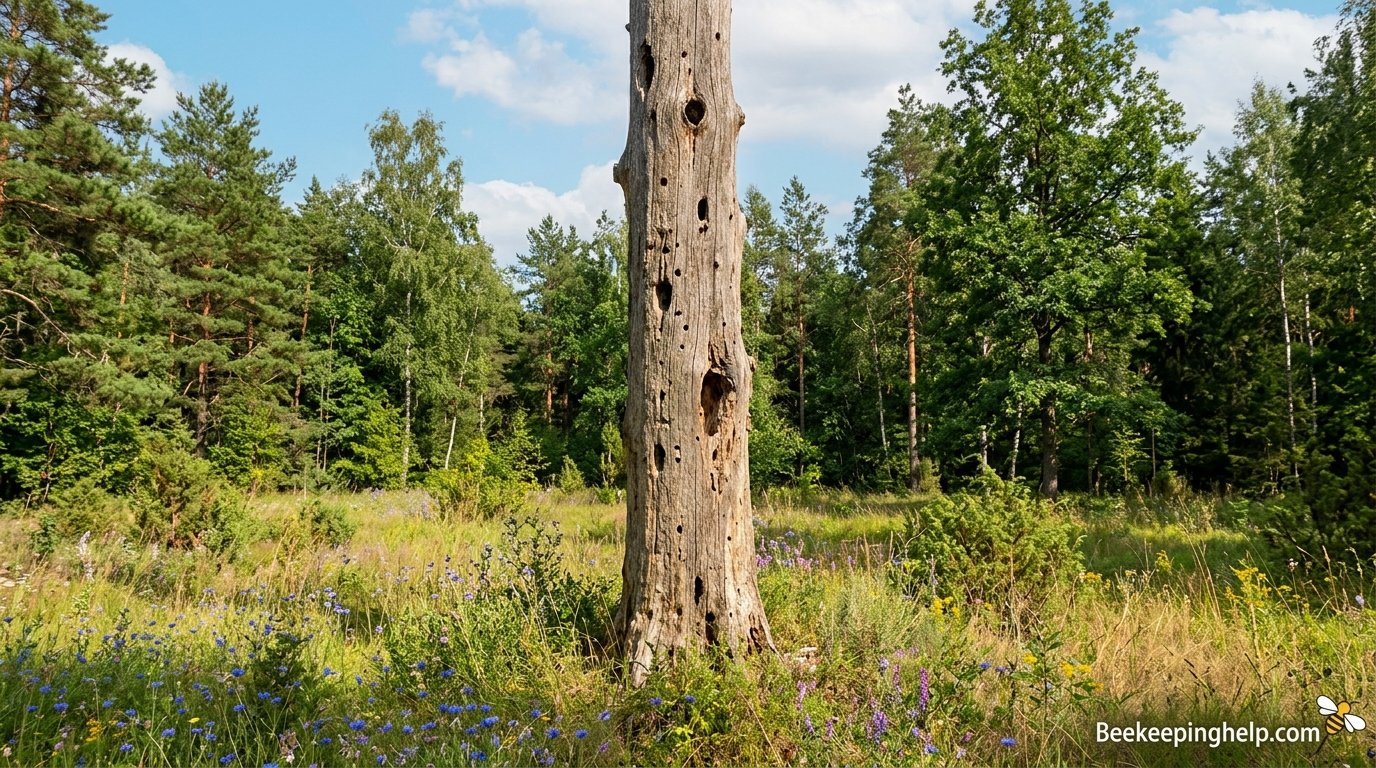
Foresters and conservationists sometimes deliberately leave standing dead trees in a woodlot specifically because of the biodiversity value they provide — bees included.
Snag hives have one notable trade-off compared with a hollow cavity inside a living trunk: there’s no ongoing sap flow or living tissue to slow further decay, so a snag is, by definition, on a clock. Depending on species and climate, a large hardwood snag can remain structurally sound enough to host a colony for anywhere from five to twenty-plus years before the wood softens past the point of safely supporting comb weight and colony traffic. Experienced tree-hive trackers sometimes note the estimated “time since death” of a snag as a rough proxy for how much longer a resident colony is likely to have before it needs to relocate — a useful data point if you’re monitoring a wild colony over multiple seasons rather than just spotting it once.
6. Split-Trunk and Storm-Damage Hives
After a lightning strike or major storm splits a trunk without killing the tree, the crack often runs deep enough to expose a hollow section beneath the bark. Bees will move in through the crack itself, using it as a natural, well-hidden entrance.
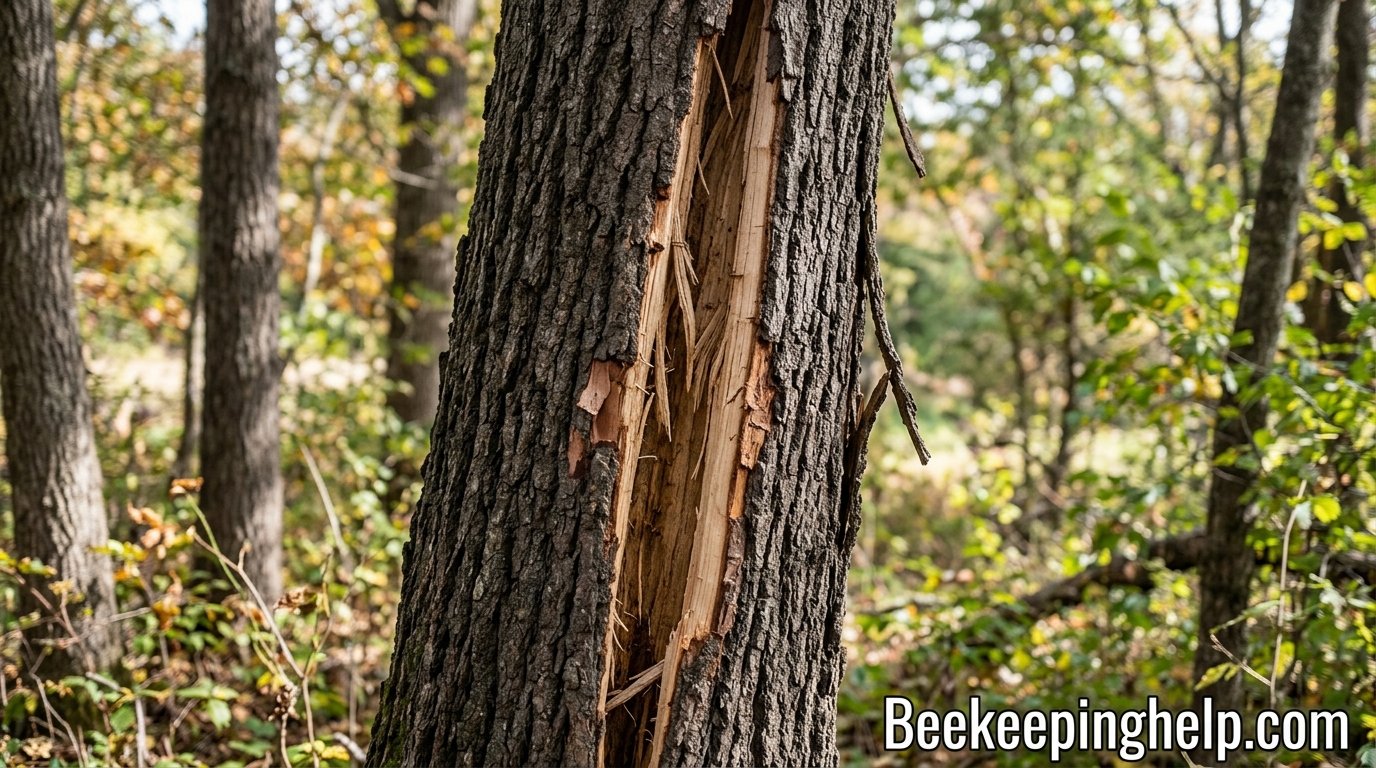
These hives are notoriously hard to spot from ground level since the entrance can be a thin vertical seam rather than an obvious round hole.
Because the entrance seam is often only a few millimeters wide at its narrowest point, split-trunk colonies benefit from a level of concealment that few other tree hive types can match — even experienced hive hunters frequently locate them by ear or by tracking bee flight lines back to the trunk rather than by spotting the entrance visually. The trade-off is structural risk. A tree that has already split once under storm stress is more likely to fail completely during a future storm than an intact hollow trunk would be, which means split-trunk colonies statistically have a shorter expected tenure than hollow-trunk colonies in an otherwise healthy tree of the same species and age.
7. Root-Cavity and Buttress Hives
Large trees with wide buttress roots — the flared, wall-like roots visible above ground on species like old beeches, cottonwoods, and some oaks — sometimes develop hollow pockets in the gaps between buttresses. When decay or erosion opens a cavity low in this root structure, colonies can move in through a gap that’s easy to mistake for a simple hole in the ground.
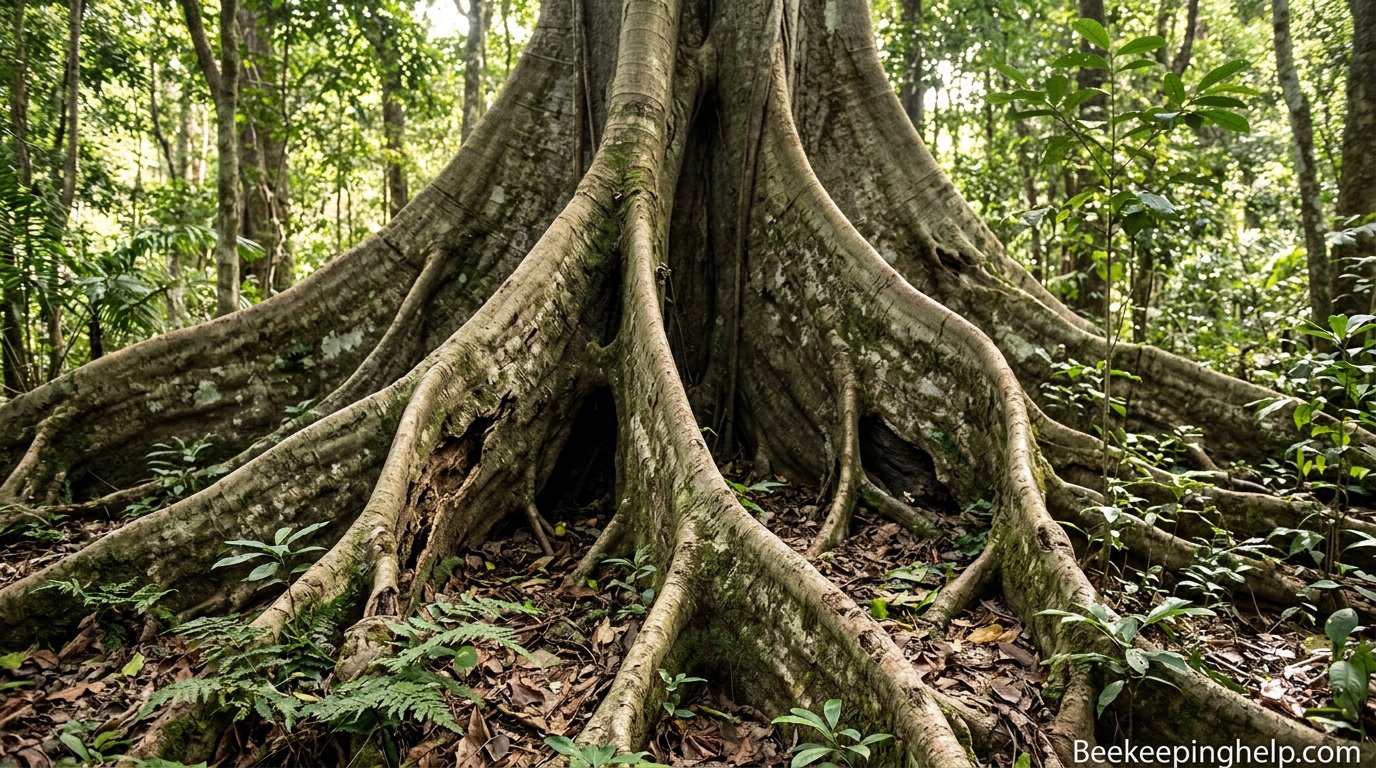
Root-cavity hives share some traits with ground-level stump hives — soil insulation, higher predator exposure — but they differ in one important way: because they form inside a still-living tree’s root structure rather than a dead stump, they tend to be more structurally durable over the long run. The living wood around the cavity keeps growing and sealing the margins of the decayed area, in the same slow process that forms hollow-trunk hives higher up the tree, just applied to the root flare instead of the main stem.
These hives are also among the easiest to walk right past. Because the entrance sits low, often shadowed by the buttress roots themselves and sometimes partly hidden by leaf litter or low ground cover, a colony can go completely unnoticed by people using a trail or yard regularly, right up until bee traffic becomes obvious on a warm, still afternoon.
8. Multi-Chamber Trunk Hives
Occasionally, decay inside a large old trunk doesn’t produce one clean cavity but several connected pockets, separated by ridges of sound wood with narrow internal passages between them. Colonies that settle into this kind of trunk build comb across multiple chambers rather than one continuous space, effectively creating a multi-room hive inside a single tree.
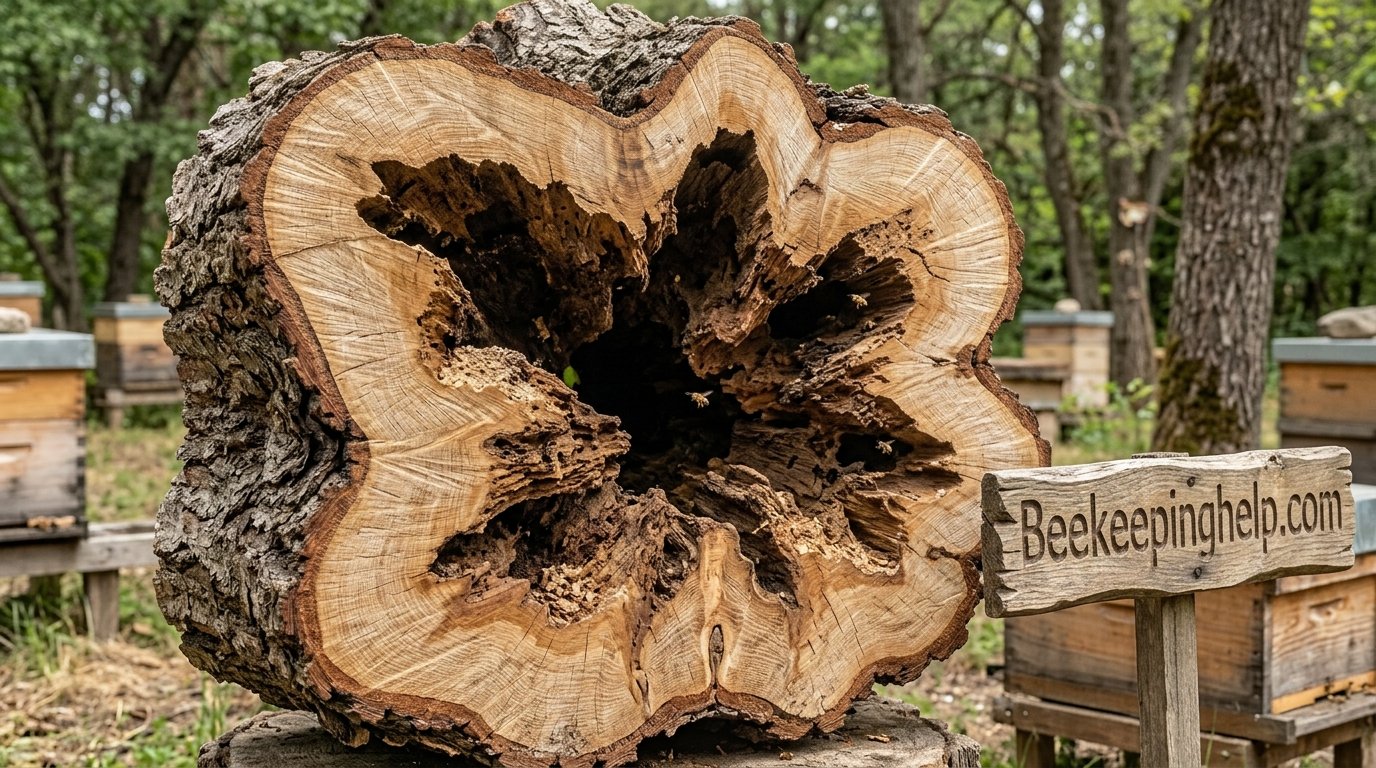
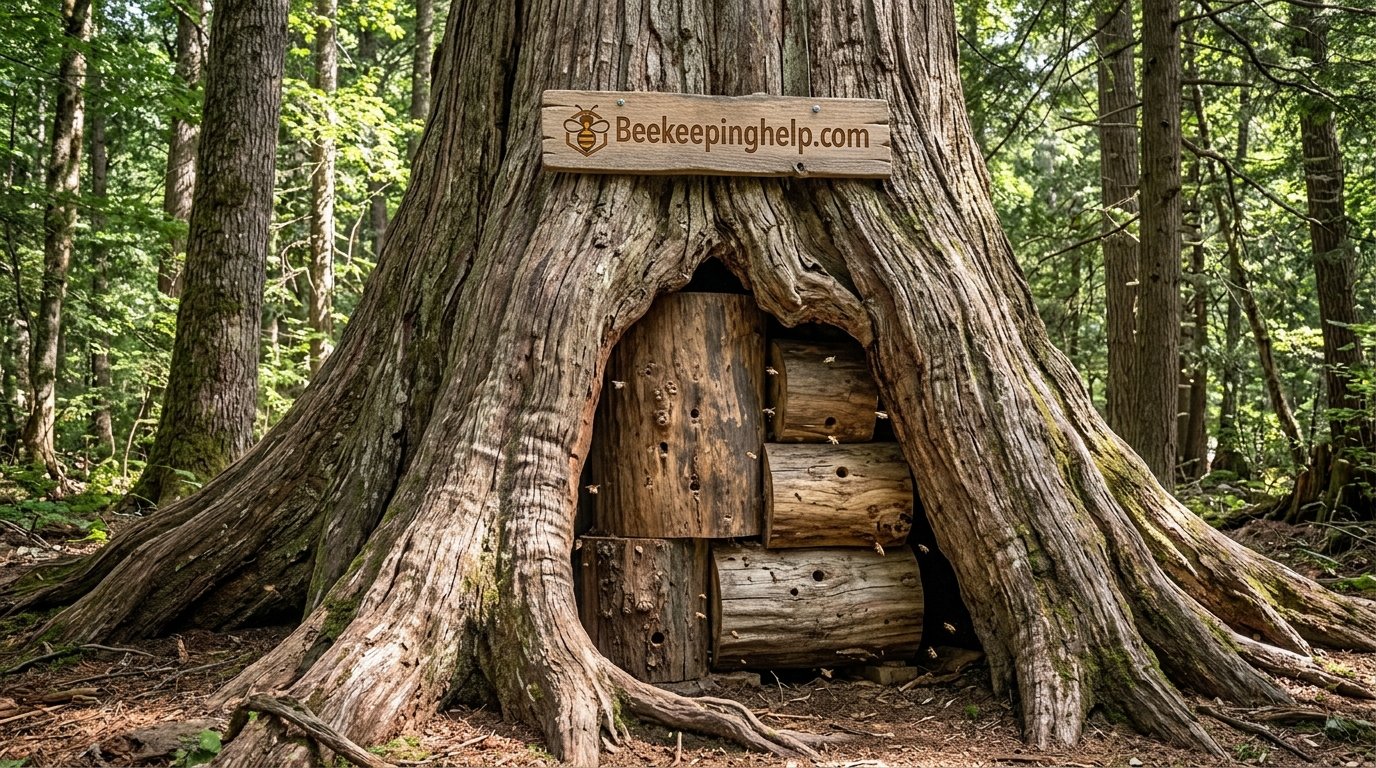
Multi-chamber trunk hives are almost exclusively found in very old, very large-diameter trees, simply because it takes a substantial amount of trunk volume for decay to form more than one distinct pocket without the whole structure collapsing. When they do occur, these hives tend to be some of the largest and longest-lived wild colonies a hive hunter is likely to find, since the extra chamber space lets the colony grow well beyond what a single-cavity hollow-trunk hive could support, and gives it room to relocate comb internally if one chamber develops a leak or a mold problem.
From a defense standpoint, multi-chamber hives also give a colony a fallback position. If a predator manages to breach one chamber, the narrow internal passage to the next chamber acts as a natural chokepoint, similar in principle to the small external entrance that every tree hive relies on for defense in the first place.
9. High-Canopy Hollow-Limb Hives
Not every hollow cavity is down near the base of a tree. Large primary limbs, particularly on old oaks and sycamores, can develop their own internal hollows high in the canopy, sometimes forty feet or more off the ground. Colonies that choose these sites trade easy predator access at ground level for a much harder-to-reach — and harder-to-inspect — home.
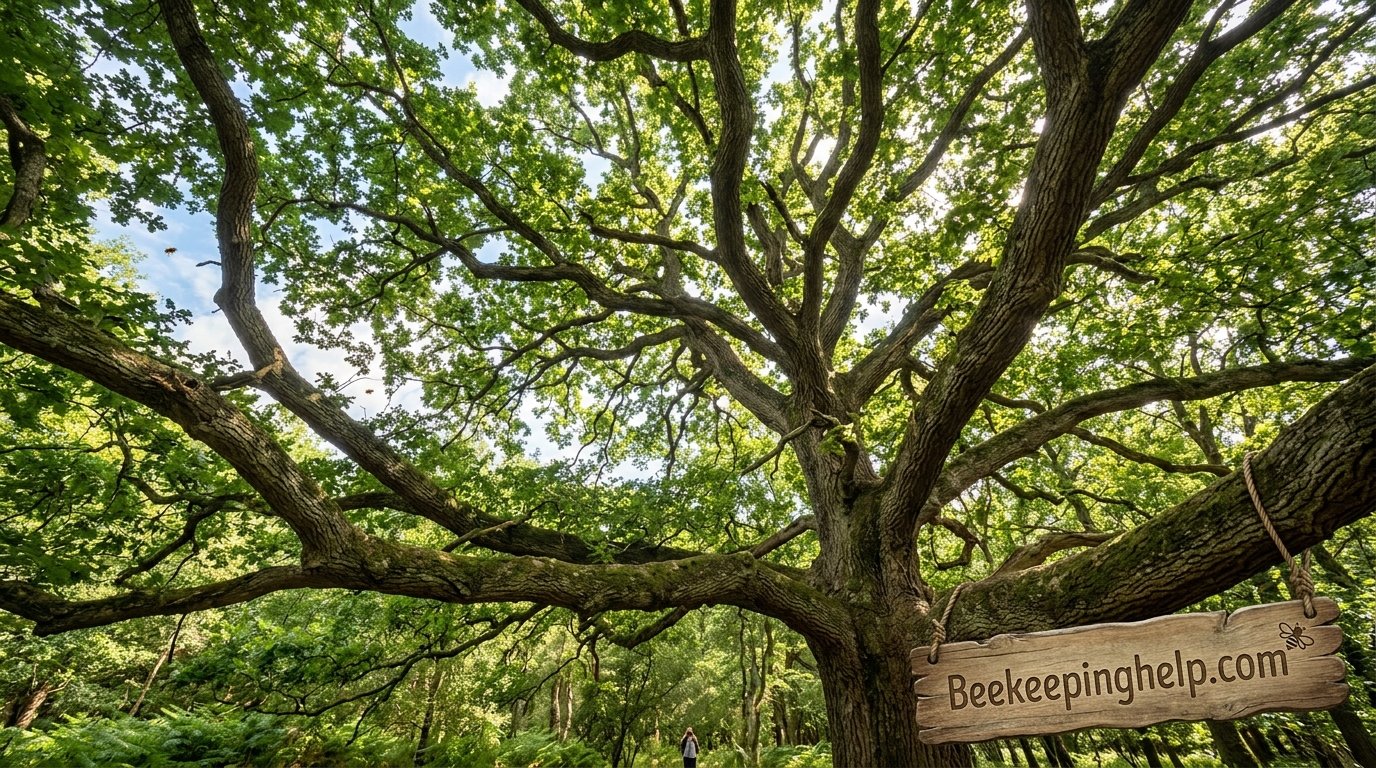
Height comes with real advantages. Bears, raccoons, and skunks — three of the most persistent tree-hive predators — are far less likely to reach a cavity forty feet up than one at eye level or below, and wind exposure that high is usually offset by the insulating mass of the limb itself if the tree is healthy and the hollow well-formed. The downside is accessibility for humans, too: canopy hives are almost impossible to inspect, treat, or safely cut out, which is part of why professional removal services will often recommend simply monitoring a high canopy colony rather than attempting extraction unless it poses a direct hazard.
Canopy hollow-limb hives are also disproportionately likely to be the “mother colonies” behind swarms that show up unexpectedly in a neighborhood. Because they’re so rarely disturbed, these colonies can persist and reproduce swarms for years without ever being noticed by the people living or working nearby.
Comparison Table: Tree Hive Types at a Glance
| Type | Typical Location | Insulation | Ease of Spotting | Colony Longevity |
|---|---|---|---|---|
| Hollow-Trunk | Mid-trunk cavity | Excellent | Moderate | Years, if tree survives |
| Exposed Branch | Open branch | Poor | Very high | Weeks to one season |
| Ground Stump | Base/root area | Very good | Low | Several years |
| Knot-Hole | Old woodpecker hole | Good | Moderate | 1–3 years typically |
| Dead Snag | Standing dead tree | Good | Low to moderate | Until snag decays fully |
| Split-Trunk | Storm/lightning crack | Good | Very low | Variable |
| Root-Cavity | Buttress root gaps | Very good | Very low | Many years |
| Multi-Chamber | Large old trunk, several pockets | Excellent | Moderate | Often longest-lived |
| High-Canopy Limb | Hollow in a thick upper limb | Good | Very low | Years, rarely disturbed |
How Scout Bees Choose a Tree Cavity
When a colony swarms, scout bees fan out and evaluate dozens of potential homes using a surprisingly rigorous checklist: cavity volume (roughly 20–40 liters is ideal), entrance size (small and defensible), entrance height off the ground, dryness, and draft protection. Scouts then return to the swarm cluster and perform a waggle dance to “vote” on the best site — a process well documented in honey bee behavioral research.
This is the same underlying logic beekeepers rely on when designing modern equipment. If you’ve ever compared a Flow Hive to a traditional Langstroth box, you’ll notice both are still trying to approximate the ideal cavity dimensions bees have selected for millennia — a topic we cover in detail in Flow Hive vs. Langstroth.
The waggle-dance “vote” isn’t a single decisive event; it’s an iterative consensus process that can take anywhere from a few hours to several days. Early on, dozens of scouts may be independently dancing for dozens of different candidate sites, each advertising the direction, distance, and, through the vigor of the dance, their subjective assessment of how good that site is. As more scouts visit and confirm the top-rated candidates, the dances for weaker options gradually fade out while dances for the strongest site or two intensify, pulling in more scouts to verify it directly. Only once a strong quorum of scouts — typically estimated in research at around fifteen to twenty individuals present at the same site simultaneously — has been reached does the swarm actually commit and fly as a unit to the new home.
Entrance size gets an outsized amount of attention in this process, and for good reason: an opening in the 10–15 square centimeter range appears repeatedly in observational studies of successful tree cavity selections, which is roughly comparable to a hole a bit larger than a golf ball. Anything much bigger forces the colony to spend disproportionate effort building propolis “curtains” to narrow the opening after moving in, while anything smaller can bottleneck forager traffic during nectar flow. Height off the ground matters almost as much — cavities several meters up are consistently favored over ground-level openings, likely because they reduce exposure to some of the most persistent tree-hive predators.
Signs You’ve Found a Tree Hive
- Steady bee traffic in and out of a single small opening
- An audible hum near the trunk, especially on warm afternoons
- Propolis staining (a dark, resinous streak) around the entrance
- Wax cappings or comb fragments on the ground below
- A faint honey or beeswax smell near the base of the tree
If you notice several of these signs, it’s worth observing from a safe distance before taking any action — including yard work or trimming — near that tree.
Timing your observation matters more than most people expect. A tree hive’s entrance traffic looks completely different depending on the hour and the season. On a warm, sunny afternoon in late spring or summer, a healthy colony can show what looks like near-constant motion, with foragers leaving in one steady stream and returning heavy with pollen or nectar in another. On a cool morning, or through most of the winter, the same colony might show almost no visible activity at all, with only the occasional bee emerging on a mild, sunny day for a “cleansing flight.” That seasonal quiet is one of the most common reasons a tree hive goes undiscovered for years — it simply doesn’t look occupied most of the time.
Sound is an underrated diagnostic tool here. Placing an ear gently against the bark near a suspected cavity — without disturbing the tree or getting close to the entrance itself — can reveal a low, steady hum that’s distinctly different from wind noise or insect sounds from elsewhere in the canopy. Beekeepers who specialize in hive hunting sometimes use a simple stethoscope for exactly this purpose, since it lets them confirm occupancy without needing to see the entrance directly, which is especially useful for split-trunk or root-cavity hives where the opening itself is nearly invisible.
Regional Variation in Tree Hives
Not every region produces the same mix of tree hive types, and the differences track fairly closely with climate and forest composition. In cooler temperate regions with long, cold winters, hollow-trunk and snag hives dominate almost by necessity — the insulation value of a thick wood shell is close to a survival requirement once nighttime temperatures drop well below freezing for weeks at a time. Exposed branch hives are correspondingly rare in these climates and, when they do appear, are almost always short-lived, late-season swarms rather than established colonies.
In warmer, more humid regions, the calculus shifts. Cavity nesting is still common, but exposed comb becomes a genuinely viable long-term strategy for some populations, since the cost of poor insulation is much lower when winter temperatures rarely threaten the colony directly. Regions with a pronounced dry season versus wet season, rather than a hot-versus-cold seasonal split, tend to see colonies place a higher premium on rain and drought protection than on temperature regulation specifically, which shows up as a preference for deeper, more sheltered cavities even in climates that never really get cold.
Forest composition plays its own role independent of climate. A forest dominated by fast-growing, shorter-lived softwoods tends to produce fewer large-diameter hollow-trunk candidates than an old-growth or mixed hardwood forest with plenty of oaks, maples, and beeches that have had a century or more to develop the kind of heartwood decay that makes an ideal cavity. This is part of why old-growth preservation is sometimes cited by conservationists specifically in the context of wild pollinator habitat, not just as a general biodiversity talking point.
How Tree Hives Change Through the Seasons
A tree hive isn’t a static structure — the colony inside actively manages it differently depending on the time of year, and those changes are visible if you know what to look for. In early spring, as the queen ramps up egg-laying and forager traffic increases with the first blooms, entrance activity picks up sharply, and a hive that seemed dormant all winter can suddenly look bustling within a couple of warm weeks.
Late spring through early summer is swarm season, and it’s the period when a tree hive is most likely to throw off a new swarm of its own, assuming the colony has grown strong enough and the cavity has begun to feel crowded. This is also, not coincidentally, the period when scout bees from other swarms are most actively searching for new cavities, which is why late spring is the best time of year to spot a temporary exposed branch cluster or a swarm trap in active use nearby.
By late summer, colony growth slows and the focus shifts to building up honey stores for winter. Entrance traffic remains steady but the character of it changes — more returning foragers visibly loaded with nectar, fewer of the exploratory flights common in spring. Come autumn, drone bees are often evicted from the colony entirely as resources tighten, and it’s not unusual to see a brief flurry of activity at a tree hive entrance as drones are pushed out and unable to re-enter.
Winter is the quietest period by far. A healthy colony clusters tightly around the queen deep inside the cavity, vibrating flight muscles to generate heat and rotating positions so no single group of bees stays on the cold outer edge of the cluster too long. From the outside, a wintering tree hive can look completely abandoned, which is exactly why late-winter tree clearing or trimming carries a real risk of unknowingly destroying an active colony that simply isn’t showing any visible activity that day.
Predators, Pests, and Threats to Tree Hives
Tree hives face a longer list of natural threats than most managed hives ever encounter, precisely because there’s no beekeeper checking on them or intervening when something goes wrong. Bears are the most dramatic and destructive predator across much of North America and parts of Europe, capable of tearing into even a well-established hollow-trunk cavity to reach both the brood and the stored honey. A hive that survives a bear encounter often shows visible claw damage to the bark for years afterward, which is itself a useful, if unfortunate, identifying sign for hive hunters.
Smaller mammals present a more persistent, lower-intensity threat. Skunks in particular have learned to scratch at low hive entrances at dusk, eating the guard bees that emerge to investigate the disturbance one at a time, night after night, which can slowly weaken a colony’s defensive workforce without ever fully breaching the hive itself. Raccoons will do something similar when they can reach an entrance, and mice sometimes move into the outer margins of an unused portion of a large cavity during winter, which can introduce additional stress even without directly attacking the bees.
On the pest and pathogen side, tree hives deal with the same core threats as managed colonies — Varroa mites, small hive beetles, and various brood diseases — but without any human intervention to treat them. This is precisely why feral tree colonies that do survive for many consecutive years are so interesting to researchers and breeding programs: their survival is, functionally, a real-world test of natural resistance traits, since only genetically fitter colonies tend to persist untreated for a decade or longer in the presence of Varroa.
Woodpeckers themselves can occasionally become a threat rather than a benefactor, drumming into the outer wall of an occupied cavity in search of insect larvae and sometimes weakening the structure enough to let in rain or additional predators. It’s one more example of how tightly interconnected the various tree hive types and their surrounding wildlife really are.
Ants are a subtler but surprisingly common nuisance for tree colonies, particularly in warmer climates. Certain ant species will establish a foraging trail directly to a hive entrance and steal small amounts of honey or attack weakened brood over time, a slow drain rather than a sudden attack. Strong colonies generally keep ants in check through aggressive guarding and by maintaining a clean, well-propolized entrance that offers ants little foothold, but a colony already weakened by disease or a harsh winter can lose that battle gradually. Wax moths present a related, secondary risk: they rarely trouble a strong, actively defended colony, but can move quickly into abandoned comb after a colony dies out or swarms away, which is one reason an empty cavity that once hosted bees doesn’t always stay empty, or clean, for long.
Human activity rounds out the list of threats, even when unintentional. Land clearing, prescribed burns conducted at the wrong time of year, and even well-meaning tree trimming during winter dormancy have all been documented causes of tree-hive colony loss, simply because an occupied cavity gave no visible signs of activity at the moment work began.
A Short History of Bee Trees
Long before modern apiculture, “bee trees” were a recognized and actively sought resource across much of the world. In parts of Europe, particularly in the forests of what’s now Poland, Belarus, and Russia, a specialized form of forest beekeeping called “beekeeping in the wild” or tree beekeeping developed, in which practitioners would carve artificial cavities directly into standing living trees, deliberately mimicking the natural hollow-trunk hive rather than waiting for one to form on its own. Some of these carved tree cavities, tended across many human generations, remained in continuous use by bee colonies for well over a century.
In North America, early European settlers quickly learned from necessity, and later from indigenous knowledge, how to locate bee trees in the forest as a source of wild honey, long before honey bees were widely kept in movable-frame hives. “Bee hunting” or “bee lining” became a genuine woodcraft skill: a hunter would set out a small dish of sugar water or honey some distance from where bees were already foraging, watch which direction the fed bees flew back toward — their “bee line” — and then move the bait progressively closer to the source, triangulating the location of the hollow tree itself, sometimes over the course of several days.
That tradition is part of where the modern swarm trap comes from. A baited box designed to intercept a swarm before it commits to a wild tree cavity is, in a real sense, a direct descendant of the same instinct that drove historical bee hunters — an attempt to work with, rather than against, the natural cavity-seeking behavior scout bees have relied on for millions of years.
Removal, Relocation, and Safety Considerations
Removing a colony from a tree is a specialized job, and it’s very different from removing a hive box. Cutting into a hollow trunk can destroy the comb, kill the queen, and provoke a large, well-established colony into defensive behavior. In most cases, the safer and more ethical route is a “cutout” performed by an experienced beekeeper, or simply leaving the colony alone if it isn’t posing a real risk.
When Leaving It Alone Makes Sense
- The tree is far from foot traffic
- No one in the household has an allergy
- The colony has been stable and non-aggressive
When Professional Removal Is Needed
- The hive is near a doorway, patio, or play area
- The tree itself is structurally unsound
- Someone nearby has a known bee-sting allergy
A professional tree cutout typically starts with a careful assessment of the cavity’s shape and size, often using a simple listening device or a thermal-imaging tool to map roughly where the comb sits before any cutting begins. Once the entry point is opened, the beekeeper works methodically, cutting comb into frame-sized pieces, securing brood comb with rubber bands into empty frames so the developing bees aren’t lost, and searching carefully for the queen throughout the process, since a cutout that loses the queen is far less likely to result in a colony that survives the transition. The whole process can take anywhere from one to several hours depending on cavity depth and colony size, and it’s genuinely physical, often dusty, occasionally sticky work.
After the visible comb and bees are removed, an experienced cutout specialist will also take steps to prevent robbing and re-colonization of the empty cavity — cleaning out leftover wax and propolis residue that would otherwise attract a new swarm to the same now-vulnerable opening in the tree.

If you’re assisting with a cutout, proper protective gear isn’t optional.
Browse Protective GearFeral Tree Hives vs. Managed Hives
| Aspect | Feral Tree Hive | Managed Hive |
|---|---|---|
| Inspection access | None | Full frame-by-frame access |
| Pest treatment | Not possible | Routine mite/pest management |
| Genetic diversity | Often high — untreated selection pressure | Depends on breeding program |
| Honey harvest | Not practical | Standard practice |
Many beekeepers actually value feral tree colonies as a genetic resource, since bees that survive untreated in the wild for multiple years have often developed natural resistance traits. For a deeper look at how a managed hive is built and functions, see how does a beehive work and parts of a bee hive and their functions.
The comb architecture itself differs in a way that’s easy to overlook. In a managed Langstroth hive, comb is built inside removable frames on a fixed, uniform spacing that the beekeeper controls. In a tree hive, bees build free-form comb, shaped entirely by the contours of the cavity, with the spacing between combs — known as “bee space” — determined naturally by the colony rather than imposed by equipment. Some researchers studying feral colonies have found that this free-form comb, combined with the smaller, more irregular cell sizes bees sometimes choose without a manufactured foundation to guide them, may play a role in the mite-resistance advantages some feral populations display, though this remains an active area of study rather than settled science.
The Conservation Value of Tree-Nesting Colonies
Wild tree hives play a quiet but important role in forest ecosystems. They pollinate wildflowers and understory plants that managed apiaries, often positioned near agricultural fields, may rarely visit. Foresters who leave old hollow trees standing — rather than clearing them for tidiness — are often unknowingly protecting genetically distinct bee populations that have adapted to local conditions over many generations.
If you’re designing a backyard habitat with bees in mind, even something as simple as leaving one dead or hollow tree standing (where safe to do so) can make a meaningful difference. And if you eventually want a managed hive alongside that wild habitat, our guide to the best beekeeping hives is a solid next stop, along with tips on how to paint a beehive so it blends naturally into a garden setting.
Feral tree colonies also function as a kind of living seed bank for genetic traits that formal breeding programs may not prioritize. Traits like grooming behavior that helps bees remove Varroa mites from each other, or hygienic behavior that prompts workers to detect and remove diseased brood before an infection spreads, tend to persist more reliably in populations that have faced continuous, untreated selection pressure over many generations. Some regional queen-breeding programs have begun deliberately sourcing genetic material from long-surviving feral tree colonies for exactly this reason, treating an old bee tree almost like a wild-type reference population.
There’s a broader habitat argument too. A single mature hollow tree can support far more than one wild bee colony over its lifetime — flying squirrels, bats, various cavity-nesting birds, and a long list of insects all depend on the same kind of structural decay that makes a tree attractive to bees in the first place. Protecting bee trees, in practice, usually means protecting an entire cluster of dependent species at once.
Building Tree-Hive Habitat On Purpose
Landowners and land managers who want to actively encourage wild tree colonies have a few practical levers available, most of which are less about direct intervention and more about patience and restraint. The single most effective step is simply leaving large-diameter dead or dying trees standing wherever they don’t pose a genuine safety hazard, rather than removing them for the sake of tidiness. It typically takes decades for a tree to develop the kind of heartwood decay that produces an ideal hollow-trunk cavity, so protecting existing older trees does far more good, far faster, than planting new ones with future habitat in mind.
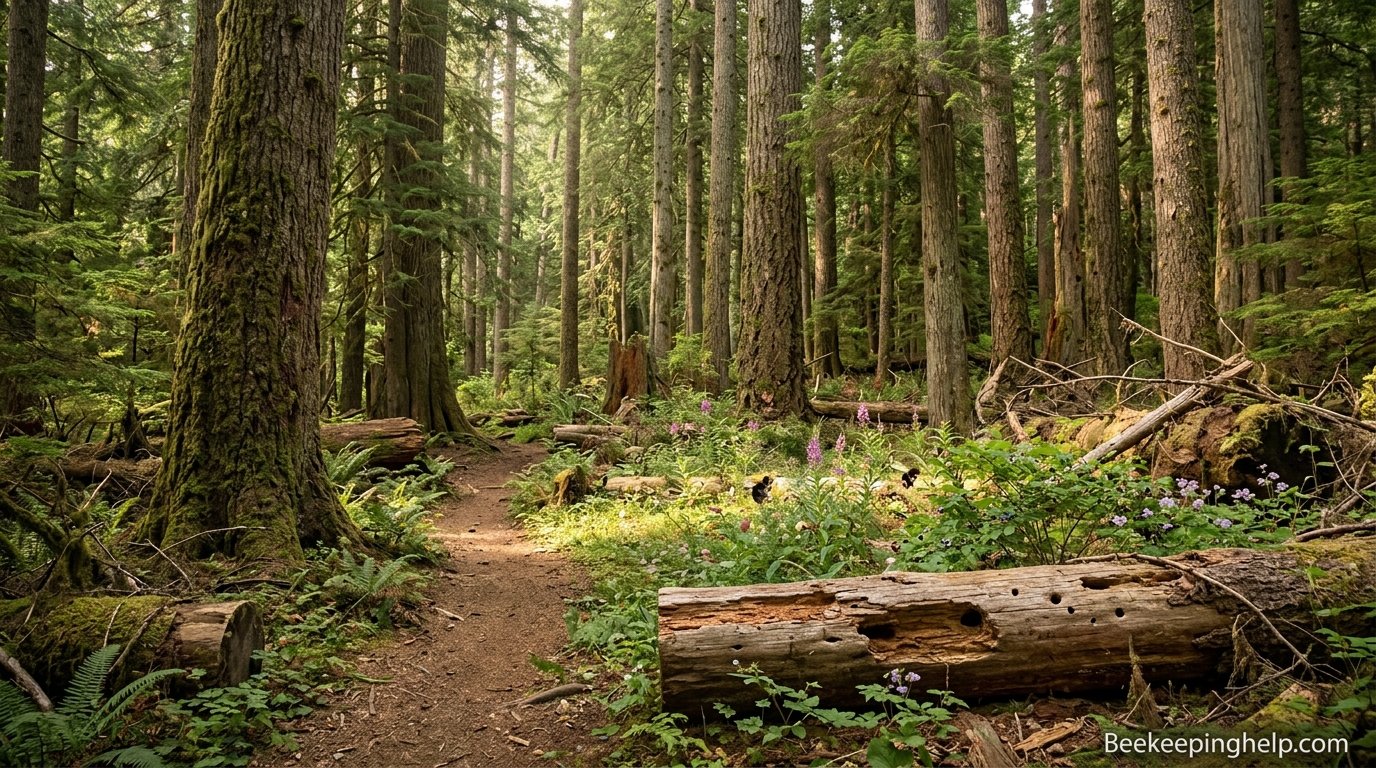
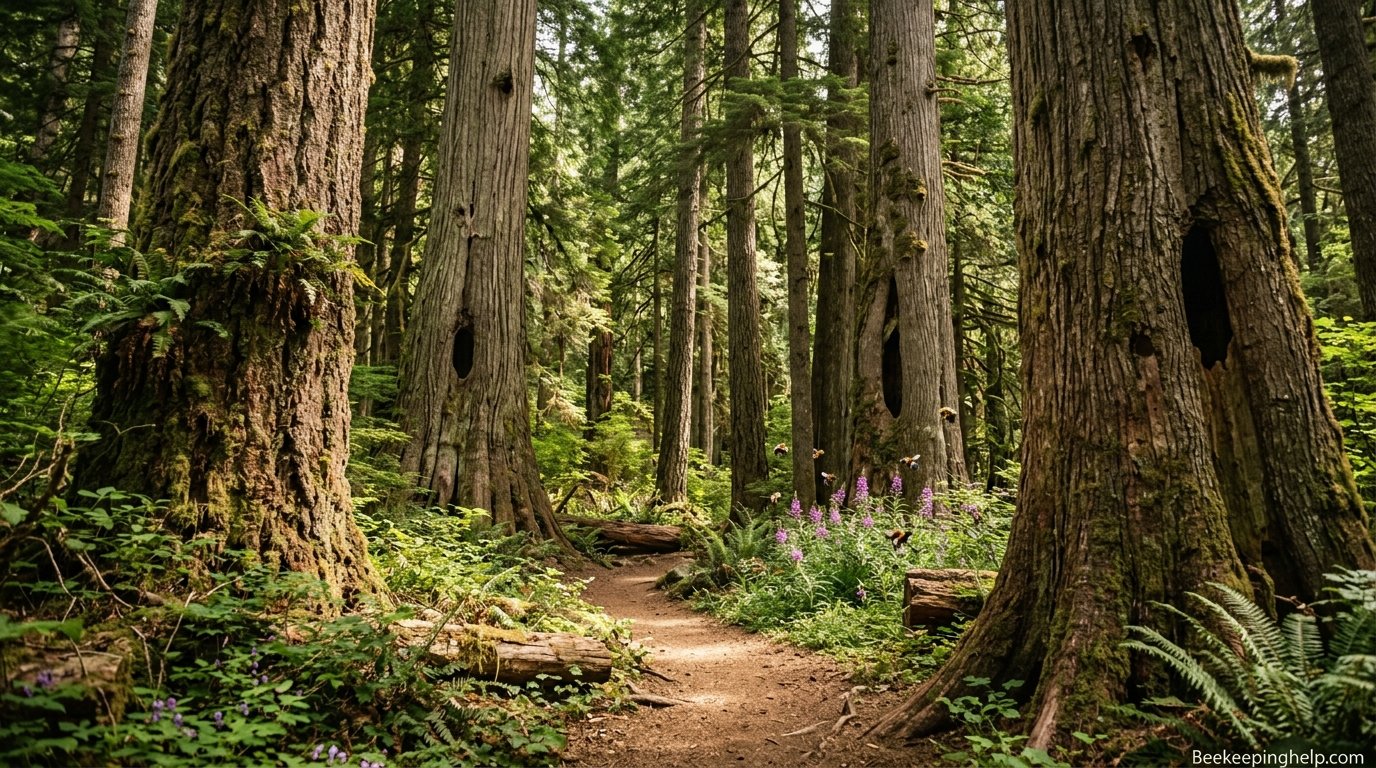
For anyone managing a smaller property without large old trees already on it, a well-placed swarm trap is the more realistic near-term option, effectively offering scout bees an artificial cavity that competes favorably with whatever natural options exist nearby. Positioning matters more than most people expect — traps placed several meters off the ground, in partial shade, away from strong wind exposure, and baited with a lemongrass-oil-based lure consistently outperform traps set at ground level or in full sun. For a full walkthrough of building or setting one up correctly, see our guide on how to make a beehive.
It’s also worth resisting the urge to “help” an occupied tree hive directly. Unlike a managed colony, a wild tree colony isn’t expecting or benefiting from inspection, feeding, or treatment, and well-intentioned interference — prying open a cavity to check on the bees, for instance — is far more likely to harm the colony than support it. The most effective form of habitat support is almost always passive: protect the tree, leave the colony undisturbed, and let natural selection do the rest.
Frequently Asked Questions
How can I tell if bees living in a tree are honey bees or wasps?
Honey bees are fuzzy, golden-brown, and move in a steady, purposeful stream in and out of a single opening. Wasps are smoother, often more yellow-and-black striped, and tend to nest in papery exposed structures rather than deep wood cavities.
Is it illegal to remove a wild bee colony from a tree?
Rules vary by region. In many areas honey bees aren’t protected the way native pollinators can be, but some municipalities regulate hive removal methods. It’s worth checking local ordinances before attempting removal yourself.
How long can a colony survive inside a tree?
A stable hollow-trunk colony can persist for many years, sometimes even decades, as long as the tree remains structurally sound and the cavity stays dry.
Will bees damage the tree they live in?
Generally no. Bees don’t excavate wood themselves; they rely on cavities already created by decay, woodpeckers, or storm damage, so their presence doesn’t meaningfully worsen the tree’s structural health.
Can I attract a wild swarm to move into a box instead of a tree?
Yes — this is exactly what swarm traps are designed for. A box with the right volume, a small entrance, and a lure like lemongrass oil can successfully out-compete a nearby tree cavity during swarm season.
What time of year are tree hives most active?
Late spring through summer, when swarm season peaks and colonies are foraging heavily to build up stores for winter.
Are tree hive colonies more aggressive than managed hives?
Not inherently, though a long-established feral colony that has never been handled by humans may be more defensive simply because it isn’t accustomed to inspection or smoke.
Do tree hives produce harvestable honey?
Technically yes, but harvesting from a tree cavity usually destroys the comb and disrupts the colony, so it’s rarely done in practice outside of a full cutout relocation.
What should I do if a tree hive is too close to my house?
Contact a local beekeeper or pest-control service experienced in live bee removal rather than sealing the entrance or using pesticide, which can leave a rotting colony inside your wall or trunk.
Can two colonies live in the same tree?
It’s uncommon but not impossible if the tree has multiple separate cavities far enough apart that the colonies don’t compete directly for the same entrance or resources.
How can I tell how old a tree hive colony is?
There’s no perfectly reliable way from the outside, but heavy propolis staining, a well-established flight path worn into surrounding vegetation, and a noticeably calm, settled demeanor around the entrance can all suggest a colony that’s been established for several seasons rather than a recent arrival.
Do all wild bee colonies eventually move into trees, or do some stay in other structures?
Trees are the preferred natural cavity, but scout bees will readily settle for wall voids, chimneys, or other man-made cavities that meet their basic size and shelter criteria if no suitable tree is available nearby during swarm season.
Conclusion
From hollow trunks to old woodpecker holes, trees have been the original beehive for longer than humans have kept bees at all. Recognizing the different types of beehives in trees helps you make better decisions — whether that means leaving a stable feral colony alone, arranging a professional cutout, or setting a swarm trap to invite a colony into a managed hive instead. Every one of these approaches starts with the same thing: understanding how and why bees choose the tree they do.
Ready to set up a home for your own colony? Explore our full guide to the best beekeeping hives to get started.
Shop Beekeeping Starter Kits