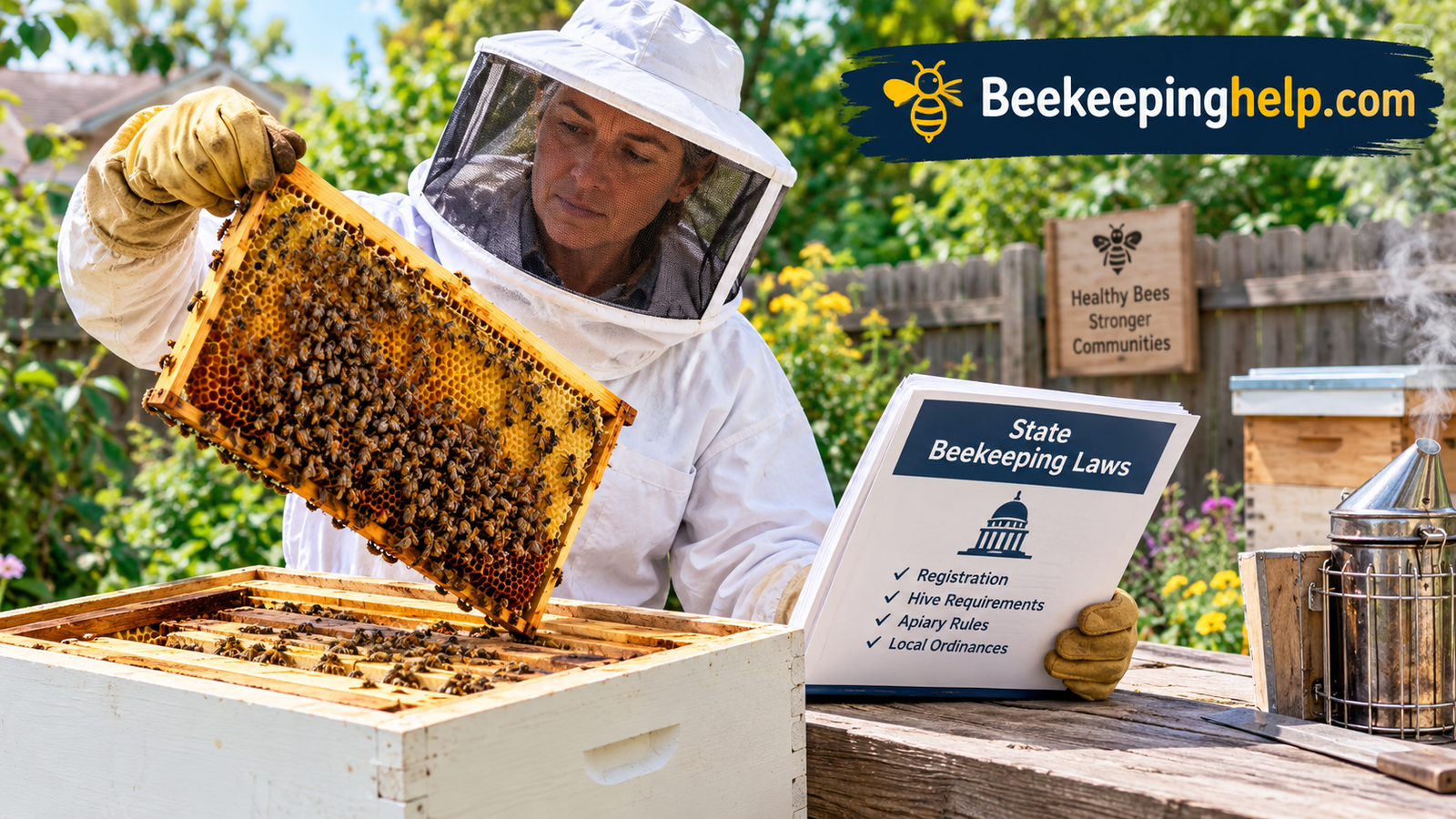
Beekeeping Laws by State: A Practical Guide to Registering, Placing, and Selling Legally
Rules for keeping bees change at every border you cross — state line, county line, city limit, and sometimes the subdivision entrance. This guide explains who regulates what, what nearly every state requires, and exactly which questions to ask before your first colony arrives.
Why Beekeeping Laws Matter More Than Most Beginners Realize
Beekeeping sits in an unusual legal space. A beehive is agricultural livestock in some places, a hobby animal in others, and a regulated pollinator resource almost everywhere. That means the answer to “am I allowed to keep bees here?” is never a simple yes or no — it depends on which layer of government is asking.
New beekeepers usually worry about the wrong things. They spend weeks comparing boxes and frames, then discover after the bees arrive that their city requires written registration, their subdivision forbids “livestock,” or their state requires the owner’s name on every hive body. None of those problems are hard to solve. All of them are much easier to solve before a colony is sitting in the backyard.
The good news is that beekeeping regulation in most places is designed to be supportive rather than punitive. State apiary programs exist primarily to track and contain brood diseases such as American foulbrood, and the inspectors who run those programs are often the most knowledgeable beekeepers you will ever meet. Registration is usually inexpensive, inspections are frequently free, and many of the people enforcing the rules are genuinely delighted when a new beekeeper calls to ask a question.
The tricky part is that the rules live in four different places at once: federal policy sets the broad agricultural framework, state apiary statutes handle registration and disease control, county and municipal zoning codes decide where hives may physically sit, and private covenants from a homeowners association can add yet another layer on top. A setup that is perfectly legal under state law can still violate a subdivision covenant, and a setup approved by the city can still run into a state requirement about hive labels or movement permits.
That is what this guide is built to sort out. We will work through registration, placement, selling honey and hive products, disease law, moving bees across state lines, neighbor disputes, insurance, pesticides, and the recordkeeping habits that keep you compliant year after year. Along the way you will find comparison tables you can scan in under a minute, plus links to hands-on guides covering everything from how to start beekeeping to the finer points of beekeeping practice in the apiary.
The Golden Rule of Beekeeping Compliance
Ask before you place, register before your bees arrive, and keep every document. That single habit resolves the overwhelming majority of legal problems beekeepers run into.
Starting Your First Hive?
Get your gear lined up while you sort out registration.
Check Starter Kits on AmazonWho Actually Makes and Enforces Beekeeping Laws
Before you can follow the rules, it helps to understand who wrote them and who shows up if something goes wrong. Beekeeping regulation in the United States developed in response to a genuine agricultural emergency: outbreaks of American foulbrood in the early era of commercial beekeeping threatened not just individual apiaries but the pollination capacity of entire regions. States responded by passing apiary acts — statutes that gave agricultural officials the power to inspect colonies, order treatment, and in the worst cases destroy infected hives to protect the surrounding area.
That origin story explains almost everything about how bee law works today. It is disease-centered first and nuisance-centered second. When a state requires registration, the underlying purpose is traceability: if foulbrood shows up in an apiary, inspectors need to know which colonies moved where. When a city limits the number of hives per lot, the underlying concern is usually neighbor relations rather than pollinator health. Understanding which concern drives which rule makes it far easier to negotiate.
The four layers of regulation
| Layer | Who Administers It | What It Usually Controls | Typical Trigger |
|---|---|---|---|
| Federal | Agricultural and environmental federal agencies | Interstate movement, pesticide labeling, conservation programs, national organic standards | Crossing state lines or selling across state lines |
| State | State department of agriculture, apiary inspection program | Apiary registration, hive identification, brood disease control, movement certificates | Buying bees, moving hives, disease report |
| County / City | Planning, zoning, and code enforcement offices | Number of hives, setbacks, placement height, water sources, nuisance conditions | Complaint from a neighbor or a permit application |
| Private covenant | Homeowners association or landlord | Whether any animals or “livestock” are allowed at all | Visible equipment, fencing, or a neighbor complaint |
Who you will actually be talking to
In practical terms, three people matter most. The first is your state apiarist or apiary inspector — the person who handles registration, inspects colonies for brood disease, and signs the certificates you need when moving bees. The second is your local zoning officer, who decides whether your property is classified in a way that permits hives and how many. The third is your county agricultural extension agent, who may not have enforcement power but almost always knows both of the first two people personally.
It is worth noting that enforcement style varies enormously. Some states run active inspection programs with staff who visit commercial operations on a schedule. Others rely almost entirely on complaint-driven contact and voluntary registration. Neither approach is more “strict” in a way that matters to you; what matters is that in both cases, the beekeeper who registered and cooperated is treated very differently from the beekeeper who never made contact.
- Disease authority: Inspectors can generally open colonies, order treatment, restrict movement, and require destruction of infected equipment.
- Registration authority: Most states require apiary registration, and some require renewal with updated colony counts and locations.
- Nuisance authority: Local governments respond to complaints about stinging, swarming, odor, standing water, and excessive colony numbers.
- Commerce authority: Selling honey, bees, queens, or nucs can trigger food safety, labeling, and business registration requirements.
If you are still in the research phase, it helps to understand the equipment you will eventually register and place. A clear picture of the parts of a bee hive and their functions makes conversations with inspectors and zoning officers much easier, because you will be able to describe exactly what you plan to install and where.
Build Your Beekeeping Library
Good references shorten every legal conversation.
Browse Beekeeping Books on AmazonApiary Registration: The One Rule Almost Every State Shares
If there is a single requirement you should assume applies to you, this is it. Most states require beekeepers to register their apiary — the physical location where colonies are kept — with the state department of agriculture or its designated apiary program. Some states require registration before bees arrive on the property. Others allow a short grace period. All of them expect the registration to be kept current when you add colonies or move the apiary to a new location.
Registration is not a licensing exam and it is not a zoning approval. It is a database entry that tells the state which properties hold honey bee colonies. That information serves three purposes: disease traceability, spray notification for nearby agricultural applications, and emergency response if an invasive pest is detected in the region.
What you will typically be asked for
Exact forms vary, but the questions are remarkably consistent from state to state. Having these details ready makes registration a five-minute task rather than a research project.
- Your name and contact information, including the person responsible for the colonies if that is not you.
- The physical location of the apiary, often with directions that a driver can follow without a navigation app.
- The number of colonies present, and in some states the maximum number you expect to maintain.
- Whether the apiary is permanent or migratory, which matters if you move hives for pollination.
- Hive identification details, since many states require the owner’s name and address or a registration number to appear on the hive body.
- Landowner consent if you do not own the property where the colonies sit.
Hive labels, tags, and identification
Identification rules are one of the most commonly missed details. A number of states require that each hive body or colony location carry the name and address of the owner, or a registration number issued by the state. This is not busywork. If a colony swarms into a neighbor’s yard, ends up in a public park, or is found to be the source of a disease spread, the label is what lets an inspector contact you without issuing a citation.
The practical approach is simple: label everything at the time you assemble it. Weatherproof labels on the back or side of the hive body, away from the entrance, stay legible longer and do not disturb the bees during inspections. If you keep out apiaries on other people’s land, label them clearly and give the landowner a copy of your registration.
| Item | Why It Is Needed | How to Prepare |
|---|---|---|
| Apiary address | Identifies the exact location for inspectors and spray notification | Write directions a driver can follow without GPS |
| Colony count | Tracks scale of operation and disease exposure | Update whenever you add colonies, split, or sell |
| Owner identification | Allows contact if a colony is lost, swarms, or is involved in a complaint | Apply durable labels to hive bodies before install |
| Landowner consent | Required when hives sit on rented or borrowed land | Keep a short signed note or agreement on file |
| Renewal date | Lapsed registrations can draw fines and complicate movement certificates | Calendar the renewal alongside your seasonal tasks |
What happens if you skip registration
Usually not much — until something goes wrong. Beekeepers who are unregistered rarely get caught through routine inspection. They get caught when a neighbor complains, a colony is found in a public space, an inspector traces a disease outbreak, or a delivery of bees is checked at a state line. At that point, the difference between “my registration is current” and “I did not know I had to register” is the difference between a friendly conversation and a formal order.
Registration also matters personally. If you are buying colonies or equipment from another beekeeper, being registered gives you a documented claim to what you own and where it is kept — details that become important in an insurance claim or a property dispute. New beekeepers comparing first-year expenses should also look at whether you can keep bees in your backyard before committing to equipment purchases, because local placement rules sometimes change the plan.
And if you are still assembling your first colony, registration goes hand in hand with sourcing bees properly. Understanding what a nuc is in beekeeping will help you ask sellers the right questions about health certificates and documentation.
Ready for Your First Colony?
Compare hive kits while your registration clears.
Check Beehive Kits on AmazonZoning, Setbacks, and Local Ordinances: Where Most Disputes Begin
State law may say your bees are welcome. That does not mean your parcel is zoned in a way that allows them. Local ordinances are where beekeeping plans most often stall, and local rules are the ones beekeepers are least likely to research in advance.
Municipal and county codes treat bees in a few different ways. Some jurisdictions classify honey bees as livestock, which means a property has to be zoned for agricultural or animal-keeping use. Others treat a small number of backyard hives as an accessory use, similar to a garden shed, and regulate only the number and placement. A growing number of municipalities have written specific apiary ordinances that set clear limits and, in exchange, give beekeepers a legal pathway to keep hives as long as they comply.
The provisions you are most likely to encounter
| Provision | What It Typically Says | How Beekeepers Handle It |
|---|---|---|
| Colony limit | Maximum number of colonies based on lot size or zoning class | Keep fewer hives on site and place extras at an out apiary |
| Setback | Minimum distance from property lines, structures, or public rights-of-way | Orient entrances toward a fence or hedge and move the stand inward |
| Water requirement | A water source must be available on the property so bees do not visit neighbors | Install a shallow, floated water station and keep it filled |
| Flyway barrier | A fence, hedge, or screen near the hive entrance forcing bees to fly upward | Plant a hedge or install lattice at least as tall as the hive stand |
| Nuisance clause | No condition that endangers or unreasonably disturbs neighbors | Manage swarming, keep colonies gentle, and respond to complaints quickly |
| Registration with the city | A local permit or notification separate from state registration | Apply early and keep the permit visible with the apiary records |
How to find your ordinance without wasting a week
Municipal codes are searchable online in most places, but the terminology is rarely friendly. Search for the words apiary, bee, livestock, animal keeping, and nuisance rather than “beekeeping.” If the code is silent on bees entirely, the general animal-keeping or nuisance provisions still apply, which is exactly why a conversation with the planning office is worth having.
When you make that call, ask three questions and ask them in writing: Are honey bees permitted on my parcel? How many colonies are allowed, and does that number change with lot size? What placement conditions apply? A short email confirming the answers becomes your evidence if a neighbor later disputes the setup.
Placement strategies and their trade-offs
| Approach | Pros | Cons |
|---|---|---|
| Back corner of the lot | Maximum distance from neighbors; easy screening with plantings | Longer carry distance for heavy supers; less visibility for monitoring |
| Elevated on a stand or roof | Fence-line compliance; keeps equipment away from children and pets | Harder inspections; requires safe access and weather protection |
| Out apiary on borrowed land | Removes local limits; often better forage and fewer neighbor issues | Travel time; requires landowner agreement and separate registration |
| Community garden or shared lot | Built-in public support; shared labor and visibility | Multiple stakeholders; liability and access questions to resolve |
Placement is also a design question, not only a legal one. The orientation of the entrance, the height of the stand, and the surface beneath the hive all affect how bees behave and how neighbors experience them. Reading up on where to place a beehive before you drill a single hole will save you from relocating a populated hive later — a task that is legal, physical, and unpleasant all at once.
Two smaller legal details come up more often than expected. First, some municipalities restrict structures visible from the street, which can affect fencing, shed storage, and even the color of hive bodies; how to paint a beehive is worth reading if your ordinance touches exterior appearance. Second, feral colonies in trees can fall under different rules entirely — if a colony is established in a hollow on public land, removal usually requires a licensed individual rather than a hobbyist with a ladder. Our guide to types of beehives in trees covers what to do when nature sets up an apiary without asking.
Setting Up a Compliant Hive Stand
Sturdy, level stands keep inspectors and neighbors happy.
Shop Beehive Stands on AmazonThe State-by-State Regulatory Landscape
Every state has an apiary program, but the shape of those programs differs. Understanding which category your state falls into tells you what to expect and what to ask first. The tables below are organized by region and are designed as a starting point for your own research rather than a substitute for it.
Four program styles you will see across the country
- Registration-led states: Registration is straightforward, inspections are largely voluntary or complaint-driven, and the emphasis is on traceability.
- Inspection-led states: Inspectors actively visit operations, and certificates of inspection are expected when colonies change hands or move.
- Permit-led states: Moving bees, selling bees, or bringing in used equipment requires advance paperwork, sometimes with quarantine periods.
- Delegated states: The state sets the framework while counties or agricultural districts administer registration, placement, and enforcement locally.
Where to start: regional reference
In every case, the fastest path is to search your state name with the phrase “apiary registration” and contact the program directly. Ask about registration timing, hive identification, movement certificates, and any rules specific to selling bees or honey.
| State | Program Home (Typical) | Confirm Before Your Bees Arrive |
|---|---|---|
| Connecticut | State department of agriculture, apiary program | Registration timing and any municipal colony limits |
| Maine | State agriculture department, apiary inspection | Hive identification and wintering rules in your town |
| Massachusetts | State agricultural resources department | Board of health involvement and local registration |
| New Hampshire | State agriculture department, apiary program | Registration and disease reporting expectations |
| New Jersey | State agriculture department, apiary inspection | Municipal ordinance language on “livestock” |
| New York | State agriculture and markets department | Registration deadlines and local setback standards |
| Pennsylvania | State agriculture department, apiary services | Registration of apiary locations and colony counts |
| Rhode Island | State environmental management agency | Local permitting and lot size thresholds |
| Vermont | State agriculture agency, apiary program | Registration and any town-level placement rules |
| State | Program Home (Typical) | Confirm Before Your Bees Arrive |
|---|---|---|
| Alabama | State agriculture and industries department | Registration and hive labeling expectations |
| Arkansas | State plant board, apiary program | Movement paperwork and inspection availability |
| Delaware | State agriculture department | Registration timing and county placement rules |
| Florida | State agriculture and consumer services department | Registration requirements and hive certificate rules |
| Georgia | State agriculture department, apiary inspection | Registration and requirements for selling colonies |
| Kentucky | State agriculture department, apiary program | Registration and any county-level limits |
| Louisiana | State agriculture and forestry department | Registration, inspection access, and movement rules |
| Maryland | State agriculture department, apiary program | County registration and setback requirements |
| Mississippi | State agriculture and commerce department | Hive identification and local ordinance language |
| North Carolina | State agriculture and consumer services apiary division | Registration timing and requirements for bee sales |
| South Carolina | State plant industry program | Registration and inspection scheduling |
| Tennessee | State agriculture department, apiary inspection | Registration and movement certificate rules |
| Texas | State apiary inspection service | Registration, hive identification, and county-level ordinances |
| Virginia | State agriculture and consumer services department | Registration and local placement standards |
| West Virginia | State agriculture department, apiary program | Registration and hive marking expectations |
| District of Columbia | Local agriculture and health agencies | Urban apiary permitting and rooftop placement rules |
| State | Program Home (Typical) | Confirm Before Your Bees Arrive |
|---|---|---|
| Illinois | State agriculture department, apiary program | Registration timing and municipal colony caps |
| Indiana | State agriculture department | Registration and local placement ordinances |
| Iowa | State agriculture department, apiary inspection | Registration and hive identification |
| Kansas | State agriculture department | Registration and movement documentation |
| Michigan | State agriculture and rural development department | Registration, inspection access, and local limits |
| Minnesota | State agriculture department, apiary program | Registration and requirements for selling colonies |
| Missouri | State agriculture department | Registration and county-level placement rules |
| Nebraska | State agriculture department, apiary program | Registration and hive marking standards |
| North Dakota | State agriculture department | Registration for migratory operations and movement |
| Ohio | State agriculture department, apiary program | Registration and local nuisance provisions |
| South Dakota | State agriculture department | Registration and movement between yards |
| Wisconsin | State agriculture, trade and consumer protection | Registration and colony count expectations |
| State | Program Home (Typical) | Confirm Before Your Bees Arrive |
|---|---|---|
| Alaska | State agriculture program | Registration and wintering expectations |
| Arizona | State agriculture department | Registration and Africanized bee protocols |
| California | State food and agriculture department, administered by county agricultural commissioners | County registration, placement, and hive access rules |
| Colorado | State agriculture department, apiary program | Registration and local ordinance thresholds |
| Hawaii | State agriculture department | Registration and strict import requirements |
| Idaho | State agriculture department | Registration and movement certificates |
| Montana | State agriculture department, apiary program | Registration for migratory and stationary yards |
| Nevada | State agriculture department | Registration and county placement standards |
| New Mexico | State agriculture department | Registration and hive marking expectations |
| Oregon | State agriculture department, apiary program | Registration, local limits, and swarm response rules |
| Utah | State agriculture and food department | Registration and inspection scheduling |
| Washington | State agriculture department, apiary program | Registration and movement or sales documentation |
| Wyoming | State agriculture department | Registration and landowner permission for out yards |
Two states, two different conversations
Planning to keep bees in the Sun Belt? Read our guide to how to start beekeeping in Texas, which covers how a large, county-influenced state handles registration and placement. Elsewhere, the fundamentals are similar even when the paperwork differs.
Build a Reference Shelf
Regional beekeeping guides make state rules easier to apply.
Find Beekeeping Handbooks on AmazonHive Limits, Lot Size, and Placement Standards
Ask ten beekeepers how many hives a residential lot can legally hold and you will get ten answers — because the correct answer depends entirely on the lot, the municipality, and how the ordinance defines a “colony.” This section breaks down the frameworks you will encounter and how experienced beekeepers work within them.
How limits are usually written
Most ordinances use one of three approaches. The first is a flat cap: a set number of colonies for any residential parcel regardless of size. The second is a graduated scale that ties the allowed number to lot area, sometimes expressed as colonies per acre or per unit of land. The third is performance-based, with no fixed number but a nuisance standard that can be enforced if neighbors complain.
What almost all of them share is an expectation of good husbandry. Well-managed colonies that do not swarm into neighbors’ yards, that have a reliable water source, and that are kept on clean, maintained equipment rarely generate complaints. Complaints are what bring inspectors and code enforcement to a property, and complaints are almost always preventable.
Placement factors regulators actually care about
| Factor | Why It Matters Legally | What Good Practice Looks Like |
|---|---|---|
| Distance from boundaries | Most placement disputes start with proximity to a neighbor’s space | Set hives back from property lines and aim entrances away from traffic |
| Flight path height | Bees flying at head height near patios trigger complaints quickly | Raise the stand and use a hedge, fence, or screen as a flyway barrier |
| Water access | Bees seeking water in pools, pet bowls, or birdbaths are a top complaint source | Provide shallow water with floats and place it before installing colonies |
| Visibility | Visible hives can attract attention in restrictive subdivisions | Screen with plantings and keep the area tidy and well maintained |
| Colony temperament | Defensive colonies are the most common source of formal complaints | Requeen aggressive colonies and inspect during calm, warm conditions |
| Swarm control | Swarms draw emergency calls and can strand colonies in public spaces | Inspect on a schedule and manage buildup before the swarm impulse |
Rural, suburban, and urban differences
On agricultural land, beekeeping is usually treated as a normal farm activity and placement rules are minimal. In suburban municipalities, expect the most detailed ordinances and the most sensitive neighbors. In dense urban settings, rooftop and community garden apiaries often work well precisely because they solve the setback problem by putting distance vertically rather than horizontally.
Urban beekeeping also introduces building considerations. Rooftop hives need weight allowances, safe access for inspections, and a plan for moving supers down safely. Neighbors below deserve a conversation, and many building managers respond well to a short written plan that covers hive count, access, and swarm response.
Equipment choice interacts with placement too. A setup that suits a large rural yard may be awkward on a balcony or rooftop, and different hive designs handle transportation and elevation differently. Comparing designs through beehive types with pictures and understanding how a beehive works will help you choose a system that fits both your space and your local rules. If you are comparing specific designs, our look at Flow Hive versus Langstroth covers how the two approaches differ in handling and space needs.
Choose the Right Hive for Your Space
Compare formats that fit your lot and your local limits.
Check Langstroth Hives on AmazonSelling Honey, Beeswax, and Value-Added Products Legally
Honey is one of the most commonly permitted home-produced foods, and many beekeepers sell at farm stands and markets without ever touching a commercial kitchen. But the moment you exchange honey for money, you are a food producer in the eyes of the law — and the rules that apply depend on what is in the jar, where it came from, and who you are selling it to.
Cottage food rules and honey
Most states maintain a cottage food framework that allows certain low-risk foods to be produced in a home kitchen and sold directly to consumers. Honey is frequently included, sometimes with conditions: it must be produced by the seller’s own colonies, sold direct to the end consumer, and labeled according to a prescribed format. Sales to restaurants, grocery stores, or online buyers in other states often fall outside the exemption entirely.
The trap is infusions. Plain honey is one thing; honey infused with garlic, chili, herbs, or fruit is frequently classified differently, because the added ingredient changes the safety profile. Dried herb blends are often treated more leniently than fresh ingredients, but this is exactly the question to put to your state food safety program before you produce a single case.
Product categories and their regulatory buckets
| Product | Typical Regulatory Bucket | Common Requirement |
|---|---|---|
| Raw honey | Cottage or small-scale food exemption | Producer identification, net weight, product name, direct sales only |
| Comb honey | Cottage or small-scale food exemption | Same labeling basics, plus clean handling and pest protection |
| Beeswax blocks and candles | Usually not food; product safety standards apply | Accurate description, safe materials, and clear labeling |
| Lip balm and salves | Cosmetic or topical product rules | Ingredient listing and cosmetic labeling expectations |
| Infused honey | Often falls outside basic cottage exemptions | Verify classification before production; may need a commercial process |
| Mead and honey alcohol | Alcoholic beverage regulation | Licensing, bonding, and separate production rules entirely |
Labeling essentials
Even when a full nutrition panel is not required, certain elements are nearly universal. Get these right on the first print run and you will avoid reprinting labels later.
- Product identity: State plainly what the container holds — honey, comb honey, creamed honey, or beeswax.
- Net quantity: The amount of product in the container, expressed in standard units.
- Producer information: Name and address of the person or business that produced and packaged it.
- Required disclaimers: Some states require a phrase indicating the product was made in a home kitchen not subject to routine inspection.
- Truthful claims: Avoid health claims, and be careful with terms such as “pure,” “raw,” or “local,” which can carry specific expectations.
Two routes to market compared
| Route | Pros | Cons |
|---|---|---|
| Home kitchen exemption | Low startup cost; simple paperwork; direct customer relationships | Sales limited to direct-to-consumer channels; revenue caps in many states |
| Commercial kitchen | Access to wholesale, retail, and online channels; broader product range | Higher cost, inspections, licensing, and ongoing compliance obligations |
Storage and handling matter legally as well as practically. Crystallization, moisture content, and fermentation all affect whether a batch is fit for sale, and a single complaint about a fermenting jar can bring a food safety inspection. Our guide to how to store honey covers the handling habits that keep product consistent. And if you are thinking about scaling up, it is worth reading whether beekeeping is profitable before you invest in commercial-grade extraction and packaging.
Bee Health Laws: Inspections, Disease Reporting, and Quarantines
This is the legal heart of beekeeping regulation. Everything else — registration, movement permits, hive labels — exists to support the single goal of keeping serious brood diseases from spreading. If you understand this section, you will understand why inspectors ask for what they ask for.
What inspectors are looking for
Apiary inspections focus on a handful of conditions with real regulatory consequences. American foulbrood is the most serious: a bacterial disease of bee larvae that produces durable spores surviving for decades in equipment. European foulbrood is generally more manageable but still reportable in many jurisdictions. Varroa mite infestation levels matter increasingly as states track resistance patterns. Small hive beetle, tracheal mites, chalkbrood, and sac brood round out the list of concerns most inspectors watch.
Importantly, an inspector’s visit is usually an opportunity rather than a threat. Inspections are commonly offered at no cost to the beekeeper, and early detection is far cheaper than losing an apiary. Many experienced beekeepers schedule an inspection every year specifically because it gives them an expert second opinion.
Conditions and typical regulatory responses
| Condition | Why It Matters Legally | Typical Response |
|---|---|---|
| American foulbrood | Highly infectious, long-lived spores threaten neighboring operations | Quarantine, treatment orders, and in severe cases destruction of equipment |
| European foulbrood | Spreadable through drifting bees and shared equipment | Management advice, possible movement restrictions, follow-up inspection |
| Varroa mites | Drives colony loss and resistance patterns states monitor | Treatment guidance and monitoring recommendations |
| Small hive beetle | A regulated pest in some regions, spread by movement of equipment | Advice on traps and yard management; movement rules in some areas |
| Unknown colony loss | Sudden losses can indicate pesticide exposure or an emerging pest | Investigation, sampling, and possible involvement of other agencies |
Your obligations as the beekeeper
Most states place a positive duty on beekeepers to report suspected brood disease, and many require notification before selling or moving colonies. Beyond the legal duty, there is a practical one: colonies that are struggling due to disease or pests also become sources of robbing and drift, which spreads the problem to neighbors’ hives. Understanding what robbing is in beekeeping and how to prevent it is part of responsible disease management.
Seasonal stress amplifies health problems. During a dearth, colonies that are starving rob each other and spread disease across the neighborhood. Swarm season creates its own risk profile — a colony that swarms into a wall cavity is both a nuisance and a potential disease reservoir, so understanding what swarming is in beekeeping and controlling it is a legal matter as much as a husbandry one.
- Keep an inspection log with dates, findings, and any treatment applied.
- Record mite counts so you can demonstrate monitoring rather than guessing.
- Store treatment receipts and follow label directions exactly — off-label use creates both health and legal risk.
- Retire and dispose of old comb and equipment properly rather than passing it along to a new beekeeper.
Stay Ahead of Mite Pressure
Monitoring tools make your records far more convincing.
Check Mite Monitoring Kits on AmazonMoving Bees Across State Lines (and Selling Bees and Nucs)
Colony movement is the point where beekeeping law becomes genuinely interstate. Bees travel with the seasons and with the pollination calendar, and states protect themselves by requiring documentation for colonies coming in from elsewhere. Even a hobbyist who buys a single nuc from a seller two states away can trigger a requirement.
Documents commonly requested
| Scenario | Documents Often Needed | Common Pitfalls |
|---|---|---|
| Buying bees from another state | Certificate of inspection from the origin state, sometimes a destination permit | Arranging paperwork after the pickup date |
| Moving your own colonies | Registration details and an inspection certificate for the destination | Not updating the apiary location on your registration |
| Transporting used equipment | Sometimes a permit or a declaration of condition | Assuming empty boxes are unregulated |
| Selling colonies or nucs | Seller registration, inspection status, and truthful labeling | Selling without confirming the buyer’s state requirements |
| Pollination contracts | Colony strength documentation, placement terms, and dates | Verbal agreements with no record of colony condition |
Buying bees the compliant way
Whether you are buying a package, a nuc, or a full colony, ask the seller for three things before money changes hands: proof of registration in their state, evidence of a recent inspection or health certificate where required, and a clear description of queen status and colony condition. Reputable sellers answer these questions without hesitation, because they are questions every serious beekeeper asks.
The sourcing decision shapes your legal exposure more than most beginners realize. Local bees adapted to your region often arrive with simpler paperwork and better overwintering odds. If you want a walkthrough of the buying process and the questions to ask, see our guide on how to buy bees for beekeeping.
If you plan to sell bees yourself
Bee selling is a business activity with its own obligations. Many states require sellers of colonies, packages, or queens to be registered and to meet inspection standards. Sales across state lines add destination-state requirements, and buyers increasingly expect written documentation of what they are purchasing. Keep records of every transaction: date, buyer, colony description, queen status, and any certificate issued.
Transportation practice matters too. Colonies move best at night when foragers are home, with ventilation secured and entrances open at rest stops in safe locations. Overheating during transport kills more colonies than legal paperwork ever will.
Transport Colonies Safely
Straps and ventilation gear protect your investment in transit.
Shop Transport Gear on AmazonNeighbors, Nuisance Laws, Liability, and Insurance
Most legal trouble in beekeeping does not come from the state. It comes from the property line. Sting complaints, swarms landing on a neighbor’s porch, bees drinking from a swimming pool, and hives that look alarming to someone unfamiliar with bees — these generate the calls that bring enforcement to your gate.
What neighbors are actually reacting to
| Complaint | Root Cause | Fix |
|---|---|---|
| “Bees are everywhere” | Bees seeking water or drifting between colonies | Install a nearby water source and reduce entrance congestion |
| “I got stung” | Defensive colonies, a swarm, or a foraging sting far from the hive | Requeen aggressive colonies and review placement and timing |
| “There is a swarm in my yard” | Missed swarm control during buildup | Increase inspection frequency and maintain swarm control measures |
| “Your hives look unsafe” | Unkempt equipment, leaning stacks, or poor visibility | Maintain tidy stands, secured lids, and clear access paths |
| “Bees near the patio” | Flight path at human height near a sitting area | Raise the stand and add a hedge or screen to redirect flight |
Liability in plain language
Bee stings are usually treated under general negligence principles rather than strict liability. In practice, that means the question is whether you acted reasonably: did you keep gentle stock, maintain your equipment, respond to complaints, and follow applicable rules? A beekeeper with documented inspections, current registration, and a friendly relationship with neighbors is in a very different position from one who ignored repeated complaints.
Two habits carry disproportionate weight. The first is documentation: a simple log of inspections, treatments, and neighbor conversations shows you were attentive. The second is communication: knocking on the door to say “I’m putting bees in the back corner, here is my number if anything concerns you” disarms most problems before they start.
Insurance
Standard homeowner policies often contain exclusions or limitations around animal liability, and some insurers treat apiaries as an agricultural exposure requiring separate coverage. Umbrella liability policies, specialty beekeeping coverage, and policies carried by beekeeping associations are the most common solutions. If you sell products, carry bees for hire, or run pollination contracts, your coverage needs expand considerably.
Review your policy language rather than assuming. Ask specifically: Are bee stings covered? Is property damage caused by colonies covered? Are claims arising from sales or services covered? Our guide to beekeeping insurance walks through the questions worth asking an agent.
Protective gear and duty of care
Personal protection is part of the same picture. Visitors, family members, and helpers near an apiary should be properly equipped, and equipment should be maintained so it performs when needed. A suit inspection should be routine; see our bee suit review for what to look for, and keep gear clean with how to wash a bee suit. One question that comes up constantly is whether bee suits protect from wasps, especially in late summer when both are active.
Neighbor agreements: pros and cons
| Approach | Pros | Cons |
|---|---|---|
| Informal conversation | Fast, friendly, and low friction; keeps relations warm | No written record if memory differs later |
| Short written note | Documents hive count, placement, and your contact details | May feel formal to some neighbors; needs periodic updates |
| Shared honey arrangement | Builds goodwill and gives neighbors a stake in the apiary | Creates expectations; label and food rules still apply |
Glove care is another small duty-of-care detail. Cracked, stiff, or contaminated gloves fail at the wrong moment and encourage sloppy handling. Read up on how to clean beekeeping gloves and consider a backup pair; a good starting point is our roundup of the best beekeeping gloves.
Gear Up Before Guests Visit
Reliable protective equipment is part of responsible keeping.
Check Bee Suits on AmazonHOAs, Rentals, and Keeping Bees Where You Don’t Own the Land
A surprising number of beekeepers do not own the land their bees sit on. Renters, community gardeners, rooftop beekeepers, and anyone with an out apiary on a friend’s property all face the same question: who has the authority to say yes?
Homeowners associations
An HOA covenant is a private contract, and it can be stricter than local law. Where a city permits hives, an association can still prohibit them under a “no livestock” or “no animals” clause. Conversely, some associations have updated their covenants specifically to allow small apiaries, often with conditions about hive count, screening, and registration.
Read the covenants rather than asking a neighbor what they think they say. Look for definitions of “livestock,” “animal,” “structure,” and “nuisance.” If the documents are ambiguous, request a written determination from the board before installing colonies. In some regions, agricultural protection statutes limit how far associations can restrict genuine agricultural activity, but that is a question for local counsel rather than assumption.
Renters and shared land
| Situation | Key Document | What to Look For |
|---|---|---|
| Rental property | Lease agreement | Animal clauses, alterations, and liability language |
| Subdivision | HOA covenants and rules | Definitions of livestock or animals and any apiary provisions |
| Borrowed land / out apiary | Landowner agreement | Access, duration, indemnity, and who registers the site |
| Community garden | Garden rules and insurance certificate | Member consent, signage, and liability coverage |
| Rooftop or balcony | Building management approval | Weight limits, access, water, and neighbor notification |
What a landowner agreement should cover
A one-page agreement is usually enough. Identify the exact location, the number of colonies, who owns the bees, who is responsible for maintenance and stings, how long the arrangement lasts, and what happens to the hives if either party ends it. Include a line about registration and who carries insurance. Both parties should keep a copy.
Cost is often the barrier to entry rather than legality. Beginners underestimate the total outlay for bees, boxes, protective gear, tools, and feed. Our breakdown of how much it costs to start beekeeping gives a realistic picture, and how hard it is to start beekeeping covers the learning curve alongside the paperwork.
Plan Your First Season
Practical gear picks for small-space and shared-land hives.
Browse Beginner Gear on AmazonPesticides, Spray Notification, and Right-to-Farm Protections
The relationship between beekeepers and pesticide applicators is one of the most important — and most avoidable — legal flashpoints in agriculture. Both sides usually want the same thing: healthy crops and healthy pollinators. Communication is what keeps them from colliding.
Notification lists
Many states maintain registries where beekeepers can list the location of their apiaries so that applicators in the area can provide advance notice before certain treatments. Registration with these lists is separate from apiary registration in some states and combined in others. If your state offers a notification service, use it — it is one of the few compliance steps with immediate practical benefit.
Notification is not a guarantee. Weather, drift, and label violations all occur, and a written record of your apiary location becomes important evidence if exposure happens. Keep photos of colony condition before and after nearby applications, and note the date, product name if known, and wind direction.
Reducing exposure risk
| Risk | Preventive Step | Documentation |
|---|---|---|
| Drift onto the apiary | Site hives away from spray boundaries and downwind exposure zones | Photo record of hive placement and surrounding crops |
| Bloom-period treatments | Talk with neighboring growers about timing and alternatives | Written notes of conversations and agreed timing |
| Contaminated water | Provide clean on-site water so bees avoid treated puddles | Dates when water sources were installed and maintained |
| Spillage or dumping | Mark hives clearly so applicators know colonies are present | Registration number and signage visible in photographs |
| Suspected exposure | Report promptly to your apiary program and request sampling | Timeline of observations, weather, and colony behavior |
Right-to-farm: what it does and does not do
Agricultural protection statutes, commonly called right-to-farm laws, generally protect established farming operations from nuisance claims when they follow normal agricultural practices. For beekeepers, the value of these statutes depends heavily on context — how the operation is defined, how long it has existed, and whether local ordinances recognize beekeeping as agriculture.
What these statutes do not do is shield negligence. A beekeeper who ignores disease, keeps aggressive stock next to a school, or leaves standing water for neighbors’ children is not protected by any statute. Good husbandry remains the strongest legal defense.
Feeding and management during risky periods
During dearth or after a spray incident, colonies often need supplemental feeding and close monitoring. Feeding practices can themselves become a nuisance if they attract robbing or wasps, so keep feeding contained and appropriate. Our guides cover what to feed a bee, along with a look at the best bee feeder options and how to make a bee feeder yourself. If you are preparing to work a stressed colony, review what to use in a bee smoker so the colony stays calm during an urgent inspection.
Keep Colonies Calm and Manageable
A reliable smoker makes emergency inspections far safer.
Check Bee Smokers on AmazonYour Compliance Roadmap: Records, Associations, and Staying Current
Everything in this guide becomes manageable when it is organized. The beekeepers who never seem to have legal trouble are not luckier — they simply have a routine that handles registration, records, and communication before problems have a chance to grow.
The compliance sequence
- Research your layers. Check state apiary requirements, county zoning, municipal code, and any HOA or lease language before buying anything.
- Register the apiary. Complete state registration and any local permit, and note the renewal date on your calendar.
- Label everything. Apply owner identification or registration numbers to hive bodies and keep spares for replacements.
- Prepare the site. Set stands, provide water, install a flyway barrier, and orient entrances before colonies arrive.
- Document the start. Record where your bees came from, who sold them, and any certificates you received.
- Keep records ongoing. Log inspections, mite counts, treatments, feeding, splits, sales, and neighbor conversations.
- Stay connected. Join your state and local beekeeping associations and attend inspector-led workshops.
- Review annually. Re-read your ordinances and registration status each season and update colony counts.
Recordkeeping habits worth building
A paper notebook works perfectly well and survives dead batteries. What matters is consistency: one entry per inspection, with date, weather, colony temperament, brood pattern, food stores, mite observations, and any action taken. When a neighbor complains, an inspector visits, or an insurer asks a question, that notebook turns a subjective disagreement into a documented history of responsible management.
- Apiary register: Locations, colony counts, registration numbers, and landowner contacts.
- Health log: Inspections, treatments applied with dates and product names, and mite monitoring results.
- Transaction file: Purchases of bees and equipment, sales of colonies and honey, and any certificates issued.
- Correspondence folder: Emails with zoning officials, inspectors, neighbors, and landowners.
Where to keep learning
Regulations evolve, and husbandry knowledge reduces legal risk more than most people expect — gentle, healthy colonies simply generate fewer complaints. If you are still assembling your first setup, our guide to how to make a beehive and the explainer on how beehives are made cover construction, while how to improve your beekeeping skills focuses on the habits that make inspections smoother.
Tool choice matters during every inspection. Learn how a bee smoker works so you use it correctly rather than excessively, and keep a comparison of the best bee smokers in mind when yours wears out. Working calmly and predictably is the single biggest thing you can do to keep your neighbors comfortable with your bees.
Build Your Toolkit
The right tools keep inspections short and colonies calm.
Shop Beekeeping Tools on AmazonFrequently Asked Questions About Beekeeping Laws
Do I have to register my beehives?
In most states, yes — at least at the apiary level. Registration is usually inexpensive and handled by the state department of agriculture or its apiary program. Some states require it before bees arrive on the property, while others allow a short grace period. Registration is separate from any local permit your city or county may require.
Is it legal to keep bees in a residential backyard?
Often, yes, but it depends on your zoning classification and local ordinance. Some municipalities treat bees as accessory use, some classify them as livestock, and some have dedicated apiary rules. Search your municipal code for “apiary,” “bee,” “livestock,” and “nuisance,” then confirm with the planning office in writing.
How many beehives can I keep on my property?
That is set locally. Common frameworks include a flat cap per property, a graduated limit based on lot size, or a performance standard enforced only when problems arise. Rural parcels generally face fewer restrictions than suburban lots. Always ask how the ordinance counts colonies and whether seasonal increases count against your limit.
Can my homeowners association prohibit beekeeping even if the city allows it?
Yes. HOA covenants are private contracts and can be stricter than local law. Review the covenants for definitions of “livestock,” “animal,” and “nuisance,” and request a written determination from the board before installing hives. Some associations have adopted specific apiary provisions that permit small numbers of colonies under conditions.
Do I need a permit to sell honey?
Selling honey usually falls under a cottage food or small-scale food framework that allows direct sales to consumers, with specific labeling requirements. Selling to restaurants, retailers, or buyers in other states often takes you outside those exemptions. Infused honey, beeswax cosmetics, and honey alcohol each follow different rules entirely.
What information must appear on a honey label?
At minimum: the product identity, net quantity of contents, and the name and address of the producer. Many states also require a statement indicating the product was made in a home kitchen. Avoid health claims, and be cautious with terms like “pure,” “raw,” or “local,” which carry expectations you must be able to support.
What happens if a neighbor complains about my bees?
In most cases the first step is a conversation or a notice from code enforcement rather than a citation. Respond promptly, review the specific concern — stings, swarms, water, flight paths — and make changes such as requeening, adding a water source, or installing a flyway barrier. Document everything you do in response.
Does homeowners insurance cover bee stings?
Coverage varies. Some policies contain animal liability exclusions or limitations that apply to bees, while others cover incidents under general liability. Umbrella policies and specialty beekeeping coverage are common solutions. Ask your agent directly about sting liability, property damage caused by colonies, and claims arising from sales or pollination services.
Do I need paperwork to move bees across state lines?
Often, yes. Many states require a certificate of inspection for colonies entering from another state, and some require a permit for used equipment as well. Contact both the origin and destination programs before you move anything, and allow time for inspection scheduling.
Can an inspector force me to destroy my hives?
Inspectors generally have authority to order treatment, restrict movement, and in serious disease cases require destruction of infected colonies and equipment. American foulbrood is the usual trigger because its spores persist for decades. Cooperating early, keeping records, and requesting a second opinion where allowed all work in your favor.
Are beekeepers protected from pesticide exposure by law?
Protection is limited. Many states maintain spray notification lists for registered apiaries, and pesticide labels must be followed by applicators. Those tools reduce risk but do not eliminate it. Register your apiary for notification, mark hives clearly, communicate with nearby growers, and document conditions if exposure is suspected.
What is the very first step if I want to keep bees legally?
Research before you buy. Confirm that your parcel permits hives, how many are allowed, and what placement rules apply; then complete state registration and any local permit before your colonies arrive. That sequence avoids nearly every common compliance problem new beekeepers encounter.
Still Deciding Where to Start?
A solid starter kit removes the equipment guesswork.
Check Starter Kits on AmazonFinal Takeaways: Keep the Bees, Keep the Paperwork Simple
Beekeeping laws look intimidating in the abstract and turn out to be quite manageable in practice. Almost every requirement traces back to one of two goals: keeping disease from spreading and keeping neighbors comfortable. If your approach addresses both, you are compliant in spirit and usually compliant in fact.
The pattern that runs through this entire guide is sequence. Research your local rules before you buy equipment. Register the apiary before the bees arrive. Set up water and flyaway barriers before the first foragers take orientation flights. Keep records from day one rather than reconstructing them after a complaint. Each of these steps is small on its own, and together they create a property that inspectors and neighbors regard as an asset rather than a problem.
It also pays to remember that regulation is not the enemy of the hobby — it is the reason the hobby still exists. State apiary programs protected honey bees from diseases that once wiped out entire regions, and the registration you complete contributes to that shared defense. The beekeeper who answers the inspector’s questions and reports problems promptly is helping every other beekeeper within flying distance.
Finally, stay curious and stay connected. Rules change, ordinances get rewritten, and the best source of current local knowledge is almost always your state association and your local club. Pair that community knowledge with solid husbandry — good swarm control, gentle stock, clean equipment, and consistent inspections — and you will spend your time enjoying the apiary rather than explaining it.
Start Your Apiary the Right Way
Get the essentials lined up before your bees arrive.
Check Price on Amazon