Beginner Gear Guide
Best Beekeeping Starter Kit: 7 Complete Setups That Take You From Box to Bees
Between complete hives, box kits, beeswax coatings and tool sets, “starter kit” means seven different things. Here is what each one actually gives you, and which fits the way you plan to keep bees.

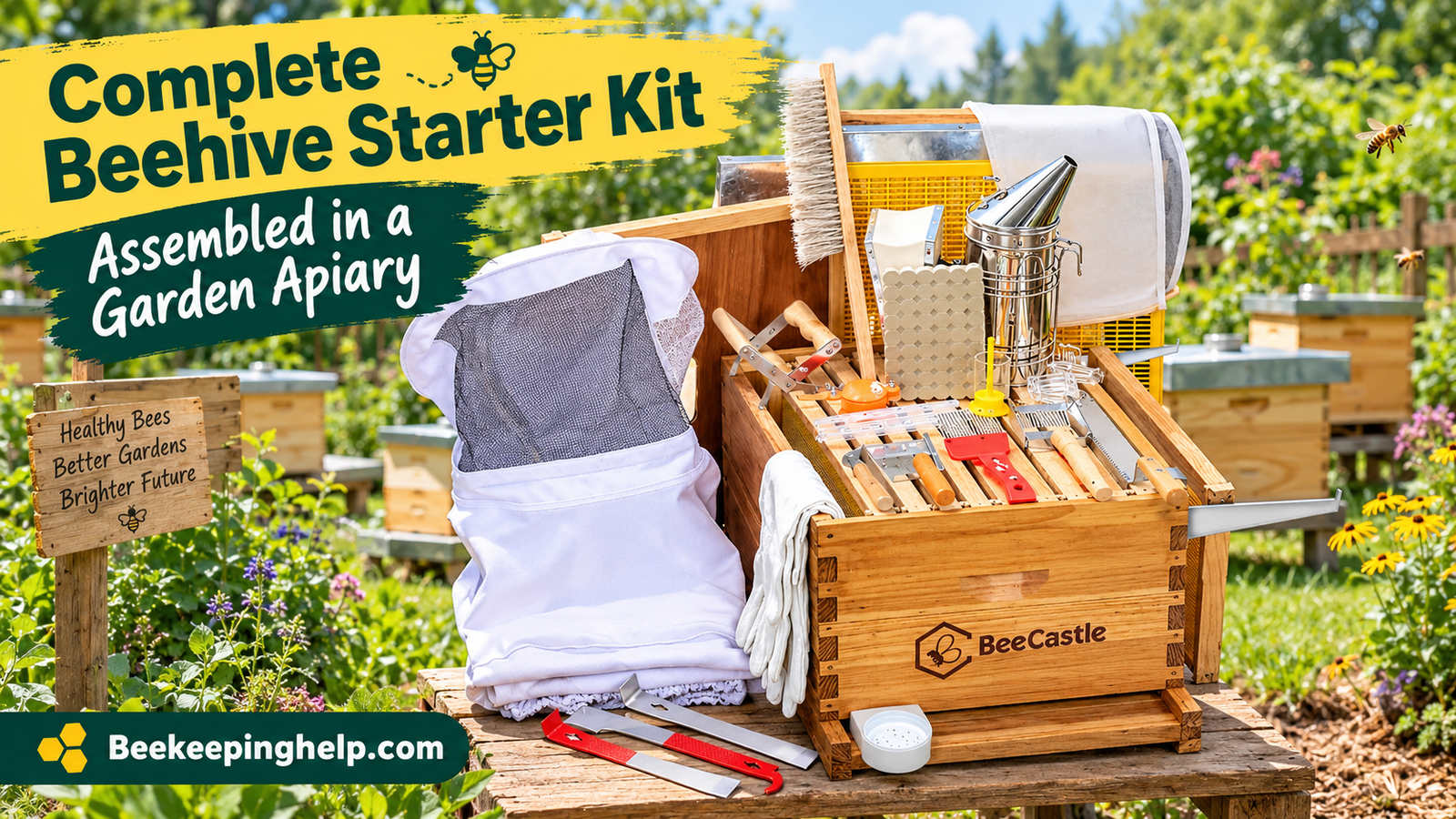
A coated hive body straight from the box: less prep work up front, more time learning to read your colony.
Why the Right Starter Kit Makes or Breaks Your First Season
Buying a beehive for the first time is a strange shopping experience. You are choosing equipment you have never touched, for an animal you have never managed, in a hobby where the difference between “this is wonderful” and “this is not for me” often comes down to whether your gear caused you problems in week one.
That is the real value of a good beekeeping starter kit. Not that it saves a few dollars, though it often does, and not that it arrives in one box, though that is convenient. The value is that it removes a hundred small decisions at the exact moment when you have no basis for making them. Frame spacing, foundation types, which cover goes where, whether you need a queen excluder before you own a single bee — these are questions that matter enormously and mean nothing to someone who has never opened a hive.
But here is the catch: the phrase “starter kit” covers at least three completely different products. Some are full, ready-to-house-bees hives with boxes, frames, foundation and covers. Some are box kits that give you the woodenware but assume you already understand how the pieces stack. And some are tool kits — the hive tools, smokers and brushes that turn a wooden box into a working hive. Knowing which of those you are looking at is the difference between a smooth start and a second round of shopping.
This guide breaks down seven of the most popular options across those categories: the BeeCastle 10-Frame Complete Beehive Kit, the Honey Lake 8-Frame Beehive Starter Kit, the Hoover Hives Original Beeswax Coated Kit, the MayBee 8-Frame Beeswax Coated Starter Kit, the ThxBees 10-Frame Complete Hive Kit, the Honey Keeper 20-Frame Complete Box Kit, and the Leriton 30-Piece Beekeeping Tool Kit. Some are complete setups, some are box kits, and one is purely the tools — and we will be clear about which is which, because the marketing language around these products is not always.
If you have never kept bees at all, it is worth reading a broad overview of beekeeping first, or our step-by-step introduction to how to start beekeeping. Gear choices land very differently once you understand the shape of a season. And if you are still weighing whether the hobby fits your life and your property, our guides on keeping bees in your backyard and how hard it is to start beekeeping set honest expectations before you spend anything.
Shopping for Your First Setup?
Compare complete hive kits and see what is included before you buy.
Check Price on AmazonQuick Comparison: Our Top Picks
Every kit in this guide appears below in one table so you can scan the differences before reading the full reviews. Descriptions reflect the general design and intended use of each product; always confirm current specifications and what is included on the product page before ordering, since bundle contents change.
| # | Image | Product | Key Specs | Verdict | Check Price |
|---|---|---|---|---|---|
| 1 |  |
Top PickBeeCastle 10-Frame Complete Beehive KitBest Overall Starter Kit |
|
The most complete path from delivery day to first bees. | Check Price on Amazon |
| 2 |  |
Honey Lake 8-Frame Beehive Starter KitBest Lightweight 8-Frame |
|
A sensible 8-frame start for smaller, lighter setups. | Check Price on Amazon |
| 3 | |
Hoover Hives Original Beeswax Coated KitBest Coated Woodware |
|
Skip the paint cans — the coating is already on. | Check Price on Amazon |
| 4 |  |
MayBee 8-Frame Beeswax Coated Starter KitBest Coated 8-Frame |
|
Coating convenience in a lighter, easier-to-lift format. | Check Price on Amazon |
| 5 |  |
ThxBees 10-Frame Complete Hive KitBest Complete 10-Frame |
|
Full-size hive ready for a colony that grows fast. | Check Price on Amazon |
| 6 |  |
Honey Keeper 20-Frame Complete Box KitBest for Expansion |
|
Extra frames and boxes for a colony heading toward harvest. | Check Price on Amazon |
| 7 |  |
Leriton 30-Piece Beekeeping Tool KitBest Tool Bundle |
|
The accessory set that turns woodware into working gear. | Check Price on Amazon |
See What Each Kit Includes
Open full listings to compare bundle contents and sizing.
Check Price on AmazonWhat a Beekeeping Starter Kit Actually Includes — and What It Doesn’t
Before comparing individual kits, it helps to know what the pieces are and what role each one plays. A Langstroth-style hive — the stacked-box design used by the overwhelming majority of beekeepers — is essentially a vertical apartment building, and every kit is a variation on the same floor plan.
The pieces that make a hive functional
At the bottom sits the bottom board, which forms the floor and usually creates the entrance. Above it goes the brood box or deep hive body, where the queen lays and the colony raises young. On top of that you stack additional boxes — often called honey supers — as the colony grows and the nectar flow arrives. Each box holds a row of frames that hang side by side, and each frame holds foundation, the sheet of wax or plastic that guides the bees into building straight, removable comb. Finally, an inner cover and a weatherproof telescoping outer cover seal the whole stack from rain and temperature swings.
Smaller components matter more than their size suggests. An entrance reducer narrows the doorway so a young colony can defend it. A queen excluder sits between brood boxes and honey supers, keeping the queen laying where you want her. Frame grips, nails, and assembly hardware round out most bundles.
What “complete” usually means
When a product is described as a complete hive kit, it typically includes the woodenware, frames and foundation needed to house a colony. The BeeCastle and ThxBees kits in this guide fall into that category, as do the coated options from Hoover Hives and MayBee. Box kits like the Honey Keeper 20-frame set focus on the boxes and frames themselves, which suits beekeepers who already have covers or who want to expand an existing hive.
What is almost never included
Bees, to start. No kit ships with a colony; you will need to arrange a package, a nuc, or a local split separately — our guide on how to buy bees for beekeeping and the explainer on what a nuc is in beekeeping cover those routes. Protective gear is another gap: most kits do not include a veil, jacket or gloves, though a few bundles throw in a hat. And while some kits include a basic hive tool or brush, a dedicated tool set like the Leriton bundle is usually a separate decision.
Also missing: knowledge of the parts themselves. If you have never seen a frame drawn out with comb, spend a few minutes with our diagram of the parts of a beehive and their functions and the walkthrough of how a beehive works. Understanding the floor plan makes every spec sheet on this page instantly readable.
One useful mindset shift: you are not buying a product, you are buying a system that you will expand. Everything you choose at the start — frame format, box size, coating — should still make sense when you own three hives instead of one. Our comparison of Flow Hive versus Langstroth explains why this particular system dominates, and our pictorial guide to beehive types shows the alternatives.
Ready to See the Options?
Browse complete beehive kits and compare what arrives in the box.
Check Price on AmazonHow We Picked These Starter Kits
Choosing a starter kit is less about finding the objectively best box and more about finding the box that matches how you intend to work. Someone keeping two hives in a suburban garden has completely different needs from someone running a dozen colonies across two out-apiaries. So instead of pretending there is one winner for every reader, we evaluated these kits across five dimensions that genuinely change the experience of starting out.
1. Completeness for a first hive
Does the kit get a beginner from delivery to a functional hive without another shopping trip? Complete kits score well here; box kits score differently, because they are designed for people who already know what else they need. We judge each product against its stated purpose rather than forcing everything into one scale.
2. Wood quality, joinery and finish
Hives live outdoors in full sun, driving rain and freeze-thaw cycles for years. The quality of the wood and the tightness of the joints determine whether your hive is still square and serviceable after several seasons or whether you are re-gluing corners during a nectar flow. Coated and pre-finished options score extra points here for beginners, because finishing is a step that is easy to get wrong and easy to skip.
3. Frame and foundation design
Frames are the working surface of the hive. A kit with well-made frames and foundation that the bees accept readily saves you from the discouraging experience of a colony that draws comb unevenly. We look at how frames fit, how many are included, and whether the foundation type is standard enough to source replacements.
4. Expandability and compatibility
Your first hive will grow. Kits built to standard dimensions mean you can add boxes and frames from any supplier later, rather than being locked into one brand’s ecosystem. Standard 8-frame and 10-frame formats are the safe bet here, and every kit in this guide follows those conventions.
5. Overall value for a growing operation
Price matters, but so does how much else you have to buy around it. A kit that costs slightly more but arrives finished and ready can be better value than a cheaper kit that needs paint, additional frames and a separate tool set before it is usable. Value also includes longevity — a hive that lasts many seasons spreads its cost across every inspection and every harvest it supports.
How we describe products. Rather than quoting measurements, ratings or bundle counts that can change without notice, we describe each kit by its format, finish and intended use — exactly as the product name and category suggest. Always confirm current details on the product page. For a broader look at the whole market, see our guide to the best beekeeping hives.
It is also worth saying what this is not: it is not a laboratory comparison, and no responsible evaluation involves installing colonies purely to generate data. Everything here reflects how these kits are used by real beekeepers — assembled on a weekend, placed on a stand, populated with a package or a nuc, and worked through a normal season. If you want the beginner’s version of that journey from the very beginning, start with how to start beekeeping.
Comparing Hive Kits Now?
Check formats and bundle details before you commit to a system.
Check Price on Amazon8-Frame vs 10-Frame: Choosing the Format You Will Still Like in Five Years
The single most consequential decision in this entire article is not which brand you buy — it is which frame format you commit to. Eight-frame and ten-frame equipment are not interchangeable, and once you own several boxes, switching means either selling everything or running two systems side by side. Fortunately, the trade-offs are straightforward.
What the numbers mean
The number refers to how many frames sit side by side inside a hive body. A ten-frame deep box is wider and heavier when full; an eight-frame deep box is narrower and noticeably easier to lift. Everything else — frame depth, box stacking, covers — follows the same general pattern, and both formats use standard Langstroth dimensions that keep your equipment compatible across brands.
The weight question
This is the deciding factor for many people. A deep box full of honey and brood is genuinely heavy, and experienced beekeepers will tell you that lifting supers is the most physically demanding part of the hobby. Eight-frame boxes reduce that burden meaningfully, which is why they are a popular recommendation for anyone with back or shoulder concerns, or anyone who expects to keep hives alone without a helper.
The capacity question
Ten-frame equipment gives a colony more room per box, which can mean fewer boxes to manage across a strong season and slightly more efficient use of space on your stand. Beekeepers who plan to run several colonies, who expect strong nectar flows, or who simply want the most widely stocked format often lean ten-frame. The BeeCastle and ThxBees kits here are ten-frame; the Honey Lake and MayBee kits are eight-frame.
Availability and future-proofing
Ten-frame equipment is more commonly stocked by suppliers, which makes it easier to find replacement frames and boxes on short notice. Eight-frame gear is entirely standard and widely available, but if you are buying locally rather than online, it is worth checking what your nearby supplier keeps in stock. Whichever you choose, buy within one format from day one.
| Factor | 8-Frame | 10-Frame |
|---|---|---|
| Lifting a full box |
|
|
| Colony capacity |
|
|
| Footprint |
|
|
| Availability |
|
|
| Best suited to |
|
|
Still undecided? Consider the hive style you plan to use long term. Our overview of beehive types with pictures shows how the format decision fits into the wider landscape, and if you are curious about building rather than buying, how to make a beehive shows what construction actually involves.
Best 10-Frame Complete Hive Kits
If you want the most common format, the most widely stocked accessories and room for a colony to grow, ten-frame equipment is the default choice — and these three kits cover the range from a complete first hive to a box set built for expansion. Each follows standard dimensions, so the pieces work with anything else you add later.
| # | Image | Product | Key Specs | Check Price |
|---|---|---|---|---|
| 1 | |
BeeCastle 10-Frame Complete Beehive KitBest Overall |
|
Check Price on Amazon |
| 2 | |
ThxBees 10-Frame Complete Hive KitBest Complete Build |
|
Check Price on Amazon |
| 3 | |
Honey Keeper 20-Frame Complete Box KitBest for Expansion |
|
Check Price on Amazon |
Best Overall
BeeCastle 10-Frame Complete Beehive Kit
This is the kind of kit that makes the whole venture feel achievable. The BeeCastle 10-frame set arrives as a complete hive rather than a pile of components that still need decisions made about them, which is exactly what a first-time beekeeper needs in the weeks before their bees arrive. Everything stacks in the familiar Langstroth pattern, so the layout you learn on is the layout you will use for the rest of your beekeeping life.
What makes it our top pick is coherence. Because the boxes, frames and covers are designed to work together from the start, you spend your first season learning about bees rather than troubleshooting equipment fit. That matters more than it sounds. A beginner who fights with mismatched parts on a Saturday afternoon tends to rush the inspection that follows — and rushed inspections are how colonies get defensive and beginners get discouraged.
Key Features
- Standard 10-frame format compatible with widely available extras
- Complete hive build covering the core components a colony needs
- Straightforward Langstroth stacking that is easy to learn on
- Room to add boxes and frames as your colony grows
- A sensible single-hive start before you expand to more colonies
What We Like
- Complete approach that reduces early guesswork
- Standard format that plays well with future equipment
- Good match for a first hive in a home apiary
- Straightforward to assemble and set up
Keep in Mind
- Ten-frame boxes get heavy when full
- Protective gear and bees are separate purchases
- You may want additional boxes later in the season
Who it’s best for: First-time beekeepers who want a complete, standard 10-frame hive to learn on without piecing the system together.
Our Top Pick for Beginners
See the BeeCastle complete kit and confirm what is currently included.
Check Price on Amazon
Best Complete Build
ThxBees 10-Frame Complete Hive Kit
Some beekeepers want the widest possible runway. The ThxBees 10-frame kit is aimed at exactly that: a complete hive setup with the components you need to house a colony and enough room in the system for a strong colony to expand through a full season. If you live somewhere with a generous nectar flow, or you are installing a particularly strong nuc, that extra capacity is welcome.
There is also a psychological benefit to buying complete. When your bees arrive — usually at a moment of high excitement and low free time — you want the hive standing ready, painted or finished, positioned and waiting. A kit that gets you there in one purchase removes the last-minute scramble that catches so many beginners out in spring, when suppliers are busy and delivery times stretch.
Key Features
- Full 10-frame format following standard hive dimensions
- Complete component set for housing a colony from the outset
- Capacity that supports a colony as it builds through the season
- Compatible with additional boxes and frames from other suppliers
- Well suited to beekeepers planning more than one colony
What We Like
- Complete setup that is ready for a growing colony
- Standard sizing keeps future expansion simple
- Good foundation for a small home apiary
- Takes the pressure off installation week
Keep in Mind
- Full-size boxes are heavy at harvest time
- Assembly and finishing still take a weekend
- Tools and protective gear come separately
Who it’s best for: Beekeepers who want a complete, expandable 10-frame hive with room for a strong colony to grow.
Want Room to Expand?
Check the ThxBees complete kit and review the current bundle contents.
Check Price on Amazon
Best for Expansion
Honey Keeper 20-Frame Complete Box Kit
Not every purchase is about starting from zero. Plenty of beekeepers reach this point with a hive already standing and a colony that is outgrowing its space, or with covers and a bottom board purchased separately and a need for boxes and frames to complete the stack. The Honey Keeper 20-frame box kit is built for that moment: a focused set of boxes and frames with enough capacity to make a real difference to a working hive.
Twenty frames is a meaningful amount of equipment. It can mean a second deep brood chamber, or a honey super plus replacement frames, or simply a stock of assembled frames ready for the next spring build-up. Whatever the use, having frames on hand before you need them is one of the quiet advantages experienced beekeepers rely on — because comb-building season does not wait for shipping.
Key Features
- Box-and-frame kit sized for genuine expansion capacity
- Useful for adding brood chambers or honey supers to an existing hive
- Standard format that matches common hive equipment
- Practical way to stock up before a busy build-up season
- Flexible for beekeepers who already own covers and bases
What We Like
- Real expansion capacity rather than a token extra
- Great for beekeepers who already have some hardware
- Standard sizing across the range
- Helps you be ready before the flow arrives
Keep in Mind
- Not a complete first hive on its own
- Assumes you already know your setup
- Frames need foundation and assembly time
Who it’s best for: Beekeepers expanding an existing hive or stocking up on boxes and frames ahead of a strong season.
Adding Boxes This Season?
See the Honey Keeper box kit and check the current configuration.
Check Price on AmazonTen-frame equipment is the backbone of most apiaries, but the format only works well if the hive is set up properly from the beginning. Our guides on where to place a beehive and the best beekeeping hives cover the decisions that come right after you choose your kit.
Shopping 10-Frame Equipment?
Compare complete 10-frame kits and box sets in one search.
Check Price on AmazonBest 8-Frame Starter Kits
Eight-frame kits have a devoted following, and once you have lifted a full deep box on a hot afternoon, you understand why. The narrower format takes real weight off the hardest part of hive management while giving a colony everything it needs to thrive. These two kits are strong examples of the format, one standard and one with the convenience of a beeswax coating.
| # | Image | Product | Key Specs | Check Price |
|---|---|---|---|---|
| 1 | |
Honey Lake 8-Frame Beehive Starter KitBest Lightweight Start |
|
Check Price on Amazon |
| 2 | |
MayBee 8-Frame Beeswax Coated Starter KitBest Coated 8-Frame |
|
Check Price on Amazon |
Best Lightweight Start
Honey Lake 8-Frame Beehive Starter Kit
For many people, the deciding factor in this hobby is not bees at all — it is boxes. If you cannot comfortably lift a full deep brood box, hive management becomes a dreaded chore rather than a Saturday pleasure. The Honey Lake 8-frame kit sidesteps that problem entirely by giving you a starter hive in the lighter format, and it is one of the most genuinely helpful choices a new beekeeper can make.
Eight-frame equipment is fully standard, so nothing here limits you later. You can add boxes, swap in frames from any supplier, and run this hive alongside ten-frame equipment in the same apiary if you ever choose to. What changes is the working experience: shorter reach across the frames, less strain during inspections, and a hive that is easier to manage solo.
Key Features
- 8-frame format designed around lighter, easier handling
- Starter-oriented kit suited to a first colony
- Standard dimensions compatible with common hive accessories
- Compact footprint that fits smaller gardens and stands
- A practical choice for beekeepers working alone
What We Like
- Noticeably easier to lift and maneuver
- Friendly format for solo inspections
- Standard sizing that keeps options open
- Comfortable fit in tight spaces
Keep in Mind
- Less capacity per box than ten-frame setups
- May require stacking more boxes overall
- Check local availability of matching extras
Who it’s best for: Beekeepers who want a lighter, easier-to-handle starter hive, especially anyone managing hives alone.
Prefer a Lighter Hive?
See the Honey Lake 8-frame starter kit and confirm what it includes.
Check Price on Amazon
Best Coated 8-Frame
MayBee 8-Frame Beeswax Coated Starter Kit
Two great beginner conveniences meet in this kit: a lighter eight-frame format and a beeswax-coated finish that skips a chunk of the prep work. For anyone who has ever planned to paint a hive “next weekend” and then watched a whole season go by with bare wood in the rain, that combination is genuinely appealing.
Beeswax coating is a natural fit for hive equipment. Bees live in wax, they build in wax, and a wax-treated exterior speaks the same language as the colony inside. Practically speaking, it means the wood arrives with protection already applied and you are not waiting on dry weather and a free afternoon before you can install bees. Combined with the eight-frame format’s easier handling, this is about as smooth a start as the hobby offers.
Key Features
- 8-frame format for lighter boxes and easier lifting
- Beeswax-coated wood that reduces finishing work up front
- Compact design suited to home and backyard apiaries
- Standard layout that accepts common frames and accessories
- Convenient starting point for a first colony without paint delays
What We Like
- Coating saves preparation time and mess
- Lighter format is comfortable to work
- Good fit for garden-scale beekeeping
- Ready sooner, so fewer delays around bee delivery
Keep in Mind
- Coatings still benefit from periodic inspection
- Smaller box capacity than ten-frame kits
- You may add boxes as the colony grows
Who it’s best for: Beekeepers who want the convenience of a coated hive in a lighter, easier 8-frame format.
Want Less Prep Work?
Check the MayBee coated starter kit and see the current details.
Check Price on AmazonWhichever format you choose, the way you handle frames matters as much as the boxes themselves. Our guide to the parts of a beehive explains what each component does during an inspection, and if you are curious about the wider range of designs, types of beehives in trees shows how wild colonies solve the same problems.
Shopping 8-Frame Kits?
Compare lightweight starter hives and coated options together.
Check Price on AmazonBest Beeswax-Coated Beehive Kits
Ask a hundred beekeepers what they would change about their first season and a surprising number say the same thing: they wish they had finished their hives properly before the bees arrived. Bare wood in the weather warps, absorbs moisture and looks tired within a season or two, and painting or treating it is a job that requires dry days and patience. Beeswax-coated kits solve the problem at the factory.
The appeal is straightforward. A wax coating gives the wood a layer of natural protection, keeps you away from paint cans and fumes on the weekend you would rather spend at the hive, and gets you to installation day sooner. It is not a substitute for good care — every hive still deserves an annual look-over — but for beginners it removes one task from a long list.
| # | Image | Product | Key Specs | Check Price |
|---|---|---|---|---|
| 1 | |
Hoover Hives Original Beeswax Coated KitBest Coated Woodware |
|
Check Price on Amazon |
| 2 | |
MayBee 8-Frame Beeswax Coated Starter KitBest Coated 8-Frame |
|
Check Price on Amazon |
| 3 | |
Honey Lake 8-Frame Beehive Starter KitBest Lightweight Pairing |
|
Check Price on Amazon |
Best Coated Woodware
Hoover Hives Original Beeswax Coated Kit
There is a particular Saturday in every new beekeeper’s calendar that gets spent entirely with paintbrushes. It is not a bad day — but it is a day not spent learning about bees, and it arrives at exactly the moment when you have the least free time and the most anticipation. The Hoover Hives beeswax-coated kit is designed to hand that day back to you.
The concept is as old as beekeeping itself. Wax and wood belong together: the coating sinks into the grain, helps shed water, and presents the colony with a surface that smells like home rather than like a hardware store. For a beginner, the practical result is a hive that can go out into the weather sooner and with less fuss, which matters enormously when your bees are arriving on a set date and the forecast has opinions.
It is also a nice fit for the wider move toward simpler, more natural approaches to hive management. You still want to check the finish each season and touch up any wear on exposed surfaces, but the heavy lifting is done before the box reaches you. If you want to understand what that coating is protecting, our article on how beehives are made walks through the construction of the boxes themselves.
Key Features
- Beeswax-coated woodwork that arrives with protection already applied
- Reduces or removes the need for painting before first use
- Weather-minded finish suited to hives left outdoors year-round
- Natural material that pairs well with the environment inside the hive
- Saves setup time in the busy weeks before bees arrive
What We Like
- Skips the painting weekend entirely
- Gets your hive outdoors sooner
- Natural, colony-friendly finish
- Straightforward choice for first-time buyers
Keep in Mind
- Coatings still need seasonal inspection
- Wood outdoors always weathers eventually
- Verify current kit contents before ordering
Who it’s best for: Beekeepers who want hive woodwork ready for the weather without spending a weekend painting first.
Skip the Painting Weekend
See the Hoover Hives coated kit and confirm current contents.
Check Price on AmazonIf you do choose to finish your hives yourself, whether on purpose or on a kit that arrives unfinished, our walkthrough on how to paint a beehive covers the technique that keeps wood sound for years. And if you want to see the coated 8-frame alternative discussed above, jump back to the MayBee starter kit review or the Honey Lake kit in the section above.
Prefer a Pre-Coated Hive?
Compare beeswax-coated kits and skip the finishing work.
Check Price on AmazonBeekeeping Tools: Why a 30-Piece Set Fills the Gaps No Hive Kit Can
Here is a scene that plays out in thousands of gardens every spring. A new beekeeper opens their hive for the first time, discovers that the boxes are glued together with propolis, and realizes they have nothing to pry with. They improvise with a screwdriver, gouge the wood, drop a frame, and spend the rest of the inspection apologizing to the colony. Tools are not glamorous, but they are the difference between a smooth inspection and a clumsy one.
The reality is that hive kits are about woodware, and woodware alone cannot do the job. You need a hive tool to separate boxes and lift frames. You need a way to calm the colony, which means a smoker. You need something to move bees gently, something to catch a queen, something to feed during a nectar shortage, and something to carry it all in. That list is long enough that buying piece by piece becomes expensive and slow — which is exactly where a bundled tool set makes sense.
Best Tool Bundle
Leriton 30-Piece Beekeeping Tool Kit
Thirty pieces sounds excessive until you have worked a hive through a full season. Beekeeping has a tool for almost every small task: the flat pry bar for stuck boxes, the frame grip for lifting without squashing, the brush for sweeping bees off a super, the queen catcher for a moment of precision, the feeder for a lean week, the scraper for wax build-up. Owning them all from day one means you never interrupt an inspection to improvise.
A comprehensive kit like this is also quietly educational. When you unpack thirty tools you have never used, you naturally ask what each one does — and that curiosity is the fastest route to competence. Beginners who own a good tool set tend to handle frames more gently, work more slowly and finish inspections more calmly, simply because they always have the right implement within reach rather than forcing a task with the wrong one.
It pairs especially well with a hive kit that focuses on woodware. Buy a complete hive for the structure, buy a tool set for the work, and you have covered the two halves of the equation. If you plan to feed your colony during a build-up or a shortage, our guides to the best bee feeders, what to feed bees and even how to make a bee feeder will help you use that part of the kit well.
Key Features
- Broad 30-piece set covering the common tasks of routine hive work
- Includes the core pry-and-lift tools that every inspection depends on
- Handy accessories for feeding, cleaning and handling frames
- Fills the gap between a woodware-only kit and a fully working setup
- Useful as a reference set while you learn what each tool does
What We Like
- Everything in one purchase, ready for inspection day
- Great value compared with buying tools individually
- Encourages proper technique from the start
- Works alongside any hive kit in this guide
Keep in Mind
- You will use some pieces far more than others
- Smokers and protective gear are often separate purchases
- Tools still deserve cleaning and occasional replacement
Who it’s best for: New beekeepers who want every common hive tool on hand from their very first inspection.
Fill the Gaps in Your Kit
See the Leriton 30-piece tool set and check what is included.
Check Price on AmazonTwo tools in particular deserve a closer look because they sit at the center of every inspection. A good smoker keeps colonies calm, and understanding it makes you a better beekeeper immediately — see our pick of the best bee smokers, then read how a bee smoker works and what to use in a bee smoker so yours stays lit and cool when you need it.
Shop Beekeeping Tools
Compare tool sets, hive tools and accessories for your first season.
Check Price on AmazonBeyond the Kit: The Gear You Still Need Before Your Bees Arrive
Even the most complete hive kit leaves a few boxes unticked, and discovering those gaps the evening before installation is a rite of passage best avoided. Let us walk through the rest of the shopping list in order of importance, because not everything on it needs to be bought at once.
Protective clothing: the first priority
Before you need anything else, you need to be able to stand next to an open hive without flinching. A veil is the absolute minimum, and most beginners are far better served by a full jacket or suit while they build confidence. Fit and coverage matter more than thickness — a good overlap between sleeve and glove prevents most of the stings beginners experience. Our bee suit review covers the options in depth, and our guide to the best beekeeping gloves handles the part of the job your hands do.
Protective gear also invites a question that comes up every summer: does any of it work against other stinging insects? Our explainer on whether bee suits protect from wasps answers that directly.
A smoker: the calm-maker
If protective gear is your defense, a smoker is your strategy. Smoke interrupts the colony’s alarm signaling and makes inspections calmer for everyone, including the bees. It is worth buying a proper one rather than improvising, and worth learning to light and keep it going — the resources linked in the tool section above cover exactly that.
Bees themselves, planned well in advance
Colonies are not an impulse purchase. Packages and nucs are often reserved months ahead, especially in regions with short beekeeping seasons, so line up your bees before or alongside your equipment rather than after. Our guide on how to buy bees for beekeeping covers the options, and what a nuc is in beekeeping explains the choice many beginners find most forgiving.
Feeding equipment and seasonal extras
New colonies often need supplemental feeding while they build comb, and so do established colonies during a shortage. A feeder and a supply of the right feed are worth having on the shelf before you need them. Beyond that, the list expands with experience: a honey extractor once you harvest, better books once your questions outgrow the internet, and proper storage solutions once your jars start stacking up. Our guides to the best honey extractors, the best beekeeping books and how to store honey cover those later stages.
Kit the Rest of Your Setup
Compare protective gear, smokers and feeders to complete your first season’s kit.
Check Price on AmazonBudgeting for Your First Season: What Beekeeping Really Costs
One of the most common questions from aspiring beekeepers is deceptively simple: what will this cost? The honest answer is that the hive is the cheap part. Equipment is a one-time outlay that spreads across many years, while bees, feeding, replacement frames and the occasional surprise form the ongoing part of the equation. Thinking in those two buckets makes planning much easier.
The one-time equipment bucket
A starter kit forms the core of this spending, and it is where a bundle genuinely saves money compared with buying boxes, frames, foundation and covers individually. Around it you add protective gear, a smoker and tools — the items from the previous section. If you chose a coated kit, you can also subtract paint and finish from the budget; if not, add them in. Our detailed breakdown of how much it costs to start beekeeping walks through the numbers in more depth.
The ongoing bucket
Bees themselves are the biggest recurring cost for most people, especially in the first year or two while colonies establish. Then there is feed for lean periods, replacement frames as comb ages, and small consumables that add up quietly. Keeping a modest contingency fund for the unexpected is genuinely good practice — a colony that needs requeening or a hive that needs replacing is much easier to handle when the budget allows for it.
Can beekeeping pay for itself?
Some hobbyists cover their costs with honey, wax and nuc sales over time; others never intend to. Both approaches are completely valid, and expectations matter more than economics. Our guide to whether beekeeping is profitable sets out realistic thinking, and beekeeping insurance covers the risk side of the ledger for anyone expanding beyond a garden hive or two.
The one cost people forget: time
A single hive is not a large time commitment, but it is a regular one. Inspections during the active season, feeding in lean periods, harvesting and winter preparation all take hours you need to have available on a fairly predictable schedule. Understanding how demanding the hobby actually is matters as much as the money — and our candid look at how hard it is to start beekeeping covers exactly that.
Plan Your Starter Budget
Compare kits and accessories and see current pricing before you buy.
Check Price on AmazonAssembly, Finishing and Setup: The Weekend Before Your Bees Arrive
Most hive kits arrive requiring some assembly, and this is genuinely one of the enjoyable parts of starting out. There is something grounding about building the home your colony will live in — and assembled properly, the boxes will serve you for years. The key is doing it calmly, on dry days, well before installation.
Step one: inventory everything
Before glue touches wood, lay out every piece against the parts list. Find the deep bodies, the covers, the frames and the hardware, and confirm nothing is missing or damaged. Beekeepers who skip this step occasionally discover a short shipment the night before their bees arrive, which is a poor time to learn it.
Step two: assemble boxes and frames
Box assembly is mostly about square joints and firm glue; frame assembly is more repetitive but equally important. Frames hang in a precise spacing that the colony depends on, so take the time to seat every foundation sheet properly and make sure each frame sits true. A frame assembled sloppily means comb built crooked, and crooked comb makes every future inspection harder.
Step three: finish the exterior
This is where coated and uncoated kits diverge. A beeswax-coated kit like the Hoover Hives set or the MayBee kit is largely ready to go; an unfinished kit benefits from a proper coat of exterior paint, particularly on the top surfaces and joints where water collects. Our dedicated guide to how to paint a beehive covers the details, including the surfaces worth treating most carefully.
Step four: choose and prepare your stand
Hives should not sit flat on the ground. Elevate them enough to keep the bottom board clear of damp, grass and splash-back, and make sure the stand is level and stable enough to hold the full weight of a stacked hive through wind and rain. Get this right and the hive stays sound for years; get it wrong and you will be fixing it mid-season.
Curious about the craft behind the boxes you are assembling? How to make a beehive covers building one from scratch, and how beehives are made shows what happens at scale in a workshop.
Get Your Setup Ready
Compare finish supplies, stands and accessories before assembly weekend.
Check Price on AmazonPlacement, Bees and Your First Inspection
Equipment is only half of a successful start. The other half is where you put the hive and how you handle the first few weeks with a colony in it. Both are simpler than they sound, and both reward a little forethought.
Choosing a site
Bees want morning sun, some afternoon shade in hot climates, shelter from strong wind, and an entrance that faces open space rather than a wall or a busy path. Elevation and drainage matter enormously — hives in cold, wet spots struggle, and hives where flight paths cross human traffic create friction with neighbours. Our full guide to where to place a beehive covers sun, wind, access and the details that make daily inspections pleasant rather than awkward.
Before you commit to a location, check the rules. Local regulations around hive placement, registration and setback distances vary widely and are easy to overlook. Our reference on beekeeping laws by state is the right place to start, and keeping bees in your backyard addresses the practicalities of a home apiary.
Installing your colony
Whether you are installing a package or a nuc, the goal is the same: get the bees into the hive calmly, give them room to build, and resist the urge to check too often. New colonies draw comb quickly when fed and left undisturbed. If you are installing from a nuc, the process is gentler still — that is one reason so many beginners choose it.
Your first inspections
Keep early inspections short and purposeful. You are looking for the queen or evidence of her, for eggs and young larvae, and for steady comb building. Move slowly, use light smoke, and close up before the colony becomes agitated. Competence grows quickly with repetition, and our guide on how to improve your beekeeping skills is full of the habits that separate careful beekeepers from rushed ones.
What to expect as the season turns
Strong colonies may swarm if they run out of room, and hungry colonies may attempt to rob their neighbours — both situations change hive temperament dramatically and both are far easier to prevent than to fix. Reading up on swarming, robbing and dearth before you experience them will save you some stressful afternoons.
Setting Up Your First Hive?
Compare stands, feeders and setup accessories for installation week.
Check Price on AmazonCommon Mistakes When Buying a Beekeeping Starter Kit
Most starter kit regrets trace back to the same handful of assumptions. The good news is that every one of them is easy to avoid once you know to look for it.
Assuming “starter kit” means “everything I need”
It usually means woodware, sometimes with a few accessories. Bees, protective gear, a smoker and often tools are separate. Read the included-items list carefully rather than relying on the title, and budget around the gaps.
Choosing a format without thinking about weight
This is the mistake that follows people for years. If lifting heavy boxes is going to be a problem for you, an eight-frame kit like the Honey Lake or MayBee options is the smarter start, regardless of what your neighbours run.
Buying multiple hives before you have kept one
It is tempting to start big, but one well-managed hive teaches you faster than three neglected ones. Plenty of successful beekeepers begin with a single colony and add more once the routines feel natural.
Waiting too long to order bees
Equipment ships quickly; bees do not. Packages and nucs are reserved well in advance and sell out in popular regions. Line up your colony early — the guide on buying bees explains the timing.
Ignoring the site until after the hive arrives
Placement is difficult to change once bees are inside. Decide where the hive will stand, prepare the stand, and confirm the legal position before installation day.
Skipping the finishing step
Bare wood weathers fast. Paint properly or choose a coated kit and the hive serves you far longer.
Buying equipment that will not expand
Standard 8-frame and 10-frame formats keep your options open. Non-standard equipment is cheap right up until you need to replace a single component.
And one more that is not a mistake so much as a missed opportunity: keep reading and keep notes. Beekeeping rewards curiosity, and the fastest improvement comes from combining good equipment with good information — our overview of beekeeping is a solid place to continue.
Avoid the Common Pitfalls
Compare complete kits and buy the right setup the first time.
Check Price on AmazonFrequently Asked Questions About Beekeeping Starter Kits
What is the best beekeeping starter kit for a beginner?
For most beginners, a complete standard-format kit is the smoothest start, because it removes the guesswork around which components work together. The BeeCastle 10-frame complete kit is our overall pick in that category, while the Honey Lake 8-frame kit is the better choice for anyone who wants lighter boxes to lift.
What does a beehive starter kit actually include?
Typically the woodenware: hive bodies, frames, foundation, a bottom board, an inner cover and an outer cover, plus some hardware. Bees, protective clothing, a smoker and often tools are sold separately. Always check the listed contents, because “complete” means different things across products.
Should I choose an 8-frame or a 10-frame hive?
It comes down to lifting and capacity. Eight-frame boxes are lighter and easier to manage alone; ten-frame boxes give a colony more room per box and are the most widely stocked format. Whichever you choose, stay within one format as you expand.
Are beeswax-coated hives worth it?
For beginners, often yes. The coating protects the wood straight away and saves the time and effort of painting before your bees arrive. Coated hives still benefit from seasonal checks and occasional touch-ups like any outdoor woodwork.
Do starter kits come with bees?
No. Colonies are purchased separately, usually as a package or a nucleus colony, and they are often reserved well in advance. Plan your bees alongside your equipment rather than after it.
What else do I need besides a starter kit?
Protective gear — at minimum a veil, ideally a jacket or suit and gloves — plus a smoker, a hive tool and feeding equipment. A bundled tool set like the Leriton 30-piece kit is a convenient way to cover the accessory side in one purchase.
How much does it cost to start beekeeping?
The hive and gear are one-time costs that last for years, while bees, feed and replacement parts are ongoing. Our detailed guide to starting costs breaks the numbers down by category.
Can I keep bees in a small backyard?
In many places, yes. What matters is the flight path, your neighbours, water sources and local rules. See keeping bees in your backyard and check your local beekeeping laws first.
Do I need to paint a new beehive?
If it arrives unfinished, yes — a good exterior coat protects the wood from sun and rain and extends the hive’s life considerably. Coated kits reduce or remove this step. See our guide on painting a beehive for the technique.
How many hives should a beginner start with?
One or two is ideal. A single hive teaches you the routines without overwhelming you, and two gives you a useful comparison between colonies. Expanding later is straightforward once the basics feel natural.
Should I build my own hive instead of buying a kit?
You can, and it is a rewarding project if you enjoy woodworking. For most beginners, though, a kit gets you to a working hive faster and with fewer fit problems. Our guide on how to make a beehive shows what building involves.
How long does a starter kit last?
With reasonable care, hive woodenware serves for many seasons. Keep it painted or coated, store spare boxes dry, inspect joints annually and replace frames as comb ages. Longevity depends far more on maintenance than on the initial price.
Still Comparing Options?
Revisit the table above or browse the full range of starter kits.
Check Price on AmazonConclusion: Choose the Kit That Matches Your First Season
A beekeeping starter kit is not really a product — it is the beginning of a routine. The right one fits your body, your garden, your ambitions and the amount of time you honestly have. Once those are clear, the choice between the kits here becomes much simpler.
If you want the smoothest all-round start, the BeeCastle 10-Frame Complete Beehive Kit gives you a standard, complete hive to learn on. If lifting is a consideration, the Honey Lake 8-Frame Starter Kit keeps the work light, while the MayBee Beeswax Coated Kit adds the convenience of a ready-finished surface. For beekeepers who want to skip finishing work entirely, the Hoover Hives Beeswax Coated Kit is the straightforward answer, and the ThxBees 10-Frame Complete Kit is a strong choice for a colony with room to grow. Expanding an existing setup? The Honey Keeper 20-Frame Box Kit adds real capacity, and the Leriton 30-Piece Tool Kit covers everything else on the shelf.
Whatever you pick, do it early, assemble carefully, place the hive thoughtfully, and give your colony time and patience. That combination — good equipment plus unhurried attention — is what turns a starter kit into a thriving apiary.
Ready to Start Your First Hive?
Compare the kits in this guide and order the right setup today.
Check Price on AmazonOne final practical note: beekeeping rules vary from place to place, and some areas have specific requirements around registration, placement and liability. Check our guide to beekeeping laws by state before installation day, and if you are still deciding whether the hobby suits your situation, how to start beekeeping and how to start beekeeping in Texas both give a realistic picture of what is ahead.