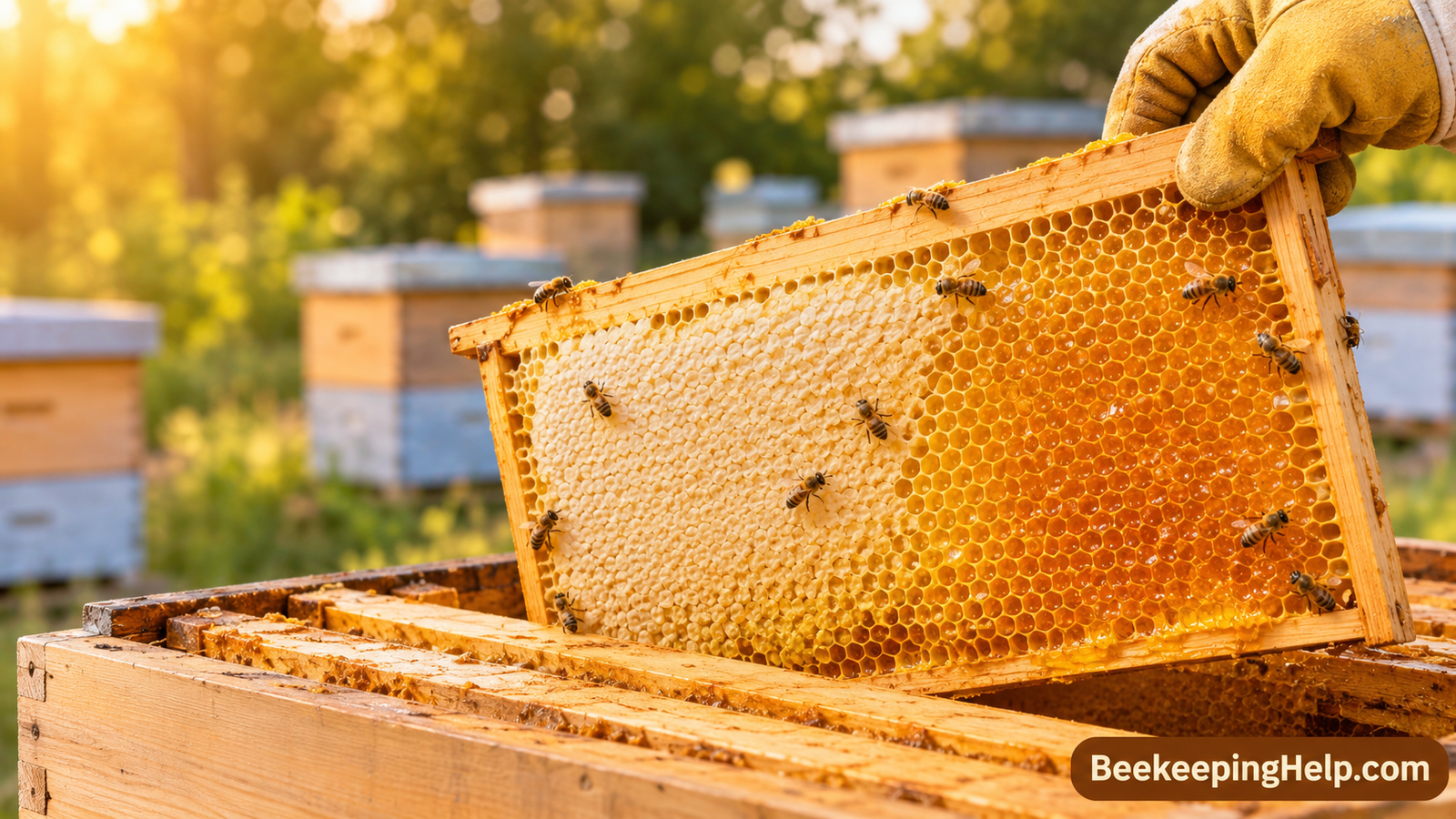
Beehive Frames and Foundation: Anatomy, Types, Installation and Capped Frames Explained
Table of contents
- Quick Answer: What Frames and Foundation Are
- Anatomy of a Beehive Frame
- What Frames Do for the Colony and for You
- Frame Names, Sizes and Types
- What Foundation Is and Which Kind to Choose
- Wired Frames, Wire Types and Reinforcement
- Foundationless Frames and Starter Strips
- How to Assemble a Wooden Frame
- How to Install Foundation and Embed the Wire (the Heated Tool Explained)
- What Capped Frames Look Like
- Frame Care, Rotation and Replacement
- What to Buy: Frames, Foundation and Tools
- Frequently Asked Questions
- Conclusion
Beekeepers throw around a handful of words that sound alike: frame, foundation, comb, super, wire, wedge. Together they decide how well your bees build, how easily you can inspect the hive, and how clean your honey harvest will be. If you have ever wondered what the wooden pieces inside a hive are called, what foundation actually does, or what a frame of capped honey versus capped brood looks like, this guide walks through every part in plain language and shows you what to buy and how to put it together.
Quick Answer: What Frames and Foundation Are
A beehive frame is the removable rectangular wooden (or plastic) rack that hangs inside a hive box. Bees build wax comb on it, the queen lays eggs in that comb, and the colony stores honey and pollen in it. Foundation is a thin sheet of beeswax or plastic, embossed with a hexagon pattern, that goes into the frame and gives the bees a head start on building straight, even comb. Frames make a hive inspectable and harvestable. Foundation makes the comb predictable.
| Part | What it is | Why it matters |
|---|---|---|
| Frame | Wooden or plastic rectangle that hangs in the box | Holds the comb and lets you lift it out without destroying it |
| Foundation | Wax or plastic sheet with a printed cell pattern | Guides bees to build straight comb inside the frame |
| Wires or reinforcement | Thin wire or plastic ribs in the frame | Keeps comb from collapsing during handling and extraction |
| Drawn comb | Foundation after bees have built it out | Reusable for years and gives the colony a major head start |
This guide covers every common question: the names of each frame part, what frames do for the colony, how to choose sizes, how wax and plastic foundation compare, how to embed foundation (including the heated tools that confuse many new beekeepers), what capped frames look like, and how to care for everything. Frames live inside the boxes covered in our guide to brood boxes vs honey supers, so read that first if you are still sorting out box sizes.
Want to see frames and foundation sold together?
Browse Frames and FoundationAnatomy of a Beehive Frame
Every standard Langstroth frame is built from four main pieces, plus a few small details that make it work. Knowing the names helps when you shop, assemble or troubleshoot.
Top bar
The top bar is the long piece across the top, usually about 19 inches long. Its extended ends, called lugs or ears, rest on the ledge (the rabbet) inside the hive box so the frame hangs freely. Most top bars have a groove or slot on the underside for holding foundation, and some have a wedge or a wax starter strip.
Side bars
Also called end bars, these two vertical pieces form the sides. On many frames, the upper portion of each side bar is wider to hold frames at the correct distance from one another. These are called self-spacing or Hoffman frames.
Bottom bar
The bottom bar closes the rectangle. It may be a single solid piece, split into two pieces that sandwich the foundation, or a grooved bar. The split style makes installing foundation simple, because the sheet slides in between the two halves.
Foundation, wires and grooves
Inside the rectangle sits the foundation. Many frames have small holes in the side bars for horizontal reinforcing wires, which keep the comb from stretching or breaking, especially when it is heavy with honey and spun in an extractor. Others have vertical wires or built-in plastic ribs.
If this is your first time looking at the hive from the inside, you may also want our overview of the parts of a bee hive and their functions, which places each frame in the context of the whole structure.
Need replacement frames or a bulk pack for a new hive?
Shop Langstroth FramesWhat Frames Do for the Colony and for You
Before frames, keepers used fixed-comb hives such as straw skeps or hollow logs. To get honey, they often cut comb out or destroyed the colony. The movable frame hive changed this. The modern frame makes use of bee space, the roughly 1/4 to 3/8 inch gap that bees leave open as a passage instead of filling with propolis or wax. When frames are spaced correctly, bees build comb inside the frame and leave the gaps alone, so each frame lifts out cleanly.
Functions for the bees
- A building platform. Bees hang in chains and secrete wax scales that they shape into comb on the frame.
- Organized storage. The comb becomes the nursery, the pantry and the honey store, all in separate zones.
- Heat management. Parallel combs create channels the colony can warm or ventilate efficiently.
- Cluster support. In winter, bees cluster on the frames and slowly move across stored honey.
Functions for the beekeeper
- Inspection. You can lift out any frame and see eggs, larvae, brood pattern, stores and signs of disease.
- Harvesting. Full frames can be removed, uncapped and spun in an extractor, and the comb returned to the bees intact.
- Colony management. You can move frames of brood or honey between boxes, make splits and equalize hives.
- Record keeping. You can tell how many frames of brood or honey a colony has, which is the easiest way to judge strength.
For a bigger picture of how comb, brood and stores work together inside a living colony, see our explainer on how a beehive works.
How bees draw comb on a frame
When you place a new frame in the hive, bees festoon it, hanging in living chains from the top bar. Special wax-producing workers shed tiny scales from glands on their abdomens, chew them with a bit of saliva and shape them into the walls of hexagonal cells. The hexagon is not an accident. It wastes no space between cells and uses the least wax for the most storage, which matters when wax costs the colony so much honey to make. A frame of new comb often starts at the top and works downward, with the queen following behind the builders to lay eggs in fresh cells.
Make inspections easier with the right tool to pry frames apart.
Shop Hive ToolsFrame Names, Sizes and Types
People ask, “what are the wooden frames inside bee hives called?” The straightforward answer is simply frames, but catalogs list them by depth and by style. The frame must match the box.
| Frame size | Approx. height | Fits box | Common use |
|---|---|---|---|
| Deep | 9 1/8 in | Deep hive body | Brood chamber |
| Medium | 6 1/4 in | Medium box | Honey super or all-medium hive |
| Shallow | 5 3/8 in | Shallow box | Honey super, comb honey |
Each frame is slightly shorter than its box so it hangs with space beneath it. Never mix frame sizes in a box. A deep frame in a medium box will not fit, and a medium frame in a deep box will hang high and encourage bees to build burr comb underneath.
Self-spacing versus plain frames
Hoffman (self-spacing) frames have wider upper side bars that touch their neighbors, so frames stay evenly spaced without effort. They are popular with beginners because they are forgiving. The tradeoff is that the contact points collect propolis, which can make frames sticky to separate. Plain frames do not self-space, and the beekeeper uses spacers or a frame-spacing tool. Some advanced keepers prefer them for the lower propolis and ease of cleaning.
Wood versus plastic
| Material | Pros | Cons |
|---|---|---|
| Wood | Traditional, easy for bees to accept, repairable | Needs assembly, can warp or rot over time |
| Plastic (one-piece) | Ready to use, very durable, easy to clean | Bees may need time to accept it, can crack in cold or sunlight over time |
| Wood frame with plastic foundation | Strong and widely used compromise | Foundation may need extra wax to be accepted |
Many hives are built with wooden frames. If you are comparing complete hive systems, our guide to the best beekeeping hives shows which come with frames included and which sell them separately.
Frame grips and spacing tools
As frames fill with honey they become heavy and slippery with propolis. A frame grip (a tool that clamps the frame by its ends) lets you lift one cleanly with one hand. A spacing tool or simple metal spacers help you set plain frames evenly. Neither is required, but both make inspections quicker, and quick inspections mean calmer bees.
Also watch the number of frames per box. Nine evenly spaced frames in a ten-frame super give the bees extra room to stretch comb out, which makes uncapping easier. In a brood box, use all ten so the queen has enough surface to lay on.
Compare wooden and plastic frames before you buy.
Shop Plastic and Wood FramesWhat Foundation Is and Which Kind to Choose
Bees make comb from wax scales secreted by their bodies, and wax is expensive for the colony to produce. Studies commonly cited by beekeepers suggest that bees consume many pounds of honey to make a single pound of wax. Foundation reduces that cost by giving them a pre-stamped pattern. Bees add wall height to the printed cells and the sheet becomes comb.
Wax foundation
Made from pressed beeswax, usually with an embossed hexagon pattern. Bees accept it readily because it smells and feels like their own wax. It is available unwired (very thin and fragile) or wired (reinforced with fine wire already inside). Beginners usually do best with wired or reinforced wax foundation because it holds up in handling and extraction.
Plastic foundation
A plastic sheet, often with a thin wax coating, or a one-piece plastic frame and foundation unit. It is durable and resists wax moths and breakage. Some colonies take longer to accept it, and a fresh coat of wax or a light rubbing with melted beeswax helps. The coating matters: bare plastic is less attractive to bees than wax-coated sheets.
Which is better?
| Foundation | Best for | Watch out for |
|---|---|---|
| Wired wax | Brood boxes, extraction, general use | Needs embedding; wax moths can damage stored frames |
| Unwired wax | Comb honey, cut comb | Fragile in an extractor |
| Plastic (coated) | Supers, heavy extraction, low maintenance | Slow acceptance if not waxed |
| Foundationless (starter strip) | Natural comb, low cost | Cross-comb if not managed |
There is no single right answer. Many keepers put wax foundation in brood boxes and use plastic in supers, or the reverse. The key is that every frame in a box matches in thickness and style so bees build evenly. If you plan to pull honey and extract it, see our guide to the best honey extractors for how frames and extractors work together.
Cell size and what it means
Standard worker-sized foundation has cells about 5.4 millimeters across. Larger cells are used for drone comb, and some keepers use slightly smaller cell patterns, arguing that they shorten development time. The research on small-cell comb is mixed, so there is no need to chase a niche size as a beginner. Standard worker foundation works well for almost every hive.
Buying good foundation
Check that sheets are flat, clean and free of cracks. Wax foundation should be stored flat, in a cool place, with the sheets kept away from sunlight, since heat makes it soft and cold makes it brittle. If you want to know whether foundation is pure beeswax, ask the supplier. Cheaper sheets may be blended with other materials, and bees sometimes reject them.
Compare wax and plastic foundation from several suppliers.
Shop Beeswax FoundationWired Frames, Wire Types and Reinforcement
Fresh comb is soft. A frame full of nectar can weigh 6 to 8 pounds, and when you spin it in an extractor the comb is under serious force. Reinforcement prevents blowouts, sagging and cracking.
Horizontal wires
The most common method: thin stainless or tinned steel wire strung across the frame through holes in the side bars. Typically two to four horizontal wires per frame in a deep and fewer in a medium or shallow. Tight wires hold the wax securely and give extra strength.
Vertical wires
Some foundation uses vertical wires pressed into the sheet at the factory. Vertical wires support comb in a different direction and are popular with commercial keepers.
Cross wires and support pins
Small pins are sometimes added in the middle of the frame to hold the foundation steady. They are an extra, not essential.
How tight should the wire be?
Tight enough that it makes a soft musical note when plucked, but not so tight that it bends the side bars. Loose wire sags and lets the foundation slump. Too-tight wire can twist the frame.
Save assembly time with pre-wired frames or ready-made wire kits.
Shop Pre-Wired FramesFoundationless Frames and Starter Strips
Foundationless means the frame holds no printed sheet. Instead, a thin strip of wax or a wooden wedge along the top bar tells the bees where to start, and they build the rest of the comb themselves. This is cheaper, appeals to keepers who want natural comb, and often gives bees the cell size they prefer. It does demand a bit more care.
Advantages
- Lower cost, with no foundation to buy.
- Bees choose their own cell size and layout.
- Pure wax comb with no plastic or added materials.
Challenges
- Cross-comb: bees may build diagonally across several frames, which makes inspection difficult. Keep the hive level and place a foundationless frame between two drawn frames to guide them.
- Fragility: natural comb is more delicate and can break in an extractor. It is best for crush-and-strain harvests or comb honey.
- Slower buildup: bees must make all the wax, so the colony fills a box more slowly than with foundation.
If you enjoy building equipment yourself, our project guide on how to make a beehive shows how frames fit into a homemade box.
Try foundationless starter strips alongside a few wired frames.
Shop Starter Strips and FramesHow to Assemble a Wooden Frame
Most wooden frames ship flat, and assembling them takes a few minutes each once you have a rhythm. You need wood glue, small nails (often supplied), a hammer, and a square or jig to keep the frame straight. A simple frame jig is inexpensive and makes assembling a dozen frames much easier.
Step-by-step
- Sort the parts. Each frame needs one top bar, two side bars, and one or two bottom bar pieces.
- Test fit without glue. Slide the side bars into the top bar slots to check they align.
- Add glue. Apply a thin line to each joint. Glue is stronger than nails alone and keeps joints tight under load.
- Join the side bars to the top bar. Press them in, and nail each joint with the supplied nails.
- Add the bottom bar. For split bottom bars, leave the gap that will hold the foundation. For solid bars, nail it into place.
- Square the frame. Set it in a jig or against a flat corner so the frame is true. A twisted frame will not hang straight.
- Let the glue cure. Wait the time listed on the glue bottle before handling them hard.
Plan on assembling frames well ahead of installation. If you are starting a new colony, you will need enough frames to fill every box, and a new colony such as a nuc typically arrives on five frames that you will move into a full-sized box with extra frames added alongside.
Get a jig and glue that make frame building fast and accurate.
Shop Frame Assembly ToolsHow to Install Foundation and Embed the Wire (the Heated Tool Explained)
Many new beekeepers search for the “hot thing to put bee foundation in.” They are almost always talking about a wire embedder, the tool that presses the frame wires into the wax so the sheet is secure. There are several options.
Ways to embed wire into wax foundation
| Method | How it works | Good for |
|---|---|---|
| Spur embedder | A small wheel you roll along the wire to press it into the wax | Small numbers of frames, no power needed |
| Electric (heated) embedder | A low-voltage transformer or battery heats the wire briefly so it melts into the wax | Medium to large batches, quick work |
| Embedding board | A flat board supports the sheet while you press the wire in | Beginners, with either a spur or a heated tool |
Step-by-step with a heated embedder
- Prepare the frame. String the wires tight through the side-bar holes and secure them.
- Lay the frame over an embedding board. Place the sheet of foundation on the board, then lay the frame on top, with the wires touching the wax.
- Connect the embedder. Clip the leads to each end of the wire, following the manufacturer’s instructions. Use only low voltage equipment designed for this.
- Heat briefly. The wire warms and sinks into the wax. Release as soon as it embeds; too much heat melts the sheet.
- Check the result. The wire should be fully sunk but the wax should look smooth, not melted or gouged.
- Seat the foundation in the top bar groove. Slide it into the slot and secure with the wedge strip, or use melted wax along the top as glue.
Installing foundation in a split bottom bar
If your frame has a split bottom bar, slide the foundation sheet between the two halves, then nail the bottom bar closed. Make sure the sheet is centered and does not touch the side bars. A small gap on each side lets the wax expand in warm weather without buckling.
Installing plastic foundation
Plastic sheets snap into frames or slide into slots and are usually held with a wedge. Check the top bar is firmly seated and the sheet is straight. If the plastic is bare, brush a thin layer of melted beeswax on it before use so bees accept it more readily.
Common installation problems
- Wax cracking when you press it: the sheet is too cold. Warm it in a sunny room for a few minutes before handling.
- Foundation sagging after a few weeks: the wires are loose or the sheet was not seated well in the top bar. Re-tension the wires and secure the top edge with melted wax.
- Bees chewing out the sheet: this happens when foundation is poorly attached or not centered. Make sure there is solid contact at the top and a small gap at the sides.
- Bent or twisted frames: pressing too hard while embedding can warp the wood. Support the frame on a flat board the whole time.
Most of these problems vanish after a few frames. Your tenth frame will look much better than your first, so do not be discouraged if the early ones look rough.
Get the embedder and tools that make installing foundation simple.
Shop Foundation EmbeddersWhat Capped Frames Look Like
Searches such as “pictures of types of capped frames” show how many beekeepers want to recognize what they are seeing. Capped cells are those the bees have sealed with a layer of wax. What is underneath changes the color and shape completely.
| What you see | Cap appearance | What it means |
|---|---|---|
| Capped honey | Smooth, flat, pale cream or white wax, often glossy | Ripe honey ready for harvest (when most of the frame is capped) |
| Capped worker brood | Slightly domed, tan to brown, dull and a bit porous | Pupae developing into worker bees |
| Capped drone brood | Larger, bullet-shaped domes, often in clusters or edges | Developing male bees; normal in small amounts in spring and summer |
| Uncapped nectar | Shiny wet cells with no cap | Honey still curing; not ready |
| Pollen | Packed, colorful cells (yellow, orange, red) | Protein for feeding brood |
What a healthy brood frame looks like
A strong brood frame shows a solid, compact pattern of capped brood, with few empty cells scattered among them. Brood is often in the center of the frame, with pollen in an arc around it and a band of honey at the top. Spotty brood, sunken or punctured caps, and a sour or rotten smell deserve a closer look and sometimes expert help.
What a harvest-ready honey frame looks like
Hold the frame flat and shake it gently. If no nectar sprays out and most cells are capped, it is usually ready. Many keepers wait until about 80 percent or more of the surface is sealed. For how to keep harvested honey properly, see our guide on how to store honey.
Other things you may see on a frame
- Burr comb and bridge comb: small blobs or bridges of wax built between frames or boxes. They show a spacing problem, and you can scrape them off with a hive tool.
- Queen cups and queen cells: peanut-shaped cells hanging from the edge or face of a frame. Empty queen cups are common. Fully built, capped queen cells usually mean the colony is preparing to swarm or replace its queen.
- Drone comb: a patch of larger cells, usually at the bottom or corners of a frame. A little is normal.
- Propolis: a sticky, reddish-brown resin that bees use to seal gaps. It shows up on frame rests and top bars and is harmless but gluey.
Learn to spot brood and honey frames with a good reference book.
Shop Beekeeping GuidesFrame Care, Rotation and Replacement
Frames are an investment, and drawn comb is worth more than the wood it sits in. Care extends their life.
Cleaning
Scrape off burr comb and excess propolis with a hive tool. Never use soap or strong chemicals on frames. Warm water and a stiff brush handle most dirt, and old frames that are black and brittle should be replaced rather than cleaned.
Rotating old comb
Brood comb darkens over time as each emerging bee leaves a thin cocoon behind. Many keepers replace a few of the oldest brood frames each year, aiming to cycle all brood comb out every 3 to 5 years. Fresh comb is healthier and cleaner, and it reduces the build-up of residues.
Storing spare frames
- Store them in a cool, dry place with good airflow.
- Keep drawn supers off the ground and covered to deter wax moths and mice.
- Freezing drawn comb for a couple of days before storage kills wax moth eggs.
- Use a hive-safe moth control method; avoid household moth balls.
Repairing frames
Cracked frames can often be glued and re-nailed. Warped top bars or broken lugs are worth replacing, since a frame that sits unevenly invites burr comb and squished bees.
Common frame mistakes
- Wrong size frames in the box: frames that are too tall or short create gaps or crowded space.
- Uneven spacing: bees respond with extra thick or bridged comb.
- Too many frames in a super: nine frames in a ten-frame box gives thicker comb, but cramming ten fat frames makes uncapping hard.
- Letting comb get too old: dark, brittle comb should be recycled.
Regular checks also help you decide when a colony is short of food. Our article on what a dearth is in beekeeping explains why the frames in your hive may suddenly look empty even in the middle of summer.
Frames in winter
In cold regions, the cluster sits on frames of honey and moves slowly upward. Do not disturb the frames in cold weather. Opening a hive on a freezing day chills the brood and breaks the cluster. Plan your winter check from the outside: tilt the hive slightly from the back to judge weight, and make sure the entrance is not blocked by dead bees or snow.
Protect stored comb and keep frames in good shape.
Shop Frame Storage and CareWhat to Buy: Frames, Foundation and Tools
The right shopping list depends on your hive size and your plans. Here is a sample list for a standard ten-frame setup.
Basic shopping list
- Ten frames per box, sized to match your deeps, mediums or shallows
- Foundation (wired wax or plastic) for each frame
- Wood glue and small nails
- Wire and an embedder, or pre-wired foundation
- A frame jig for fast assembly
- Hive tool and frame grip for lifting
How many frames do you need?
A 10-frame box holds ten. A basic starter hive with two deep brood boxes and one medium super needs about thirty frames. Because bees draw foundation in stages, many beekeepers prefer to add a second box only once the first is mostly built out. Also buy a few spares so you always have frames on hand for splits or replacements.
Starter kits and complete hives
Many kits include frames and foundation already, although quality varies. If you want to compare bundles, look at our roundup of the best beekeeping starter kit options. If you are still deciding whether the hobby suits you, our primer on how to start beekeeping covers what to expect before you spend.
Ready to stock your hive with frames and foundation?
Shop Beekeeping Frames on AmazonFrequently Asked Questions
What are the wooden frames inside a bee hive called?
They are called frames, or hive frames. Each is a rectangle made of a top bar, two side bars and a bottom bar that holds comb. The size varies (deep, medium, shallow) to match the box.
What is the function of frames in a beehive?
Frames give bees a structure to build comb on and let beekeepers remove and inspect that comb without destroying it. They keep comb organized into parallel sheets, allow harvesting and make colony management practical.
What is foundation in beekeeping?
Foundation is a thin sheet of wax or plastic with a hexagon pattern pressed into it. It guides bees to build straight, even comb inside the frame and speeds up comb building.
Do I need foundation in every frame?
No. Foundationless frames with a starter strip work, though they can lead to cross-comb if not managed. Many beekeepers mix both styles, placing foundationless frames between drawn frames.
What is the hot tool used to put foundation in a frame?
It is usually a wire embedder. An electric embedder uses a low-voltage supply to heat the wire briefly so it sinks into the wax. A spur embedder is a manual alternative that needs no power.
Are wired or unwired frames better?
Wired is better for brood boxes and any frame you plan to extract, because the wire keeps the comb from sagging or breaking. Unwired wax suits cut comb honey where you plan to eat the comb.
How can I tell if a frame is full of capped honey?
Look for smooth, flat, pale wax caps covering most of the surface. Shake the frame gently; if nectar does not fly out and most cells are sealed, the honey is typically ripe.
What do capped brood frames look like?
Worker brood caps are tan to brown, slightly domed and a little dull. Drone brood caps are larger and bullet-shaped. A healthy frame shows a solid pattern with few missing cells.
How many frames fit in a hive box?
A standard Langstroth box holds ten frames, and an 8-frame box holds eight. Some honey supers run with nine frames to encourage thicker comb that is easier to uncap.
How often should I replace old frames?
Many beekeepers replace brood frames every 3 to 5 years, or sooner if comb is very dark, damaged or mis-shaped. Replace frames with cracks or broken lugs.
Can bees use plastic foundation?
Yes. Bees will build on it, especially when it is coated in beeswax. Bare plastic sometimes takes longer to be accepted, so a light wax coating helps.
Can I reuse frames from a dead colony?
Often yes, if the colony did not die from a contagious disease. Inspect carefully, clean the frames and store them safely. If you suspect disease, ask an experienced local beekeeper or your state apiary inspector before reusing equipment.
Conclusion
Frames and foundation are the working heart of a hive. The frame is the sturdy wooden or plastic rectangle that holds the comb and makes inspection possible; the foundation is the printed sheet that guides the bees to build straight, strong comb inside it. Choose frame sizes that match your boxes, wire or reinforce frames that will be extracted, and give the bees time to draw comb before you expect a big honey harvest.
Learn what capped honey and capped brood look like and you will read your colony far more easily. Take care of your drawn comb, replace the oldest brood frames over time, and keep spares on hand. With those habits, your frames will serve you and your bees for many seasons.
Ready to build out your hive the right way?
Shop Frames and Foundation on Amazon