Do Bee Suits Protect From Wasps? What Your Suit Actually Stops — And Where It Fails
A full-length, field-tested look at how beekeeping suits perform against yellowjackets, hornets and paper wasps — including the exact fabric weights, veil styles, and closure details that decide whether you walk away untouched or stung through the sleeve.
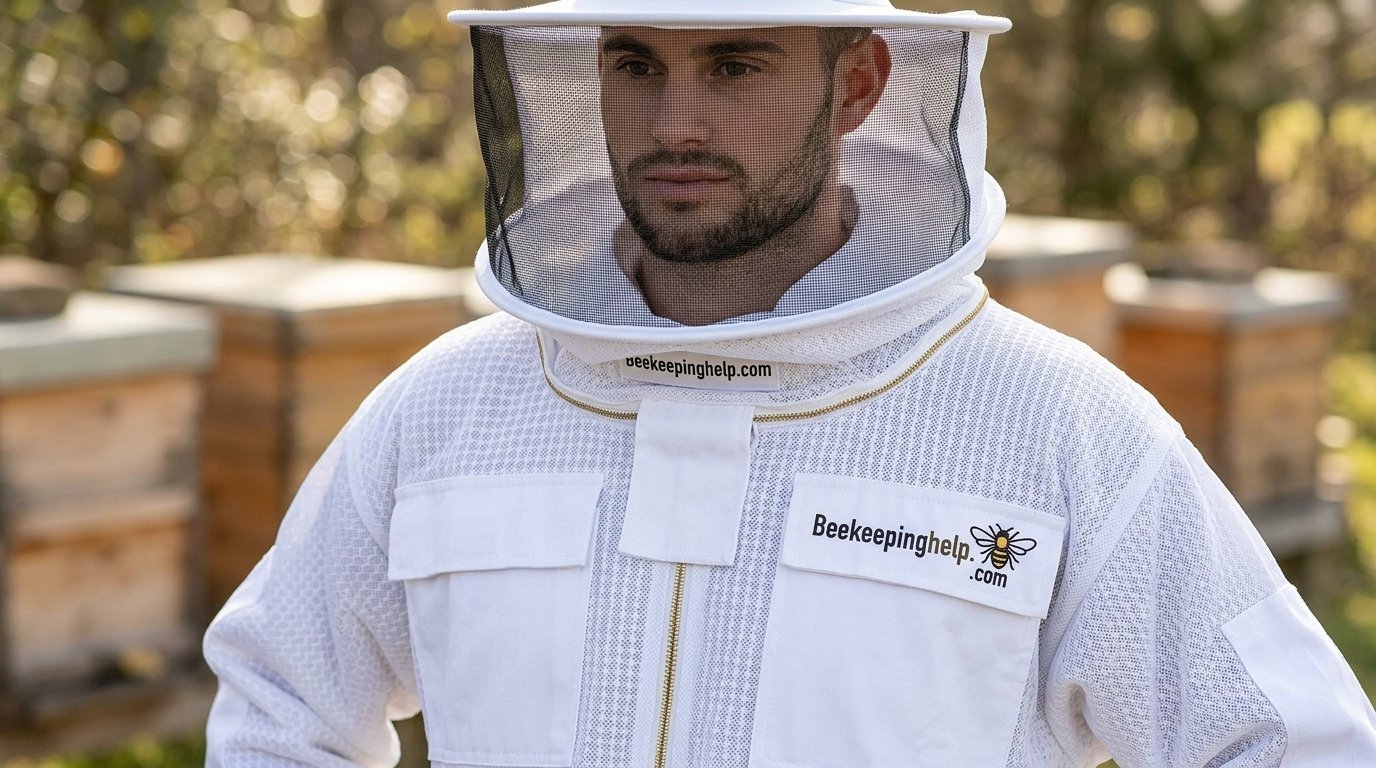
A three-layer ventilated suit is the single biggest upgrade for wasp work — the spacer mesh keeps the stinger away from skin even when the outer shell is penetrated.
The Short Answer: Yes — But Only Partly, And Only If It Is the Right Suit
A beekeeping suit will protect you from wasps. It is not marketed for wasps, it was never engineered around wasp behaviour, and every honest supplier will tell you the same thing — but in practice a good bee suit stops the overwhelming majority of wasp stings that would otherwise land on your torso, arms, legs, neck and face. If you have ever knocked down a yellowjacket nest in a shed wall wearing jeans and a hoodie, and then done the same job in a ventilated three-layer suit with a fencing veil and sealed cuffs, the difference is not subtle. It is the difference between a frantic retreat and a calm, deliberate job.
The complication is that “bee suit” describes a very wide category. It covers a $45 single-layer cotton coverall sold with a free pair of canvas gloves, and it also covers a $320 triple-layer ventilated suit with a 3 mm spacer mesh, sealed elastic gussets and a domed fencing veil that never touches your skin. Against honey bees, both of those garments perform acceptably, because honey bees sting once, sting reluctantly, and die doing it. Against wasps, those two garments are in different universes. A wasp can sting repeatedly, it can sting through thin fabric that is pressed flat against skin, it is far more persistent at probing seams and openings, and it is much more likely to crawl toward a gap rather than bumble away from it.
The three-part answer most people need
- Coverage: Yes. Anywhere the suit covers you with slack fabric, you are effectively protected. Wasp stingers are typically 2 to 3.5 mm long and cannot bridge the gap between the outer surface of a suit and your skin if that gap exists.
- Penetration: Conditionally. A thin, single-layer, stretched-tight bee suit can be stung through. Wasps exploit exactly the spots where the suit is under tension — knees when you kneel, shoulders when you reach, the seat when you crouch, the forearm when you extend it.
- Intrusion: This is where suits truly fail. Wasps find and enter openings that a honey bee would never bother with — an unzipped ankle, a veil zipper stopped 4 cm short, a torn gusset under the arm, the gap between a glove cuff and a sleeve elastic. Once a wasp is inside your suit, the suit is working against you.
- Fabric thickness plus standoff distance stops stings — not fabric strength.
- Wasps beat suits at the openings, not at the fabric.
- A ventilated three-layer suit with a fencing veil is the practical wasp-capable bee suit.
- A thin cotton beginner suit is honey-bee gear and should not be your yellowjacket plan.
Why this question comes up so often
Two groups ask it, and they need slightly different answers. The first group are beekeepers who already own a suit and are now facing a wasp problem — a nest in the compost bin, yellowjackets robbing a weak hive, a paper wasp colony under the deck rail. They want to know whether the expensive thing hanging in the garage will do the job so they do not have to buy anything else. For them the answer is usually yes with modifications, and the modifications cost about fifteen dollars.
The second group are homeowners with no beekeeping interest at all who have discovered that a beekeeping suit is the cheapest full-body sting protection on the market. A complete bee suit costs a fraction of a professional wasp suit and is available with next-day delivery, which is why it has quietly become the default DIY nest-removal garment. For them the answer needs a warning attached: the cheap bee suits that dominate search results are the ones least suited to the job, and buying at the bottom of the market is how people end up stung inside a suit they paid for specifically to avoid being stung.
There is a third, smaller group worth mentioning: people with known venom allergies who are considering doing this work anyway because a professional quote came in high. The honest advice there is that no garment is an adequate substitute for not being in the situation. Protective clothing reduces the probability of a sting; it does not reduce the consequence of the one that gets through, and anaphylaxis does not care how many stings you avoided.
What “protection” should mean to you
It is worth being precise, because “protected” is doing a lot of work in the original question. A suit can deliver four distinguishable outcomes, and knowing which one you are buying prevents disappointment:
- Zero stings. Achievable with a three-layer ventilated suit, full sealing and good technique on a moderate nest at night. This is a realistic target, not an aspiration.
- Occasional stings, job completed. The normal outcome with mid-grade gear. One or two stings, usually at a joint or through a lapse in sealing, and the work still gets finished.
- Stings that force a retreat. What happens when something gets inside. The gear did not fail structurally; a boundary did.
- Multiple stings, uncontrolled. Almost always the result of a thin suit, a daytime approach, or a nest larger than expected — frequently all three.
Everything in the sections that follow is aimed at moving you from the second and third outcomes into the first, using equipment choices and habits rather than luck.
If you are new to protective gear generally and want to understand the whole category before deciding, our detailed bee suit review breaks down the construction differences between the main suit classes and is worth reading alongside this article. Everything below assumes you want to know not just whether a suit works, but which features do the work.
What changes when the insect is a wasp
Honey bees defend a colony that is committed to a location and to a food store. Their defensive behaviour is largely reactive — they respond to vibration, dark colours, CO₂, alarm pheromone and rapid movement, and once they commit to a sting they are finished. Social wasps, particularly yellowjackets in the Vespula genus, behave differently in three ways that directly affect gear.
First, they sting repeatedly without dying, which means one wasp inside your veil can deliver five or six stings in the time it takes you to walk ten metres. Second, they recruit aggressively and pursue further from the nest — commonly 10 to 20 metres, with reports of hornets tracking intruders considerably further. Third, and most importantly for your suit, they are better climbers and more systematic explorers. A wasp that lands on your shoulder will very often walk, not fly, and walking insects find seams.
That behavioural profile is why a suit that has kept you comfortable through three seasons of hive inspections can still get you stung badly on your first wasp nest removal. The gear did not degrade. The threat model changed.
Wasps vs. Bees: The Anatomy That Decides Whether Fabric Holds
You cannot reason about protective clothing without understanding the tool the insect is bringing. A sting is a mechanical event first and a chemical event second, and the mechanics are what your suit is fighting.
Stinger length, shape and the barb question
A honey bee’s sting apparatus carries pronounced backward-facing barbs along the lancets. Those barbs are superb at anchoring into elastic mammalian skin and catastrophic for the bee, because the whole apparatus tears free when she pulls away. In fabric, that same barbing behaves oddly: a honey bee that stings a woven suit frequently becomes snagged in the weave and struggles there, often without her lancets ever reaching skin.
Wasps carry a smooth or only faintly barbed lancet. It penetrates, delivers venom, and withdraws cleanly. In fabric terms, that means a wasp does not get stuck the way a bee does. She can probe, withdraw, reposition two millimetres over and probe again, repeatedly, for as long as she is motivated. That repeat-probe capability is the single biggest reason wasps beat marginal fabric.
| Trait | Honey bee | Yellowjacket | Bald-faced hornet | European hornet | Paper wasp |
|---|---|---|---|---|---|
| Typical sting length | ~2.0 mm, barbed | ~2.0–2.5 mm, smooth | ~3.0 mm, smooth | ~3.0–3.5 mm, smooth | ~2.0 mm, smooth |
| Can sting repeatedly | No (dies) | Yes | Yes | Yes | Yes |
| Snags in woven fabric | Often | Rarely | Rarely | Rarely | Rarely |
| Walks to find gaps | Some | Constantly | Constantly | Frequently | Moderately |
| Pursuit distance | Short | Medium–long | Long | Medium | Short |
| Minimum safe standoff | ~3 mm | ~4 mm | ~5 mm | ~6 mm | ~3 mm |
The bottom row of that table is the most useful number in this entire article. “Minimum safe standoff” is the distance that must exist between the outer face of your suit and your skin for the insect to be physically unable to reach you, regardless of how motivated it is. If your suit holds 6 mm of air and mesh away from your body, a European hornet — the largest common stinging wasp in North America and Europe — cannot touch you even if it stands on the fabric and pushes.
Why standoff beats thickness
People instinctively reach for thicker, tougher fabric. That works, but it works inefficiently. Denim is roughly 0.8 mm thick, heavy canvas around 1.0 mm; both are still inside the reach of a hornet if they are pressed against skin. To defeat stings by thickness alone you would need something in the region of 4 to 6 mm of solid material, which is unwearable in summer.
A ventilated bee suit solves this with geometry instead of mass. Three layers — an outer tight-weave shell, a 3 mm crushed-spacer middle, and a soft inner liner — produce a total standoff of roughly 4 to 5 mm at a total weight far lower than canvas, while allowing air to move through. That is why ventilated suits, which feel thinner and cooler than old-style cotton, are actually far more sting-proof.
Venom load and why repeat stings matter more
Per sting, honey bee venom delivers slightly more volume than most wasp species. But because a wasp can sting five, ten or twenty times, total dose escalates quickly. That escalation is also why a single wasp trapped inside a suit is more dangerous than several wasps outside it, and why the design priority for wasp work shifts from “will fabric hold” to “can anything get in.”

Sting-resistant palms plus an elasticated gauntlet that seals against the sleeve — the joint wasps probe first.
Check Price on AmazonHow a Bee Suit Actually Works: The Four Defensive Mechanisms
A bee suit is not a single technology. It is four overlapping defences stacked into one garment, and understanding them separately tells you exactly which parts transfer to wasp work and which do not.
Mechanism 1 — Physical standoff
Already covered above, and by far the most important. Standoff is created deliberately by spacer mesh in ventilated suits, and accidentally by looseness in woven suits. Accidental standoff is unreliable because it disappears exactly when you need it: kneeling flattens the knee, reaching flattens the shoulder, bending flattens the back. Deliberate standoff does not disappear, because the spacer layer is springy and recovers.
Mechanism 2 — Weave density
A tight weave physically blocks the lancet from finding a path between yarns. Cheap suits use an open plain weave around 180 to 220 gsm; the gaps between threads are visible against the sky. Better suits use a dense poly-cotton twill at 250 to 320 gsm, which a wasp lancet has to pierce rather than slip through. Ventilated suits move the burden onto the mesh instead — the mesh holes are large but the layered offset means no straight path exists through all three.
Mechanism 3 — Visual and behavioural signalling
White and pale colours are the beekeeping standard because dark, fuzzy shapes read to defensive bees as mammalian predators. This partially transfers to wasps, who are also more reactive to dark contrasting movement, but the effect is weaker. Yellowjackets responding to a disturbed nest will attack a white suit enthusiastically. Do not treat colour as protection against wasps; treat it as a mild advantage.
Mechanism 4 — Sealed boundaries
Elastic wrists, elastic ankles, a double zipper joining veil to body, an overlapping storm flap over the zipper, and a thumb loop that stops the sleeve riding up. Against honey bees these are a nicety. Against wasps they are the core of the entire garment, because wasp intrusion is the dominant failure mode.
| Mechanism | Value vs honey bees | Value vs wasps | Typical failure |
|---|---|---|---|
| Standoff distance | High | Critical | Fabric pulled tight over joints |
| Weave density | High | Moderate | Thin single-layer cotton |
| Pale colour | Moderate | Low | Overrated by beginners |
| Sealed boundaries | Moderate | Critical | Ankle gap, veil zip stop, torn gusset |
| Smoke compatibility | High | Very low | Smoke does not calm wasps |
The mechanism that does not transfer at all: smoke
This deserves emphasis because it trips up experienced beekeepers more than any other factor. Smoke works on honey bees because it masks alarm pheromone and triggers a gorging response tied to fire survival. Wasps do not have that behavioural programme. Smoke will irritate and disperse wasps temporarily; it will not pacify them, and puffing a nest you intend to remove frequently makes the situation worse by scattering angry defenders across a wide area instead of keeping them concentrated.
If you want to understand what smoke is genuinely doing inside a honey bee colony — and therefore why the effect is species-specific — our explainer on how a bee smoker works covers the mechanism in detail. It is a useful piece of background precisely because it clarifies what you are not getting when you carry a smoker to a wasp job.
What transfers from beekeeping gear
- Full-body coverage architecture
- Veil geometry and face standoff
- Elastic cuff and ankle sealing
- Layered ventilated construction
- Slow, deliberate movement discipline
What does not transfer
- Smoke as a pacifier
- Reliance on pale colour alone
- Thin single-layer cotton suits
- Bare-hand or thin-nitrile inspections
- “They’ll calm down in a minute” patience

Essential for hive work even though it will not pacify wasps. Look for a large firebox and a protective cage.
Check Price on AmazonWhere Bee Suits Fail Against Wasps: The Seven Failure Points
Almost every wasp sting suffered by someone wearing a bee suit happens at one of seven predictable places. None of them are mysterious, and all of them are fixable in under ten minutes with materials you already own.
1. The ankle gap
The most common single failure. Standard bee suit legs finish with an elastic cuff sized to sit over boot tops. In practice the cuff rides up when you squat, exposing a sock. Wasps foraging at ground level around a disturbed in-ground nest go straight for it, and because you are usually kneeling or crouching during nest work, ankles are where the insects already are.
Fix: tuck trousers inside tall rubber boots rather than over them, then apply a wide elastic band or a strip of gaffer tape around the boot top. Wellingtons beat lace-up boots here because laces are a climbing ladder.
2. The veil zipper terminus
Double zippers running from the chest around the hood meet at a stop point, usually at the sternum or hip. Manufacturers leave a few millimetres of play where the two sliders park, and the storm flap often does not extend over it. A wasp walking the chest seam finds the hole reliably.
Fix: after zipping, fold the storm flap over and secure it with the supplied hook-and-loop tab or a plastic clothespin. Many beekeepers add a strip of self-adhesive hook-and-loop to close the last 8 cm permanently.
3. The glove–sleeve junction
Long gauntlets are supposed to overlap the sleeve elastic. If your gauntlet sits under the sleeve, gravity and arm movement open a funnel that points directly at your forearm. If it sits over the sleeve but is loose, the same thing happens when you raise your arm.
Fix: gauntlet over sleeve, always, with the suit’s thumb loop engaged and a band around the overlap. Test by raising both arms fully overhead and looking for daylight.
4. Tension points over joints
Knees, elbows, shoulders and the seat. Fabric pulled taut loses all its accidental standoff, and on a single-layer suit that means the wasp’s lancet reaches skin through 0.4 mm of cotton. This is where people get stung “through” the suit and conclude the suit is useless.
Fix: buy one size up, wear a long-sleeve base layer, and choose a ventilated suit whose spacer mesh cannot be crushed flat by body weight for more than a moment.
5. Pocket openings and tool loops
Patch pockets with an open top are small caves at waist height. Wasps enter them, then find the inner seam or the gap where the pocket is stitched to the body panel. Hive-tool loops and D-rings are similar snag points that hold an insect long enough for it to explore.
Fix: choose suits with flapped or zipped pockets, or simply keep the pockets empty and press them flat before work.
6. Abrasion holes you have not noticed
Ventilated suits wear at the knees and at the seat first. A 3 mm hole in the outer shell is invisible at arm’s length and completely adequate for a yellowjacket. Suits that have been washed thirty times have weakened stitching at the crotch gusset and underarm.
Fix: inspect against a bright window before every wasp job. Washing correctly extends life considerably — see our guide on how to wash a bee suit for the temperature and detergent rules that stop mesh from degrading.
7. Removing the suit afterwards
Genuinely one of the top causes of stings. You finish the job, walk twenty metres, and start unzipping — while two wasps are still riding on your back. The moment the veil comes off, they are at your neck and face.
Fix: walk at least 30 metres, ideally through a doorway or around a corner, then have someone check you visually, or brush yourself down thoroughly before any zipper moves.
A note on suits that failed — and what actually happened
When people report that “the bee suit did nothing,” the post-mortem almost always lands on one of three mundane causes rather than a fabric defect.
The suit was the wrong size. Bee suits are meant to be worn loose; most sizing charts assume 10 to 15 cm of ease over your chest measurement plus room for clothing underneath. Buying to your normal shirt size produces a garment that is tight over the shoulders and seat, which is precisely where the stings then land. If you are between sizes, always take the larger one — there is no downside to a baggy bee suit and a substantial downside to a snug one.
The work happened at the wrong time. A nest at two in the afternoon in late summer may have several hundred foragers in the air. The same nest at dawn may have a dozen. No fabric upgrade compensates for a tenfold increase in the number of insects testing your boundaries simultaneously, and a suit that performs perfectly at dawn can be overwhelmed at midday simply by volume.
The boundary discipline slipped. People are diligent about sealing for the first nest and casual about it for the third. The gaffer tape stays in the bag, the bands are forgotten, the storm flap is not folded. Then something walks in through a gap that was closed the previous week, and the conclusion drawn is that the suit failed.
None of these are exotic problems, which is encouraging: the failure modes are boring, and boring failures are the ones you can systematically eliminate with a checklist.

The half-suit option for above-ground nests, paired with tall boots and taped ankles for full coverage.
Check Price on AmazonFabric Weights, Weave and What the Numbers Mean on a Spec Sheet
Suit listings throw around numbers — gsm, thread count, “heavy duty cotton”, “professional grade” — with almost no standardisation. Here is how to translate them into wasp-relevant performance.
Understanding gsm
Grams per square metre is the honest measure of how much material you are getting. It does not tell you about weave structure or standoff, but it correlates strongly with sting resistance in single-layer garments.
| Fabric class | Typical gsm | Approx. thickness | Honey bee | Yellowjacket | Hornet |
|---|---|---|---|---|---|
| Lightweight cotton (budget suit) | 160–200 | 0.35 mm | Marginal | Poor | Poor |
| Standard poly-cotton | 220–260 | 0.45 mm | Good | Marginal | Poor |
| Heavy cotton drill | 280–340 | 0.65 mm | Very good | Good | Marginal |
| Canvas / duck | 380–450 | 0.9 mm | Excellent | Very good | Good |
| Two-layer ventilated | ~250 total | 2.5 mm standoff | Excellent | Very good | Good |
| Three-layer ventilated | ~300 total | 4–5 mm standoff | Excellent | Excellent | Very good |
Read that table twice, because the counter-intuitive result is in the last two rows: the ventilated suits weigh about the same as mid-grade poly-cotton yet outperform canvas, purely because of geometry. The three-layer suit is the only entry that scores “very good” against hornets while remaining wearable at 32 °C.
Weave structure
Plain weave is the simple over-under grid used in cheap suits. It is dimensionally stable and cheap, but the interstices are uniform and a lancet that finds one has a straight path through. Twill weave — the diagonal structure of denim and drill — offsets the yarn crossings, so a straight path is much rarer, and twill also drapes better, which preserves accidental standoff. Ripstop adds a reinforcing grid every few millimetres, which does very little for sting resistance but a great deal for stopping a snag from becoming a hole.
Cotton vs polyester vs blends
Pure cotton is comfortable, breathable, and takes a burn from a smoker without melting. It is also the weakest per gram, absorbs sweat which collapses standoff against skin, and shrinks. Pure polyester is stronger per gram and dries fast but melts near embers and holds odour. The 65/35 poly-cotton blend that dominates the market is the reasonable compromise: adequate strength, acceptable comfort, modest melt risk.
What “sting proof” on a listing actually means
Nothing. There is no certification body, no standardised test, and no legal definition for the phrase in the consumer beekeeping market. Some manufacturers test by pressing a mounted stinger through fabric under fixed force; most do not test at all. Treat the phrase as marketing and evaluate the construction yourself: count the layers, measure the standoff by pinching the fabric, look through the shell at a light source, and pull the seam apart gently to see whether the stitching is single-needle or lock-stitched.
A five-point in-store assessment
- Light test: hold the fabric to a window. Distinct pinholes of light in a single-layer suit mean an open weave.
- Pinch test: pinch and release. Does the material spring back to a thickness you can feel between your fingers? That is your standoff.
- Stretch test: stretch a 10 cm square. If the weave visibly opens up, it will open up over your knee too.
- Seam test: look inside. Overlocked-plus-topstitched seams survive; single-row seams unravel.
- Zip test: run the veil zipper fully. A chunky YKK-style moulded zip with a storm flap is worth a large premium over a thin coil zip.
Ventilated vs. Cotton vs. Poly-Cotton: A Direct Comparison for Wasp Work
Three constructions dominate the market. Against honey bees the choice is largely about comfort and budget. Against wasps it is about capability, and the gap is wide enough that it should drive your purchase.
| Criterion | Single-layer cotton | Poly-cotton blend | Two-layer ventilated | Three-layer ventilated |
|---|---|---|---|---|
| Typical price band | $45–$85 | $80–$150 | $140–$220 | $200–$360 |
| Standoff | Accidental only | Accidental only | ~2.5 mm | 4–5 mm |
| Yellowjacket resistance | Poor | Marginal | Very good | Excellent |
| Hornet resistance | Poor | Poor | Good | Very good |
| Hot-weather comfort | Poor | Poor | Very good | Excellent |
| Smoker ember tolerance | Excellent | Fair | Fair | Fair |
| Snag / tear resistance | Fair | Good | Fair | Fair |
| Washability | Easy | Easy | Careful | Careful |
| Bulk when packed | Low | Low | High | High |
| Expected service life | 2–4 seasons | 4–6 seasons | 3–5 seasons | 4–7 seasons |
Single-layer cotton: the beginner trap
This is the suit that arrives in a poly bag with a round hat-and-veil and a pair of cowhide gloves for under a hundred dollars. It is a perfectly reasonable introduction to hive inspections on a docile colony. It is a bad choice for wasps because it offers no engineered standoff, the weave is usually open, and the veil is typically the ring-and-drape style that collapses onto your face the moment you look down.
Pros
- Cheapest entry point
- Genuinely breathable in still air
- Ember-resistant near a smoker
- Easy to wash and repair
- Packs small
Cons
- No engineered standoff
- Clings badly when damp
- Open weave on budget models
- Usually paired with a poor veil
- Wasps sting through at joints
Poly-cotton blend: the sensible all-rounder
The workhorse of the industry. A 240–280 gsm twill blend with elastic cuffs, a decent fencing veil and lock-stitched seams will serve you for years of hive work and will handle incidental wasp encounters — a single nuisance yellowjacket at the hive entrance, a paper wasp nest under an eave. It will not comfortably carry you through a deliberate in-ground yellowjacket excavation in August.
Pros
- Good strength-to-weight
- Dries faster than pure cotton
- Wide availability and sizing
- Affordable mid-range pricing
- Handles frequent washing
Cons
- Still no engineered standoff
- Hot in direct sun
- Can melt near embers
- Marginal against hornets
- Quality varies wildly by brand
Ventilated: the correct answer for wasp exposure
Two-layer ventilated suits use an outer and inner mesh bonded by a thin spacer. Three-layer suits add a genuine 3 mm crushed-spacer core. The three-layer version is what professional removal operators wear under their coveralls or instead of them, and it is the only mainstream bee suit class that survives a determined hornet nest at close quarters.
Pros
- Engineered, non-collapsing standoff
- Dramatically cooler in summer
- Best-in-class veil designs
- Wasp-capable straight out of the bag
- Sweat does not destroy protection
Cons
- Highest price
- Bulky to store and transport
- Mesh snags on brambles and nails
- Requires gentler laundering
- Embers can melt the outer shell
Budget tiers: what to buy at three price points
Most people arrive at this question with a number already in mind, so here is how the money is best spent at each level.
Under $120 total. Skip the all-in-one starter bundle and assemble instead: a mid-grade poly-cotton jacket with a fencing veil, a cheap long-sleeve base layer, goatskin gauntlet gloves from a separate seller, tall wellingtons you may already own, and a handful of elastic bands. This combination outperforms a $110 one-piece kit because the money goes into the veil, the gloves and the sealing rather than into extra fabric you do not need.
$200–$300. The sweet spot. A three-layer ventilated one-piece suit with a domed or well-shaped fencing veil, plus a polycarbonate visor, gauntlet gloves and wellingtons. This configuration handles every common species including bald-faced hornets, stays wearable in summer heat, and will last several seasons with correct laundering. If you buy once and buy properly, buy here.
$400+. Only worth it if the frequency justifies it. At this level you are either buying a genuine professional wasp suit with an integrated rigid face shield, or buying a good ventilated bee suit plus spares — a second veil, a second pair of gloves, replacement zip sliders — which is arguably the smarter allocation for someone maintaining hives and handling occasional wasp work rather than running removals commercially.
One purchase to avoid at every tier: the round hat-and-veil combination sold as a standalone accessory to pair with your own clothing. The drawcord closure under the arms is the least secure boundary in the entire category, and pairing it with a non-suit garment leaves the whole torso and every seam unprotected. If your budget only covers a hat and veil, spend it on a jacket with an integrated veil instead and wear heavy trousers underneath.

Spacer-mesh construction, sealed thumb loops, boot straps and a domed veil — the wasp-capable configuration.
Check Price on AmazonVeils, Hoods and Face Protection: Where the Stakes Are Highest
A sting on the forearm is painful. A sting on the eyelid, lip or inside the nostril is a different category of event — swelling can close an eye for two days, and stings inside the mouth or throat are a genuine airway emergency. Wasps, unlike honey bees, actively target the face because they orient to exhaled carbon dioxide. Your veil is therefore not the accessory; it is the primary safety device.
The four veil types
Round hat and veil
A wide-brimmed hat with a cylindrical mesh veil drawn in at the bottom with cords tied under the arms. The brim holds mesh away from the face all round, which gives genuinely good standoff — often better than cheap hooded veils. The weakness is the drawstring closure at the bottom, which produces folds and gaps and relies entirely on how carefully you tied it.
Fencing veil
A hooded collar that zips to the jacket, with a stiffened mesh panel shaped like a fencing mask. Best-in-class for convenience, decent standoff at the front, and the zip-on attachment removes the drawstring failure entirely. The weakness is the sides and back, where the mesh can rest close to the ear and temple if the collar is loose or the hood is undersized.
Round hooded veil (domed)
A hood with a hoop or wire frame maintaining a dome all around the head. The best pure protection available, holding 8 to 12 cm of clearance in every direction. It is bulkier, catches in low branches, and restricts peripheral vision slightly less than people expect.
Square folding veil
The traditional four-panel English style, held out by boning at the corners. Excellent visibility, excellent standoff, fiddly setup, and largely displaced by fencing veils on the consumer market.
| Veil type | Face standoff | Side/rear standoff | Closure security | Visibility | Wasp rating |
|---|---|---|---|---|---|
| Round hat + veil | Excellent | Good | Weak (drawcord) | Good | Fair |
| Fencing veil | Good | Fair | Strong (zip) | Excellent | Good |
| Round hooded (domed) | Excellent | Excellent | Strong (zip) | Good | Excellent |
| Square folding | Excellent | Good | Moderate | Excellent | Good |
Mesh specification
Veil mesh should be woven polyester or coated fibreglass with an aperture around 1.0 to 1.5 mm. Anything larger admits small wasps; anything smaller reduces visibility to an unacceptable degree. Black mesh in front of the eyes and white elsewhere is standard because black reduces glare and increases contrast of what you are looking at — a meaningful difference when you are trying to spot a nest entrance in a shaded wall cavity.
Glasses, beards and hair
Spectacle arms hold the mesh off your temples, which is a small bonus. A beard, conversely, can push the veil outward at the chin and pull it inward at the cheeks; long hair tied in a bun behind the head can press the rear mesh against the scalp. Check your specific veil while wearing your normal kit, in front of a mirror, and look for any point where the mesh touches.
Fit, sizing and the geometry of protection
Sizing deserves its own treatment because it is the cheapest lever available and the one most often pulled the wrong way. Every millimetre of ease in a garment is a millimetre of potential standoff, so a suit that fits like a tailored boilersuit is actively worse protection than the identical garment one size up. The practical guidance:
- Chest: add at least 12 cm to your measured chest, more if you plan to wear a base layer or fleece underneath.
- Sleeve length: long enough that when you raise your arm straight overhead, the cuff still sits at or below the wrist bone. Short sleeves are the direct cause of glove-junction failures.
- Inseam: long enough to stay tucked into boots while squatting. Test this in the shop or immediately on delivery, because it is the commonest return reason.
- Torso length: the crotch of a one-piece suit should not pull when you kneel. A short rise drags the whole garment tight across the shoulders and seat at the same time.
- Hood height: with the veil zipped, there should be a visible gap between the top of your head and the crown of the hood. If the mesh sits on your hair, it will sit on your scalp when you look down.
Two-piece configurations — a ventilated jacket plus separate ventilated trousers — deserve consideration for wasp work specifically. They cost slightly more than a one-piece and add one boundary at the waist, which sounds like a disadvantage. In practice, the overlap of a long jacket over high-waisted trousers with an elastic waistband is a double-layer band of fabric around the midsection, and it lets you size the top and bottom independently, which matters if your proportions are not average. The waist overlap should be at least 20 cm and the jacket should stay fully below the trouser waistband when you raise both arms.

Maximum standoff in every direction — the strongest face protection available for hornet and yellowjacket work.
Check Price on AmazonGloves, Boots and Sealing Every Remaining Gap
The body of a bee suit is the easy part. The hard part is the six boundaries where the suit meets something that is not the suit: two wrists, two ankles, the neck, and the front closure. Solve those and the garment becomes genuinely wasp-proof.
Gloves
Beekeepers argue endlessly about gloves because dexterity matters when handling frames. For wasp work the argument evaporates: wear proper gloves. Options, ranked for wasp resistance:
- Goatskin with ventilated gauntlet — the standard. Soft enough for reasonable dexterity, thick enough that a wasp lancet does not reach the palm, and the gauntlet is the part that matters.
- Cowhide with canvas gauntlet — thicker, clumsier, slightly better against hornets, uncomfortably hot.
- Nitrile-coated work gloves — surprisingly effective on the palm and fingers, useless above the wrist. Only acceptable if your suit has integrated wrist elastic that fully overlaps them.
- Thin disposable nitrile — fine for honey bees, actively dangerous for wasps. A yellowjacket will sting straight through.
Boots
Tall rubber wellingtons are the correct answer and almost nobody uses them. They have no laces to climb, no eyelets to hide in, a smooth shaft a wasp cannot grip well, and a wide top that trouser legs tuck into. Leather work boots are acceptable if you tuck and band the trouser leg. Trainers and low shoes are not acceptable for any wasp job.
The sealing kit
Keep these five items in a small bag with your suit and you will close every gap in three minutes:
| Item | Where it goes | What it prevents |
|---|---|---|
| Wide elastic bands (2) | Boot tops over tucked trouser | Ankle intrusion when crouching |
| Elastic bands (2) | Gauntlet-over-sleeve overlap | Forearm intrusion when reaching |
| Gaffer tape roll | Any torn mesh, zip terminus | Field repair of abrasion holes |
| Spring clothespins (2) | Storm flap over zip stop | Chest-seam intrusion |
| Long-sleeve base layer | Under the suit | Restores standoff at tension points |
The two-minute pre-flight check
- Raise both arms fully overhead — look for sleeve lift and daylight at the gauntlet.
- Squat fully — look for ankle lift and knee fabric tension.
- Turn your head fully left and right — confirm the veil mesh never touches your cheek or ear.
- Run a hand along the front zip and confirm the storm flap fully covers the terminus.
- Have a partner check your back, seat and the rear of the hood, which you cannot see.

No laces, no eyelets, wide shaft for tucking trouser legs — the correct footwear for ground-nesting wasp work.
Check Price on AmazonBee Suit vs. Professional Wasp Suit: What the $600 Garment Buys You
Pest control operators who remove hornet nests for a living generally do not wear beekeeping suits. They wear purpose-built wasp or hornet suits, and it is worth knowing exactly what the extra money buys so you can decide whether you need it — and, more usefully, so you can replicate the important parts cheaply.
| Feature | Mid bee suit | Three-layer ventilated bee suit | Professional wasp suit |
|---|---|---|---|
| Price | $100 | $250 | $450–$900 |
| Standoff | None engineered | 4–5 mm | 6–10 mm |
| Outer shell | Poly-cotton | Polyester mesh | Abrasion-rated ripstop or coated nylon |
| Veil | Fencing | Fencing or domed | Rigid hood with polycarbonate face shield |
| Closures | Elastic + single zip | Elastic + double zip + flap | Double zip + storm flap + hook-loop overlap |
| Integrated boots/gloves | No | Sometimes boot straps | Often integrated overboots and gauntlets |
| Chemical resistance | None | None | Rated for insecticide overspray |
| Heat load | High | Low | Very high |
| Best for | Hive inspections | Hives + most wasp work | Repeat commercial hornet removal |
Which differences actually matter
Three of them. First, the face shield: a rigid polycarbonate visor cannot be pressed against skin and cannot be penetrated, which removes the single worst remaining risk in a bee suit. Second, the greater standoff, which puts European hornets comfortably out of reach. Third, the integrated boot and glove attachments, which eliminate the two boundaries you would otherwise be taping.
Everything else — chemical rating, abrasion shell, reinforced knees — is about doing the job forty times a year rather than twice.
Replicating the important parts on a bee suit budget
- Face shield: wear a clear polycarbonate safety visor over the veil. It holds the mesh off your face, adds a rigid barrier, and costs very little. Fog is the trade-off; an anti-fog coated model solves it.
- Extra standoff: base layer plus one size up on the suit. A loose fleece gilet under a ventilated suit adds several millimetres over the torso in cool weather.
- Boot integration: wellingtons with the trouser tucked inside and banded. Functionally equivalent.
- Glove integration: gauntlet over sleeve, banded, with the thumb loop engaged.
When you should not be wearing either one
Gear does not make every job safe. Step away and call a professional if: the nest is inside a wall cavity you would have to open; the nest is above ground level requiring a ladder, because a sting while on a ladder causes falls; the colony is very large and late-season; you are allergic or have never been stung and do not know; or the species is a hornet you cannot confidently identify. No suit compensates for a bad position.

Worn over the veil, it adds a rigid barrier and permanently holds the mesh off your face. The cheapest big upgrade available.
Check Price on AmazonSpecies by Species: Matching Gear to the Insect in Front of You
“Wasp” covers insects that differ enormously in size, aggression and nesting habit. Your suit requirement changes with the species, and misidentification is the most common reason people are under-equipped.
Yellowjackets (Vespula and Dolichovespula)
The default problem insect across North America and Europe. Compact, 10–16 mm, bright yellow-and-black, fast, and by late summer extremely defensive. Most nest underground in old rodent burrows or in wall voids, which means the entrance is at ground level and you will be kneeling among them.
Gear: three-layer ventilated suit, wellingtons with banded trousers, goatskin gauntlets, fencing or domed veil. A mid-grade poly-cotton suit with a base layer and full sealing is a workable second choice for a small early-season nest.
Bald-faced hornets (Dolichovespula maculata)
Technically a large aerial yellowjacket rather than a true hornet. Black and ivory-white, 15–20 mm, and notably willing to defend a perimeter several metres from the nest. Builds the grey paper football in trees and on eaves. Their sting is longer and their persistence is higher.
Gear: three-layer ventilated minimum, plus a face shield. Do not attempt with a single-layer suit.
European hornets (Vespa crabro)
The largest common species in temperate regions, 25–35 mm, russet-brown and yellow. Individually less aggressive than yellowjackets away from the nest, but the sting is long enough to defeat marginal standoff and the venom volume is higher. They are also active at dusk and attracted to lights, which catches people out.
Gear: three-layer ventilated with a domed veil and face shield, or a professional suit. This is the species where standoff depth genuinely decides the outcome.
Paper wasps (Polistes)
Slender, long-legged, building the small open-celled umbrella nest under eaves, railings and grill lids. Colonies are small — often under fifty individuals — and they are the least aggressive of the group, usually defending only within a metre or so.
Gear: a standard bee suit with a fencing veil and sealed cuffs is genuinely adequate here. This is the one common case where ordinary beekeeping kit is a complete answer.
Mud daubers and solitary wasps
Essentially non-defensive. They will not pursue, rarely sting, and nest individually. No specialist gear required; long sleeves and awareness are enough.
| Species | Size | Nest site | Aggression | Minimum suit |
|---|---|---|---|---|
| Yellowjacket | 10–16 mm | Underground / cavity | Very high (late season) | Ventilated 3-layer |
| Bald-faced hornet | 15–20 mm | Aerial paper nest | Very high | Ventilated 3-layer + visor |
| European hornet | 25–35 mm | Hollow tree / cavity | High at nest | Ventilated 3-layer + visor |
| Paper wasp | 15–25 mm | Open umbrella nest | Moderate | Standard bee suit |
| Mud dauber | 20–25 mm | Mud tubes | Very low | None required |

Suit, veil, gloves and tools in one bundle — the simplest way to cover every boundary at once.
Check Price on AmazonTactics: Using the Suit Correctly Turns Good Gear Into Safe Gear
Most people who get hurt in a bee suit were let down by their approach, not their fabric. The suit buys you calm; calm buys you a good outcome. Here is how experienced operators actually work.
Timing
Work at genuine dusk or before first light. Wasps return to the nest overnight, foraging activity is near zero, and cool temperatures slow flight muscles. The difference between a nest at 2 pm on a warm August afternoon and the same nest at 5 am is dramatic — you may be dealing with a tenth of the airborne defenders. Red light is far less disruptive than white; a head torch with a red mode is a small investment with a large return.
Approach and positioning
- Plan your exit before you start, and walk it once in daylight so you are not discovering a hosepipe in the dark.
- Approach from the side, never head-on to the entrance and never standing directly over an in-ground hole.
- Keep a clear line of retreat at least 25 metres long, uphill if possible.
- Never work from a ladder. If it needs a ladder, it needs a professional.
- Have a second person present at a distance, not helping, just watching and able to call for help.
Movement discipline
The hardest skill and the most valuable. Wasps orient to fast movement, to vibration transmitted through the ground, and to breath. Move at half the speed that feels natural. Do not swat. Do not brush insects off aggressively — a crushed wasp releases alarm pheromone that recruits others to the exact spot, which is the worst possible outcome when the spot is your shoulder.
If a wasp lands on your veil directly in front of your eye, the correct response is nothing. Look past it, continue what you are doing, and it will leave. The instinct to flinch is precisely what converts a landing into a sting.
If one gets inside the suit
- Stop work and walk away from the nest immediately — do not finish the task.
- Walk, do not run. Running increases vibration and breath rate and attracts more attention.
- Get to your exit point, then use the flat of your hand to press the insect against the fabric from the outside, trapping rather than crushing if you can.
- Only then unzip, in one movement, and step out of the suit completely.
- Accept that you will probably take a sting or two doing this. It is a far better outcome than continuing to work with it inside.
What to do about smoke, sprays and water
Smoke will not help, as covered earlier. Water from a hose provokes rather than controls. Aerosol wasp killers with a long jet are effective on aerial nests but require you to stand in the open for ten to fifteen seconds, which is exactly when your suit integrity is tested — do not use one without full sealing. Dust products applied to a ground nest entrance at night and left alone are the lowest-risk approach for most homeowners.
Seasonal timing across the year
Wasp colonies follow a predictable annual arc, and both the difficulty and the risk of any given job depend heavily on where in that arc you intervene. Understanding the calendar is worth more than an equipment upgrade.
| Period | Colony state | Defenders present | Difficulty | Gear needed |
|---|---|---|---|---|
| Early spring | Lone overwintered queen founding a nest | 1 | Trivial | Long sleeves, awareness |
| Late spring | First workers emerging, nest golf-ball sized | 5–30 | Easy | Standard bee suit |
| Early summer | Rapid expansion, nest grapefruit sized | 100–400 | Moderate | Ventilated suit, sealing |
| Late summer | Peak population, protein-to-sugar diet shift | 1,000–5,000 | High | 3-layer ventilated, visor, night work |
| Autumn | New queens produced, workers erratic and aggressive | Declining but volatile | High | 3-layer ventilated, visor, night work |
| Winter | Colony dead, nest abandoned | 0 | Trivial | Dust mask for old nest debris |
The single most useful takeaway from that table is that the same nest is perhaps a hundred times harder to deal with in September than in May. If you spot a founding queen building a small grey nest under an eave in spring, dealing with it then — with nothing more than a long-sleeved shirt and a stick — removes a job that would otherwise require a $250 suit and a dawn start five months later. Walk your eaves, sheds, grill covers and railing undersides once in late spring, and most of your wasp problems never happen.
The late-summer diet shift matters too. Early in the season wasps hunt insects to feed larvae, which makes them useful garden predators and largely indifferent to you. Once larval production winds down, the adults switch to sugar and become the insects that harass your picnic and rob your hives. That behavioural change, not any increase in inherent aggression, is why August wasps feel so much more hostile than June ones.

Night work is the single biggest safety improvement for wasp removal — and red light keeps defenders from orienting on you.
Check Price on AmazonCare, Repair and What to Do After a Sting Gets Through
A suit is a consumable safety device. It degrades, and the degradation is invisible until it matters.
Washing without destroying protection
Venom, alarm pheromone and propolis all accumulate in a working suit, and a suit that smells of alarm pheromone provokes attacks. Wash it. But wash it correctly: cool or lukewarm water at 30 °C, mild detergent without bleach or fabric softener, veil removed and washed separately by hand, zippers closed, and line dry out of direct sun. Softener coats mesh fibres and reduces both breathability and the springiness of the spacer layer. Hot tumble drying shrinks cotton and warps the ventilated spacer permanently. The full procedure, including how to deal with propolis stains that never come out with normal detergent, is in our guide to washing a bee suit.
Inspection schedule
| Check | Frequency | Looking for | Action |
|---|---|---|---|
| Backlight the fabric | Before every wasp job | Pinholes, thin patches, abrasion | Patch with mesh and adhesive |
| Zip run | Every use | Snags, missing teeth, slider play | Replace slider or zip |
| Elastic cuffs | Monthly in season | Loss of tension | Restitch or add bands |
| Veil mesh | Every use | Tears, UV brittleness | Replace veil — never patch the face panel |
| Crotch and underarm gussets | Seasonally | Seam failure | Restitch before it opens |
Field and workshop repair
Small outer-shell tears on a ventilated suit can be patched from the inside with mesh and a flexible fabric adhesive, or with iron-on patches on woven suits. Never patch the veil’s face panel — distorted mesh over the eyes is a hazard and the veil is the cheapest component to replace. Zip sliders are replaceable in ten minutes with a cheap repair kit and save the whole garment.
After you are stung
- Move away first. Distance before first aid, always.
- Wasp stings leave no stinger in most cases, unlike honey bee stings, so there is usually nothing to scrape out. Check anyway.
- Wash the site with soap and water, then apply a cold pack for ten to fifteen minutes.
- Expect local swelling that peaks at 24 to 48 hours. Large local reactions spanning 10 cm or more are common and not, by themselves, an allergy.
- Seek emergency care immediately for hives away from the sting site, swelling of lips, tongue or throat, wheezing, dizziness, vomiting or a feeling of impending doom. These are systemic signs.
- Multiple stings — roughly ten or more in an adult, fewer in a child — warrant medical assessment even without allergic signs, because venom load alone can cause problems.
- Carry your epinephrine autoinjector if prescribed, in a chest pocket you can reach with gloves on, not in the car.
Storage between seasons
Clean, fully dry, hung rather than folded if space allows, in a breathable cotton bag rather than plastic, away from sunlight and away from anywhere mice can reach. Rodents chew ventilated mesh enthusiastically and a suit stored in a shed over winter is a genuine candidate for a surprise hole exactly where you cannot see it.

Keeps a $250 ventilated suit in service for years — patch abrasion holes before they become sting holes.
Check Price on AmazonFrequently Asked Questions
Do bee suits protect from wasps?
Yes, substantially — but the level of protection depends almost entirely on construction. A three-layer ventilated bee suit with a sealed fencing or domed veil, gauntlet gloves and taped ankles will stop the overwhelming majority of wasp stings, including yellowjackets and hornets. A thin single-layer cotton suit will stop casual contact but can be stung through wherever fabric is pulled tight against skin, and its looser closures let wasps crawl inside. The fabric is rarely the true weak point; the openings are.
Can a wasp sting through a bee suit?
Through a single-layer cotton or thin poly-cotton suit, yes — particularly at the knees, elbows, shoulders and seat, where the fabric is stretched flat against the body. Wasp stingers are roughly 2 to 3.5 mm long, which is more than enough to cross 0.4 mm of cloth. Through a three-layer ventilated suit holding 4 to 5 mm of spacer standoff, no: the insect physically cannot reach skin.
Is a bee suit enough for removing a yellowjacket nest?
A good one is, for a small to medium ground nest approached at night with full sealing and a clear exit route. It is not enough for a nest inside a wall cavity, a nest requiring a ladder, a very large late-season colony, or if you have any history of allergic reaction. Those situations need a professional regardless of what you are wearing.
Does smoke work on wasps like it does on bees?
No. Smoke works on honey bees by masking alarm pheromone and triggering a gorging response linked to fire survival — wasps have no equivalent behaviour. Smoke will irritate and scatter them, which usually makes a removal harder by spreading angry defenders over a wider area. Carry a smoker for hive work; leave it behind for wasps.
What colour should I wear around wasps?
White or pale neutral, same as for bees, but treat it as a small advantage rather than protection. Dark, fuzzy, contrasting shapes read as predators to both bees and wasps, so avoid black, dark brown and navy. Bright florals and strong fragrances attract foraging wasps, which is a separate nuisance issue from nest defence.
Are ventilated bee suits really better than thick cotton?
Yes, and counter-intuitively so. Protection comes from the distance between the outside of the garment and your skin, not from the mass of material. A three-layer ventilated suit holds 4 to 5 mm of standoff at about the same weight as mid-grade poly-cotton, and it does not collapse when you sweat. Heavy cotton canvas only matches it by being far hotter and heavier.
Do I need gloves, or will bare hands be fine?
For wasps, always wear gloves with long gauntlets. Bare-handed inspections are a legitimate technique with calm honey bee colonies, but wasps sting repeatedly and hands are the body part closest to a nest during removal. Goatskin gloves with a ventilated gauntlet that overlaps the sleeve are the standard choice.
Where do wasps most commonly get into a bee suit?
In rough order: the ankle, when the trouser cuff rides up while crouching; the glove–sleeve junction, when the gauntlet sits under the sleeve or is loose; the front zip terminus where the two sliders park and the storm flap does not cover them; open patch pockets; and abrasion holes at the knee and seat that you have not noticed. All five are fixable with elastic bands, tape and a two-minute pre-flight check.
Should I buy a professional wasp suit instead?
Only if you are doing this regularly. A professional suit buys a rigid face shield, deeper standoff, integrated boots and gloves, and chemical resistance, for $450 to $900. For two or three nests a year, a three-layer ventilated bee suit plus a polycarbonate visor, wellingtons and gauntlets gets you most of the way there for around $300.
Can wasps sting through the veil mesh?
Not through the mesh itself, which has apertures too small and fibres too resistant. The risk is the mesh touching your skin — at the cheek, temple, ear or the tip of your nose — at which point a wasp standing on the outside can reach through. Domed hooded veils prevent this entirely; fencing veils manage it well at the front and less well at the sides. Wearing a face shield over the veil removes the issue.
Does washing my bee suit make it less protective?
Washing correctly extends its protective life; washing badly shortens it. Use lukewarm water around 30 °C, mild detergent, no bleach and no fabric softener, and line dry. Softener coats spacer mesh and reduces its springiness, which is exactly the property providing standoff. Hot tumble drying warps the ventilated layer permanently and shrinks cotton suits into the tight fit you were trying to avoid.
What if a wasp gets inside my suit while I am working?
Stop, leave the area walking rather than running, and get well clear before you open anything. At your exit point, press the insect against the fabric from the outside to immobilise it, then unzip in one movement and step out of the suit entirely. Expect that you may take a sting during this. Continuing to work with a wasp inside your suit is how people end up with a dozen stings instead of one.
The Verdict: A Bee Suit Will Protect You From Wasps — If You Choose and Wear It Like It Matters
The honest summary is that the question “do bee suits protect from wasps” has a yes answer that comes with conditions, and those conditions are entirely within your control. Buy a three-layer ventilated suit rather than a single-layer cotton one, because the engineered standoff is what actually stops the sting. Insist on a fencing or domed veil that never touches your face, and consider putting a cheap polycarbonate visor over it. Wear goatskin gauntlets over the sleeve, tuck your trousers inside tall wellingtons, band both joints, and cover the zip terminus. Work at dusk, move at half speed, keep an exit, and never climb a ladder to do it.
Do those things and the garment you already own for hive inspections becomes a genuinely capable piece of wasp equipment. Skip them, and the best suit on the market will still let a yellowjacket walk up your ankle.
Ready to upgrade the one piece of gear that does the most work? Start with the suit.
Shop Ventilated Bee Suits on AmazonYou May Also Like
Construction, fit and veil comparisons across the main suit classes.
Temperatures, detergents and the propolis problem.
Firebox size, bellows quality and heat shields compared.
Fuels that produce cool, dense smoke — and what to avoid.
The pheromone and gorging mechanism behind the smoke.
Choosing a hive system that suits your climate and goals.
Everything a first-year beekeeper needs to plan for.
A visual tour of the major hive designs.
Wild and feral colony structures explained.
Harvesting, cost and management compared head to head.
Paints, primers and which surfaces to leave bare.
Colony structure, entrance dynamics and seasonal cycles.
Build your own boxes with standard dimensions.
Commercial manufacturing from lumber to finished box.
Every component and the job it does.
All our beekeeping guides in one place.
Homepage — gear reviews, hive guides and season-by-season help.